The Wyoming Game and Fish Department is accepting nominations for the 2026 Wyoming Outdoor Hall of Fame and the new Youth Conservationist of the Year award, with a March 31 deadline. Inductees will be honored at an induction ceremony in November at the Buffalo Bill Center of the West in Cody.
Daniel Defense recognized Silencer Shop as its Business Partner of the Year, highlighting their exceptional collaboration and growth. The partnership achieved nearly 40% growth from 2023 to 2024, followed by over 90% year-over-year increase from 2024 to 2025, representing well over 150% growth in two years.
Whitetail Institute won Gold in the Food Plot Seed category of the 2026 Bowhunting World Readers' Choice Awards. VP/GM William Cousins highlighted the company's commitment to forage development and field testing. The recognition reflects bowhunters' trust in Whitetail Institute's research-driven approach to herd health and hunting success.
Otis Technology presented their 2025 Sporting Goods Sales Awards at the SHOT Show, recognizing Riley Durose of Jeff Robles & Associates as Sales Representative of the Year and Simpson Sales Company as Sales Agency of the Year for exceptional performance and customer service.
Taurus Holdings, Inc. recognized outstanding partners and employees at the 2026 SHOT Show, presenting Customer Awards to Atwood's Distributing, Dunham's Sports, and Sports South, and Business Manager Awards to Kyle Williams, Jamie Stehman, Gary Short, and Harry Spotts for their exceptional performance and dedication in 2025.
Niobrara State Park offers viewing blinds to observe sharp-tailed grouse mating displays from March 1 to May 1, with peak activity between March 7 and April 20. Reserve the trailer blind accommodating up to 12 guests or pop-up blinds by calling 402-857-3373. Use promo code "SHARPTAIL26" for discounted lodging at NebraskaStateParks.ReserveAmerica.com.
Michigan Technological University and the Department of Natural Resources Fisheries Division are conducting a survey and interviews with burbot anglers in the Lake Superior basin to understand angler awareness, values, and preferences for recreational burbot fishing. Contact Greyson Wolf at greysonw@mtu.edu for questions.
AGFC fisheries biologists urge anglers pursuing trophy bass to properly handle fish caught from deep water, which can experience barotrauma. Jeremy Risley, the AGFC's Black Bass Program coordinator, and Will Lancett, Arkansas Legacy Lunker program coordinator, provide guidance on using venting tools, weighted fin clips, and proper handling techniques to maximize fish survival for the Arkansas Legacy Lunker program.
The USDA Forest Service finalized revisions to its oil and gas leasing regulation on National Forest System lands. Secretary Brooke L. Rollins and Interior Secretary Doug Burgum announced the updated rule, which streamlines permitting processes and coordinates between the Forest Service and Bureau of Land Management to accelerate lease issuance and reduce processing backlogs.
The public can cut and remove downed trees for firewood at Tippecanoe River State Park from February 2 through March 20. Permits cost $10 per pickup truck load and must be obtained at the park's office. All proceeds support resource management and restoration efforts at the park.
The Vermont Fish and Wildlife Department reminds waterfowl hunters to remove hunting blinds from state waters by February 15 on Lake Champlain or May 15 on inland waters. State Game Warden Colonel Justin Stedman emphasizes removal is critical for boater safety and environmental protection.
Wyoming Game and Fish opened applications January 2 for elk, deer, pronghorn, moose, bighorn sheep, mountain goat, and spring turkey hunting. Application deadlines vary by species and residency, ranging from February 2 through June 1, with nonresident elk applicants able to modify applications through May 8.
Wyoming's Super Tag raffle offers hunters chances to purchase licenses for iconic species including bighorn sheep, moose, elk, and mountain lion. The deadline to purchase tickets is January 31, with winners announced in mid-February. Since 2013, Super Tag has raised over $12.5 million for Wyoming conservation efforts.
Seven governors including Jim Pillen, Sarah Huckabee Sanders, Greg Gianforte, Joe Lombardo, Mark Gordon, Larry Rhoden, and Brad Little pitched their states' pro-Second Amendment policies at the 5th Annual NSSF Governors' Forum at SHOT Show 2026, with Montana's Gianforte highlighting recruitment of firearm manufacturers and South Dakota's Rhoden praising Silencer Central's Brandon Maddox.
Guns.com achieved 16% year-over-year sales growth in 2025, with used firearm sales increasing 23%. The company expanded suppressor offerings following the federal NFA tax elimination and launched enhanced auction features through its network of over 2,000 local gun shops.
International Wildlife CrimeStoppers and Whitetails Unlimited announced a strategic partnership to combat poaching through advanced technology, community outreach, and enforcement support. The collaboration aims to protect whitetail deer populations and strengthen anti-poaching efforts across North America.
Ducks Unlimited marks its 89th anniversary, having protected or restored over 19 million acres of habitat across North America. In Fiscal Year 2025, DU delivered 1.2 million acres of conservation, with CEO Adam Putnam highlighting the organization's $3 billion Conservation for a Continent campaign as the largest continental wetlands initiative ever launched.
The International Hunter Education Association–USA (IHEA-USA) launched the EduTech Catalyst Fund in December to connect outdoor industry support with technology needs of state wildlife agencies and conservation partners. The initiative aims to modernize hunter education delivery, improve safety, strengthen volunteer support, and expand access to hunting education nationwide.
Ducks Unlimited partnered with Art Brand Studios and its subsidiary Wild Wings to launch an official licensed art collection celebrating wildlife and conservation. The program features photo-to-canvas conversions, limited-edition prints, and exclusive collections, with ten percent of proceeds supporting DU's wetlands conservation mission. The collection launches Summer 2026.
FOXPRO, founded by John Dillon, has partnered with Turkeys for Tomorrow to support wild turkey conservation through predator management. FOXPRO will provide product donations and educational resources, while TFT will promote FOXPRO's digital game calls for predator control efforts.
The Mule Deer Foundation and Infinite Outdoors announced an official partnership to advance conservation efforts and outdoor recreation opportunities. The organizations collaborated on the Access Granted initiative, which expanded free legal access to thousands of acres of public lands in Wyoming and Colorado while maintaining strong conservation outcomes.
Larry Weishuhn, a wildlife biologist and whitetail expert, joins Michael Waddell on The Michael Waddell Podcast presented by Spandau Arms, Folds of Honor, Cigars International, and The Texas Trophy Hunters Association. They discuss Weishuhn's six decades in wildlife management, deer conservation challenges including CWD and EHD, and the importance of hunters' role in funding conservation efforts.
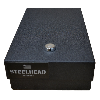
Steelhead Outdoors, founded by Charlie Pehrson and Corey Meyer, now offers custom-branded American-made firearm storage solutions including pistol lock boxes and safes. Brands can add custom logos and colors to create private label products for resale, generating additional revenue while increasing brand awareness among loyal consumers.
SK Guns has crafted a unique, one-of-a-kind Colt 1911 exclusively for the National Police Bloodhound Association Seminar hosted by the St. Johns County Sheriff's Department in St. Augustine, Florida. The custom firearm will be raffled during the seminar's banquet dinner on January 28, 2026, with raffle tickets available for purchase.
Fish Monkey offers retailers a complete spring fishing system including the Pro 365 Guide glove, Freestyle glove, Stubby glove, merino blend socks, and headgear like the Wooly Head Jersey Knit Wool Beanie and Face Guard, all designed for professional anglers and outdoor enthusiasts.
Berger Bullets will exhibit at the 2026 Jagd and Hund Show in Dortmund, Germany, January 27–February 1, showcasing their new 30 Cal 217 Grain Elite Hunter bullets and other precision projectiles. The 43rd annual show is Europe's largest hunting trade fair.
The Alabama Conservation Advisory Board will hold its first 2026 meeting on February 28 at the Alabama Department of Agriculture and Industries in Montgomery.
Michigan's Department of Natural Resources is hosting multiple advisory board meetings in February, including the Michigan Natural Resources Commission, Lake Huron Citizens Fishery Advisory Committee, Waterways Commission, and Michigan State Parks Advisory Committee. Residents are encouraged to attend and provide input on natural resource management and outdoor recreation policies.
Shooting USA features the GAP Grind 2025, the largest Precision Rifle match of the season created by George Gardner of GA-Precision to welcome new competitors. The episode also highlights a new sporting facility in Rapid City, South Dakota dedicated to marksmanship.
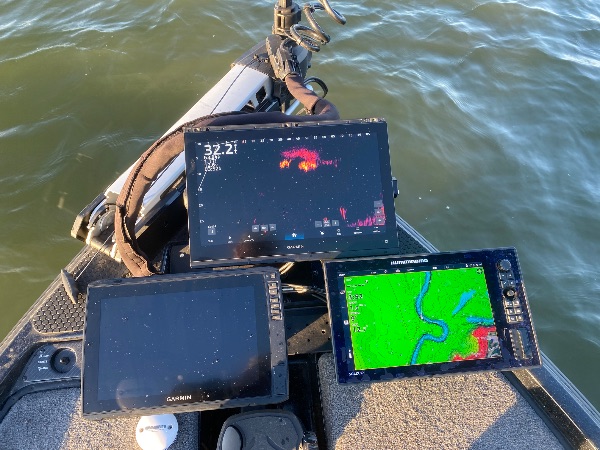
Forward Facing Sonar has rapidly moved from being a luxury to a necessity for serious anglers in both fresh and salt water. (Frank Sargeant)
Forward-facing sonar (FFS) doesn’t necessarily disprove traditional ideas of fish behavior so much as expose how incomplete they were.
Anglers with FFS are now watching fish in real time—watching them approach, hesitate, follow, turn away, re-engage, or flare and vanish. And what they’re seeing has quietly undone a lot of fishing “truths” that were built on assumption rather than observation.
One of the earliest surprises was how often fish don’t strike. Anglers now routinely watch bass, crappie, stripers and walleyes follow a lure for long distances without ever committing. Not just a few feet—sometimes dozens of yards. The fish tracks the bait, matches its speed, inspects it, then drifts off as if bored. That kind of prolonged curiosity without a strike was invisible before. We passed over countless fish without knowing they were there. Now we know where they are—and where they are not.
It means those with FFS spend their time on the water fishing where they are, and that usually results in better catches.
Making Them Bite
On live sonar, anglers often see a fish ignore a steady retrieve, then attack when the bait pauses, stalls, or suddenly accelerates. The strike doesn’t always come when the lure looks most “natural.” It comes when something changes. That has forced a rethink of retrieve theory, especially for suspended fish that aren’t tied to bottom or cover.
Live sonar has also challenged the idea that fish in a group behave as a unit. Traditional sonar compressed schools into blobs; anglers treated them as single targets. On live sonar, individuality becomes obvious. One fish charges and eats. Another tracks and fades. A third never moves at all. That explains a lot of head-scratching days when anglers “knew” fish were there but couldn’t get bit. The fish weren’t inactive as a group—some were simply uninterested.
Competition, however, changes everything. Anglers watching multiple fish respond to a bait often see a shift the moment one fish commits. Others rush in because they don’t want to lose it. That insight has reshaped how anglers think about lure size, fall rate, and speed when fish are grouped versus alone. It’s no longer just about matching the hatch—it’s about triggering the bite.
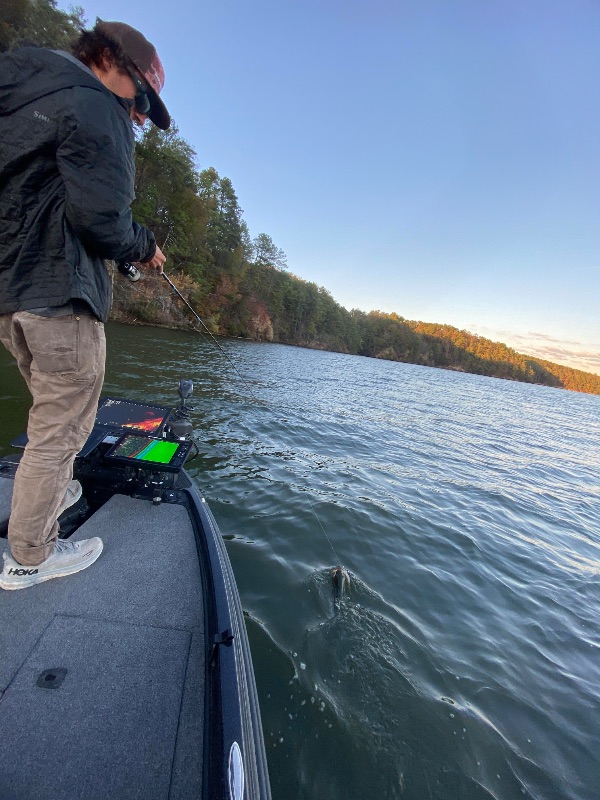
The ability to target individual fish and tease them into striking has made a huge difference in tournament tactics as well as in recreational angling. (Frank Sargeant)
Forward-facing sonar routinely shows fish abandoning textbook structure and roaming open water, sometimes hundreds of yards from anything that would have been considered a holding area a decade ago. These fish aren’t lost; they’re hunting. Anglers targeting pelagic bass, crappie, or freshwater stripers now talk less about waypoints and more about timing, direction of movement, and bait position in the water column.
By far the best live sonar bass lure is a simple lightweight jig-head soft plastic with a tapered tail in white or cream. And the best retrieve is almost no retrieve—anglers simply shake the rod to make the bait shiver as it slowly sinks down to just above the target.
Live sonar has also revealed how sensitive fish can be to movement above them. Many anglers have watched fish slide away as a boat drifts closer, or flinch when a trolling motor correction happens at the wrong moment. Some have even observed fish reacting to the sonar itself—subtle shifts rather than panic, but enough to matter. Apparently they can feel the “ping” at closer ranges. That’s led to quieter approaches, longer casts, and more deliberate boat control, especially in clear water.
Watching fish refuse a perfectly presented bait can be frustrating, but it’s also clarifying. You know the fish saw it. You know it chose not to eat. That knowledge changes decision-making. Instead of second-guessing location, anglers focus on lure choice and presentation—and often catch fish they would have missed without FFS.
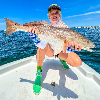
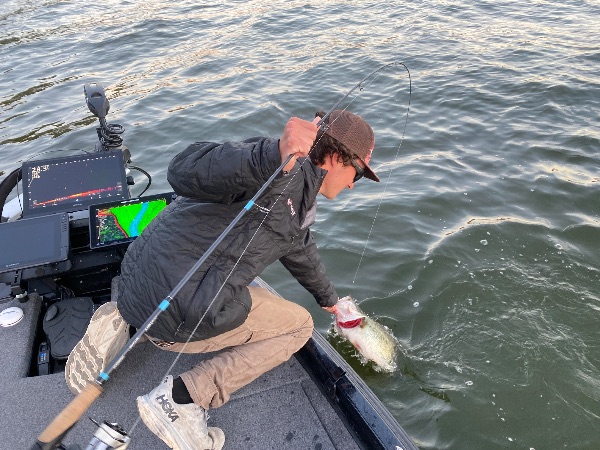
While bass caught with FFS are routinely released, the technology also makes it much easier to fill a cooler with “eating” fish like crappies. (Frank Sargeant)
Seeing fish behave in ways that contradict the rules forces anglers to abandon comforting explanations. Fish don’t always “set up” where they’re supposed to. They don’t always feed when conditions look right. They don’t always respond to the same triggers twice.
Forward facing sonar is controversial mostly because it creates haves and have-nots—it’s expensive to buy a complete setup, and those who can’t afford it not surprisingly feel envy and downright anger against those who have it. Skill with electronic gaming—a natural for those born into the age of screens—is also demonstrably tougher for older anglers.
But the wheel of progress turns and every generation feels left behind as it rolls on. It may make some of us unhappy, but FFS is here to stay, and it’s giving us generational leaps in knowledge of fish behavior that will benefit all of us who love angling.