Oregon voters narrowly approved one of the nation’s most restrictive gun control measures in 2022. It’s been a boondoggle process of court challenges and implementation delays since then. But Oregonians have responded to the impending restrictions by racing to exercise their Second Amendment rights before the government could make doing so substantially more difficult.
New research now puts hard numbers behind that response. Researchers studying Oregon’s Ballot Measure 114 found firearm-related background checks surged 157 percent immediately following the election. The rush to lawfully purchase firearms wasn’t a flash in the pan, either. Eighteen months later, researchers still identified roughly 63,000 additional firearm-related background checks beyond what otherwise would have been expected.
The message is becoming increasingly difficult to ignore. When government threatens to put a constitutional right behind a permission slip, Americans exercise that right in massive numbers before the restrictions arrive.
Oregonians Saw the Door Closing
Measure 114 passed with just 50.7 percent of the vote in November 2022. It created a permit-to-purchase requirement, mandated firearm safety training, implemented an additional completed background check before a permit could be issued and prohibited the manufacture, sale and transfer of magazines capable of holding more than 10 rounds, with limited exceptions. NSSF challenged the ballot measure at the time as unconstitutional.
Oregonians were clear-eyed about what was coming.
Researchers Katie Bollman, Benjamin Hansen, Edward Rubin and Garrett Stanford published a study in the Journal of Public Economics that found firearm-related background checks initially increased 13.9 percent in anticipation of the referendum before exploding to 157 percent immediately after voters approved it. Between the election and the court order stopping the law from taking effect, researchers estimate Measure 114 generated approximately 78,000 additional firearm-related background checks.
That response was rational and predictable. Faced with mandatory government permission, fingerprints, training requirements and restrictions on commonly owned magazines, Oregonians acted before those barriers could be erected.
A Bigger Pattern
Oregon isn’t an outlier. The same pattern is playing out wherever politicians put new restrictions between law-abiding citizens and their Second Amendment rights.
Colorado recorded 82,103 firearm background checks in July as the state approached the Aug. 1 effective date of new restrictions on commonly owned semiautomatic firearms. That was a 264 percent increase over July 2025.
Virginians responded much the same way ahead of Gov. Abigail Spanberger’s July 1 severe gun control restrictions on Modern Sporting Rifle (MSR) sales, that actually included other commonly owned firearms and standard-capacity magazines. June produced 123,699 NSSF-adjusted National Instant Criminal Background Check System (NICS) verifications for firearm sales, a 241 percent increase over June 2025. Statewide enforcement of those prohibitions has since been enjoined while litigation continues. NSSF also challenged the Viriginia laws, too.
New Jersey demonstrated the other side of the equation. After the U.S. Supreme Court’s Bruen decision eliminated the state’s unconstitutional “justifiable need” requirement for obtaining a carry permit, residents rushed through the newly opened Second Amendment door. State data showed nearly 100,000 carry permit applications were turned in and processed in the past few years, overwhelmingly driven by the post-Bruen period.
The pattern is remarkably consistent. Threaten the right and Americans exercise it before government closes the door. Remove an unconstitutional barrier and they exercise it once the door opens.
Measure 114 Isn’t Finished
For now, Measure 114 still has not taken effect. A Harney County Circuit Court struck it down under Oregon’s Constitution in 2023. The Oregon Court of Appeals reversed that ruling in March 2025 and held the measure facially constitutional. Then the Oregon Supreme Court heard arguments in November 2025 and has yet to issue its decision.
Oregon lawmakers have meanwhile pushed back the law’s operative date. House Bill 4145, enacted this year as Chapter 120, provides that Measure 114’s firearm transfer and magazine provisions will now kick in on Jan. 1, 2028.
The delay buys Oregonians even more time to choose to exercise their God-given rights. It does not resolve the fundamental problem, though. The right to keep and bear arms should not depend on first securing government permission to exercise it.
Oregonians recognized what was at stake and acted. So did law-abiding citizens in Colorado and Virginia when new restrictions crept near. The numbers tell the story. Americans value their Second Amendment rights. When government threatens to restrict those rights, law-abiding Americans don’t surrender.
Paddlefish and anglers benefit from Sport Fish Restoration funding
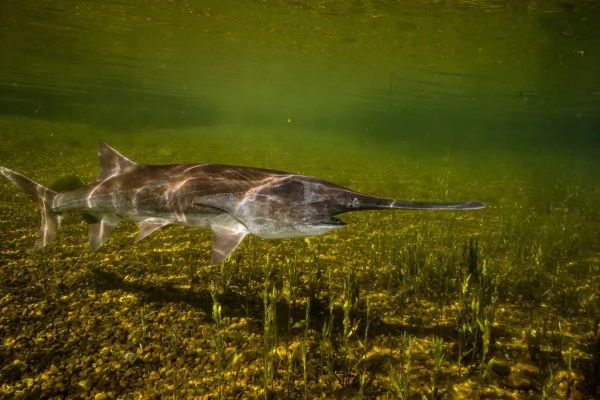
Missouri fish biologist, Jeff Finley, penned a piece on paddlefish in the 2021 book, America’s Bountiful Waters. He put his heart on his sleeve, having handled a great many individual paddlefish through a long career, ranging in size from hammer handles to fish so big it took two people to wrangle. The man had a personal and professional connection to what is arguably the oddest fish in all of the United States.
Finley mused on how little was known about the second-largest freshwater fish in the United States, going well into the 20th century. They can reach 200 pounds and seven feet long. It was Charles Puckett with the Missouri Department of Conservation (MDC) who in 1960 discovered how paddlefish spawn, albeit by happenstance.
Paddlefish are highly sought after by anglers. They can live up to 30 years and reach 200 pounds. Credit USFWS
According to Finley, Puckett “watched paddlefish converge and convulse in rapids over a gravel bar at the juncture of Weaubleau Creek [with the Osage River]. Four days later, he found larval paddlefish in the gravels.”
Much more is now known about how paddlefish make a living over their range in the larger waters of the Mississippi River system, from Louisiana to Montana.
MDC biologist Tom Boersig and colleagues are presently engaged in paddlefish research and management, made possible with consistent and reliable Sport Fish Restoration dollars derived via federal excise taxes paid by fishing tackle manufacturers.
Much of Boersig’s work centers on monitoring populations in three large bodies of water, Lake of the Ozarks, Truman Reservoir, and Table Rock Reservoir that provide trophy paddlefish fisheries.
“Anglers like catching the large, old fish,” said Boersig. “Missouri does not allow catch-and-release of paddlefish so we have to be diligent in our management.” You catch it, you keep it. Paddlefish live a long time and are slow to reach sexual maturity, making them vulnerable to over-harvest. Thus, the lake populations require consistent monitoring to prevent over-harvest to keep up sustainable trophy fisheries that so many enjoy.
Add to that equation, the number of anglers interested in paddlefish is growing, said Boersig.
“We did creel surveys—personal interviews of paddlefish anglers—and asked them about their motivations; we noted gear preferences and technology used. We collected biological information from harvested fish, recorded the size and number of paddlefish harvested, and compared that to what we catch in our winter paddlefish populations surveys.”
Boersig and colleagues put out gill nets in winter when capture is least stressful, place jaw tags on the fish and release them, and look for prior tags to determine if the fish are naturally spawned or hatchery spawned, all to estimate paddlefish population size and age structure.
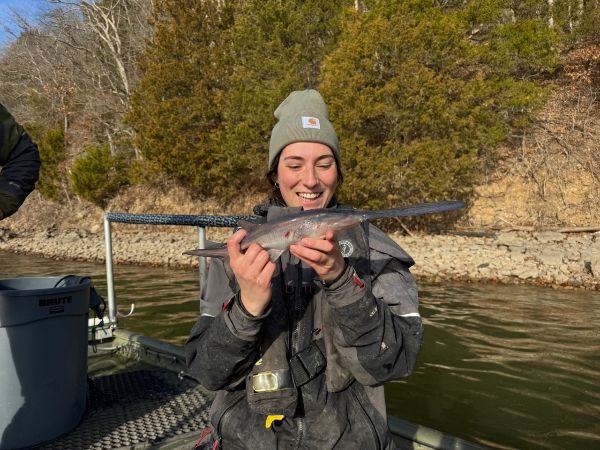
Natalie Lasko, Research Technician for the Missouri Department of Conservation, admires a young paddlefish caught from the Lake of the Ozarks. The work of she and her colleagues are partly funded by Sport Fish Restoration dollars. Credit Thomas Boersig/MDC
In essence, the work reveals how many smaller, younger fish are coming up behind the larger, older paddlefish. Those data help the biologists at MDC’s Blind Pony Hatchery, also funded with Sport Fish Restoration dollars, plan for paddlefish production for future stocking. Brood fish come from the Osage River near where Puckett first witnessed spawning paddlefish 66 years ago.
MDC biologists are nearing the end of a three-year study that will inform future management actions so as to keep producing trophy paddlefish and fish for dinner plates.
Paddlefish are Jurassic pork—another kind of white meat. The flesh is quite palatable and its roe makes fine caviar. A big paddlefish can provide a lot of locally sourced meals.
While coal and oil formed beneath our feet eons ago, paddlefish swam about, mouth agape, raking microscopic plants and animals into its maw. Today, the primitive fish is a marvel to behold—especially on the end of a stout fishing rod that can haul in a 100-pound fish.
Paddlefish are also known as oarfish and spoonbill cat for self-evident reasons. That long spatula of a snout is profusely endowed with nerves to detect the presence of its favored fare: plankton. They are survivors and have long been sought by anglers.
“An 85-year-old man we encountered in our creel surveys has been catching paddlefish nearly all of his life,” said Boersig. “We want to make sure paddlefish are there for future generations to enjoy like that seasoned angler.”
The paddlefish, the oddest of American fishes, has an allure.
—Craig Springer, for the USFWS, Office of Conservation Investment
America’s wildlife agencies have spent years developing an ambitious program called R3—Recruitment, Retention and Reactivation—designed to persuade more ordinary citizens to hunt and fish.
The theory is that agencies should recruit newcomers, retain current sportsmen and reactivate those who have wandered away from the outdoors, perhaps after discovering that golf entails fewer opportunities to accidentally commit a misdemeanor.
Government agencies, conservation organizations and outdoor companies have invested substantial money, manpower and meeting-room coffee in studying why people begin hunting and fishing, why they quit and how to bring them back. After all that research, the newly recruited hunter is generally welcomed into the fraternity with a regulation booklet written with the friendliness of an aircraft-maintenance manual and the simplicity of the federal tax code.
“Welcome to hunting,” the agency effectively says. “Please identify this duck while it travels 45 miles per hour in predawn light, remember which of six management zones you currently occupy, determine whether your shotgun plug satisfies both state and federal law, consult today’s precisely calculated shooting hours, count every bird possessed by everyone sleeping in your cabin and preserve the fully feathered wing required for identification during transportation.
Also, please remember that the rules may have changed since last Tuesday. Good luck, youngster.” Several months later, the same agency convenes an expensive symposium to explore why hunter recruitment remains difficult.
No reasonable sportsman disputes the need for serious game laws. Seasons, bag limits, licensing systems, habitat protections and restrictions against commercial wildlife trafficking form the architecture of modern conservation. Wanton waste should be illegal. So should spotlighting deer, deliberately exceeding bag limits and selling wildlife on the black market.
Hunters should be required to make a reasonable effort to retrieve wounded game, and anyone intentionally pillaging a public resource deserves more than a sternly worded brochure. The problem is not that game laws exist. The problem is that, over time, the wildlife code in many states has developed the same governing philosophy as a teenager’s bedroom closet: everything that has ever gone in remains there forever, and opening the door can result in injury.
Somewhere between protecting wildlife and specifying the paperwork that must accompany somebody else’s salmon, the regulatory train jumped the tracks, crossed three wildlife-management units and struck a man carrying an improperly labeled goose breast.
Federal migratory-bird regulations alone contain separate provisions governing taking, possession, transportation, exportation, importation, processing facilities, feathers, tagging and annual hunting frameworks. States then stack their own statutes, commission rules, emergency orders, species tables, zone maps and annual proclamations on top.
Add tribal jurisdictions, national wildlife refuges, national forests, special management areas and local restrictions, and a duck hunter may need more legal counsel than a regional bank acquisition. There exist days when the most important piece of gear in the blind is not a retriever or a shotgun, but a regulatory attorney with waterproof boots.
Washington State, for example, has rules governing possession of fish caught by another person. Under certain circumstances, the fish must be accompanied by a written statement containing the taker’s name, address, license number, signature, date and area of catch. Apparently, giving a neighbor a salmon fillet now requires documentation normally associated with adopting a Romanian orphan.
The state may also require anglers to surrender tagged portions of fish—including salmon snouts—for research purposes, which undoubtedly makes biological sense but can be awkward to explain when a game officer finds three severed fish noses in the cooler. “Officer, I assure you, this is science,” is a sentence no citizen should ever have to utter beside an interstate highway.
Many of these rules began with legitimate biological or enforcement purposes. The trouble is accumulation. Regulations are born but almost never die. Every unusual incident produces another paragraph, every paragraph requires a new definition, and every definition produces a subparagraph explaining whether a fishing lure may possess emotional-support feathers.
Somewhere in a state archive, there is probably a regulation created in 1978 after Earl Jenkins transported a muskrat in an improperly ventilated Buick. Earl is dead, the Buick is rusting in a pasture and the muskrat’s descendants have moved on, but the regulation remains, quietly waiting to turn somebody’s grandson into a wildlife criminal.
Occasionally, the machinery produces an enforcement episode so peculiar that even experienced hunters begin looking for hidden cameras. In South Carolina, a hunter was arrested after stopping his truck and looking through binoculars at a deer decoy positioned near a road during a night-hunting sting. Body-camera footage reportedly showed he never shone on the decoy with an artificial light.
The charge was eventually dismissed for insufficient evidence, and the hunter later filed a lawsuit alleging false arrest and malicious prosecution. The state agency disputes his version of events, but the episode nevertheless raises an obvious question: At what point did looking at a plastic deer become the wildlife equivalent of robbing Fort Knox?
That is not an indictment of game wardens generally. Most perform difficult, dangerous and indispensable work, often alone in remote places while confronting armed people whose judgment may have been marinating in whiskey since breakfast. Genuine poaching can be organized, lucrative and destructive.
Federal investigations have uncovered commercial market-hunting operations responsible for killing and selling huge numbers of ducks, and modern wildlife traffickers continue moving illegally obtained fish, reptiles and other animals across state and international borders. Those are actual wildlife crimes. They damage populations, undermine lawful hunters and steal a public resource for private profit. Looking through binoculars at a decoy, forgetting to sign a fish-transfer slip or carrying a pheasant across the wrong invisible line does not occupy quite the same moral universe.
The distinction matters because conservation law loses credibility when a harmless paperwork error, an obscure possession rule, or a disputed technical violation is pursued with the same enthusiasm reserved for deliberate poaching.
Hunters and anglers should not need a laminated flowchart to determine whether their lunch became contraband when it crossed a county line. They should not have to download three agency applications, consult a geolocation map, review an emergency proclamation, and call a regional office before deciding whether they may keep a fish. A system that ordinary, well-intentioned citizens cannot reasonably understand is not promoting compliance. It is manufacturing violations.
Every state should conduct a top-to-bottom review of its hunting and fishing regulations with a presumptive goal of eliminating 30 percent. That would not weaken conservation; properly done, it would strengthen it. Every rule should be required to answer a simple question: Does this materially protect wildlife, habitat, public safety, fair chase, or scientifically defensible management? If the answer is yes, keep it, explain it clearly and enforce it consistently. If the answer is that nobody remembers why the rule exists but Marvin in licensing thinks it may have involved a raccoon during the Carter administration, send it to the great regulatory compost pile.
The review should also include expiration dates for rules created to address temporary conditions. Government has an uncanny ability to declare emergencies that achieve immortality. Restrictions are added after droughts, disease outbreaks, population declines or isolated incidents, yet the circumstances eventually change while the rules remain bolted permanently to the code.
The regulatory instinct is always to add another layer because repealing a rule requires an official to accept responsibility, while creating one merely requires a committee, a public comment period, and enough acronyms to conceal what is happening. Wildlife agencies routinely insist that management must be adaptive, but the regulations themselves often adapt with all the agility of petrified wood.
Agencies cannot credibly spend millions recruiting hunters and anglers, only to greet those recruits with an obstacle course of overlapping rules that can transform innocent confusion into criminal exposure. R3 should not stand for Recruit, Regulate and Revoke. Conservation depends upon public participation, license sales, excise-tax revenue and broad confidence that game laws exist to protect wildlife rather than to create an endless scavenger hunt for technical violations.
People are more likely to respect rules they understand, and wardens are more effective when they can focus on actual poachers rather than conducting forensic examinations of freezer labels.
Protect the resource. Punish deliberate poaching. Simplify everything else. And perhaps print the remaining regulations in a booklet small enough to fit somewhere other than the bed of a pickup.
– Chris Dorsey
Chris Dorsey is a 30-year media veteran and conservation thought leader who is the founding partner of Dorsey Pictures, a Global 100 Production Studio, and Mission Partners Entertainment Group, a leading IMAX/giant screen natural history producer.
The midterm elections are less than three months away, but the 2028 race for The White House is already shaping up. That’s especially true for Democrats looking to take back 1600 Pennsylvania Avenue after President Donald Trump’s second term concludes.
President Trump has made good on his promises to implement a historically strong pro-Second Amendment, pro-firearm industry agenda that protects and reveres Constitutional rights. That track record is crystal clear to anyone remotely paying attention.
But Democrats are salivating at the chance to retake the Oval Office. That would likely mean picking up the torch on an antigun activist agenda right where former President Joe Biden left off, stomping on rights and suffocating the lawful and highly regulated firearm industry that provides law-abiding Americans the ability to exercise their Second Amendment rights.
A Rasmussen poll released early this week showed the former vice president with a sizeable lead in the 2028 Democratic presidential nomination contest. Former Vice President Harris currently takes 37 percent of poll responders. Second place honors at this point go to California Gov. Gavin Newsom, another extreme gun control politician, way back at 14 percent. Former Biden administration Transportation Secretary Pete Buttigieg takes 10 percent and U.S. Rep. Alexandria Ocasio-Cortez (D-N.Y.) garners nine percent.
The Rasmussen poll revealed the former vice president has increased her vote share in the last couple of months, when a May poll showed her taking 34 percent. But different polls show a far different landscape so far out. An AtlasIntel poll, for instance, gave a nearly inverted top four, with Rep. Ocasio-Cortez leading with 26 percent and followed by former Secretary Buttigieg with 22.4 percent, Gov. Newsom at 21.2 percent and the former vice president all the way down at under 13 percent.
Extreme Platform
The former vice president already has the antigun, anti-Second Amendment platform and track record to top the political party that wants to abolish gun rights.
Former Vice President Harris infamously led the anti-firearm industry charge by being placed as the leader of The White House Office of Gun Violence Prevention, to take a whole-of-government approach to suffocating industry and stomping on Second Amendment rights. That group apparently directly colluded with John Feinblatt’s Everytown for Gun Safety, within the West Wing, to attack a lawful firearm manufacturer—which U.S. House Judiciary Committee Chairman James Comer (R-Ky.) is still investigating.
There is no question about where the former vice president and apparent early 2028 Democratic presidential contender stands on Second Amendment rights. She wants to do away with them.
How She’d Do It
If there’s any question from skeptical voters who might think there’s no way former Vice President Kamala Harris would carry out her extreme gun control agenda, you don’t have to wonder. She told us exactly how she’ll do it.
Speaking at a conference in Nashville just two weeks ago, former Vice President Harris called for expanding and packing of the U.S. Supreme Court, as well as granting statehood (and two U.S. Senators each) to Puerto Rico and Washington, D.C. She also proclaimed that the Electoral College needed “revising” — code speak for supporting direct popular vote for the U.S. presidency.
“We must allow for a real conversation about revisiting certain things,” the former vice president told an audience, according to Fox News. “I know this is gonna be controversial coming from me, in particular. We need to revisit the Electoral College. We need to revisit the point of expanding the court to 13 justices…”
Just a few years ago, suggesting those types of “reforms” were spoken about on the fringe. But as the DSA have firmly taken hold of the Democrat party and jolted elected officials to extreme and radical positions, leading politicians on the left have been all-too-happy to play footsie with these half-baked ideas — including seizing control of the means to manufacture firearms and ammunition.
In just two short years since voters tossed her out of The White House, former Vice President Harris has raced leftward in the blink of an eye, seeking approval of the most radical factions of a party that could send her back.
Once the midterm elections are through in November, the real race for 2028 will pick up. The former vice president already has the extreme gun control agenda to carry forward from a disastrous four years under the previous administration.
Voters must #GUNVOTE® and know what lies ahead if they wish to protect and preserve their rights.
I’ve been to Glen Dene Station in New Zealand, and I didn’t fish.
There. That’s probably the most important thing I should tell you before I write another word about fishing at Glen Dene.
I went there to hunt. That’s what I knew Glen Dene for, and frankly, that’s what was on my mind. Red stag, tahr, chamois, mountains and all the other things that convince a hunter to spend a ridiculous amount of time on airplanes to get to the other side of the world.
Trout weren’t really part of the equation.
Apparently, that was a mistake.
I started talking with Richard Burdon, owner of Glen Dene Station, about the fishing around the property, and pretty quickly realized there was an entire part of the place I had missed.
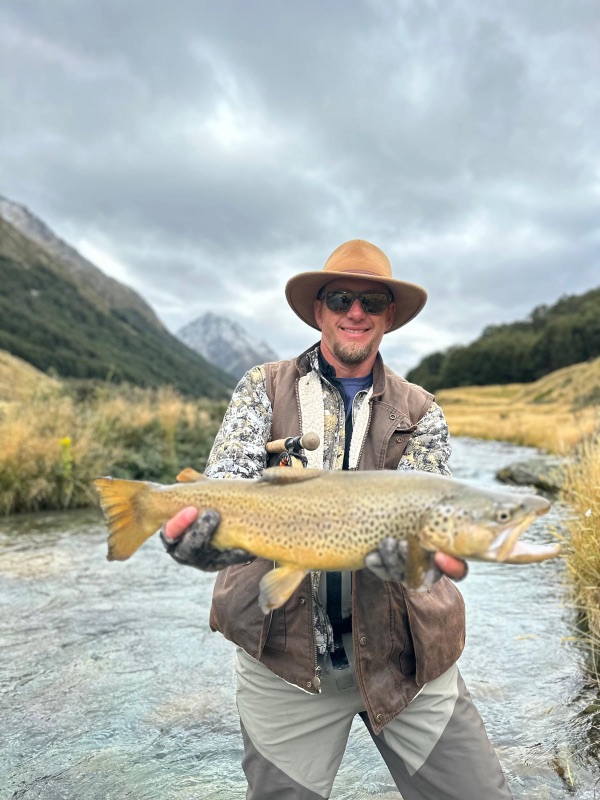
“The fishing around Glen Dene is truly world-class,” Burdon told me. “We have access to an incredible variety of waters, from crystal-clear mountain streams and spring creeks to large rivers and alpine lakes. What makes it special is the quality of the fish, the stunning scenery, and the fact that much of the fishing takes place in relatively untouched environments. It’s common to spend an entire day on the water without seeing another angler.”
I believe the last part.
I can’t tell you how good the fishing is because, again, I didn’t fish. But I’ve seen the country. I’ve been in those mountains and valleys, and untouched is a pretty good way to describe some of it.
It’s big country. Beautiful country. The kind of place where you stop occasionally and just look around because you’re trying to convince yourself you’re actually there. I most certainly did that on numerous occasions while I hunted Glen Dene.
I just apparently wasn’t looking in the right direction. I spent most of my time looking up. Maybe I should have looked down.
The funny thing is that the more Richard told me about New Zealand trout fishing, the less it sounded like the fishing I had pictured in my head and the more it sounded like hunting.
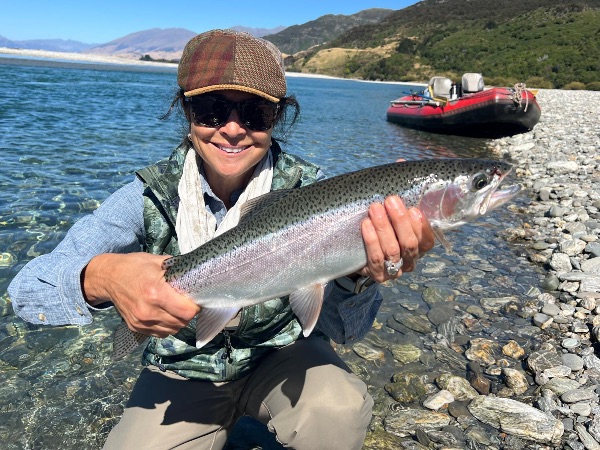
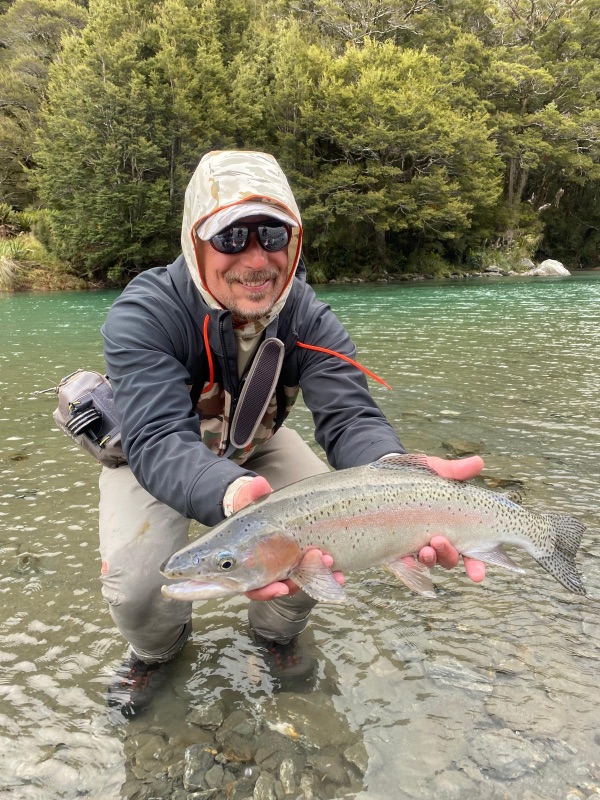
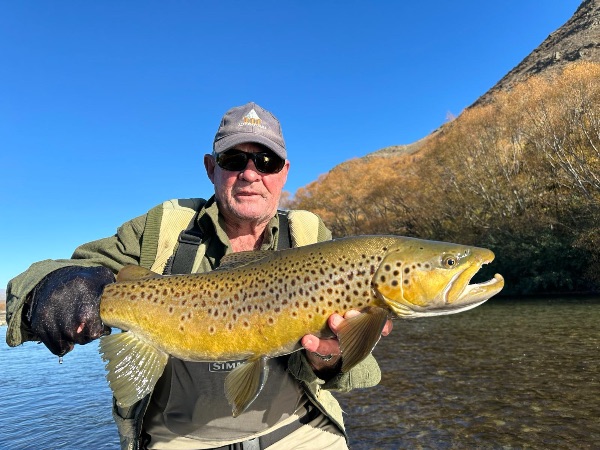
“Brown trout are generally larger, more cautious, and highly challenging to catch,” Burdon said. “They thrive in our clear waters and often require careful stalking and accurate presentations. Rainbow trout tend to be more aggressive and acrobatic, putting on spectacular displays once hooked. Many anglers enjoy targeting both species during their stay, as each provides a completely different experience.”
He had me at stalking. That’s a word I understand.
I’m not going to suddenly pretend to be some accomplished New Zealand fly fisherman here. I’m not. Put a rifle in my hands and point toward a mountain and I’ll at least have a reasonable idea of what I’m supposed to do. But hand me a fly rod and tell me there’s a giant brown trout somewhere in a clear New Zealand river and, well Im a fish out of water so to speak
When Richard started explaining how they actually fish for these trout, I understood the appeal almost immediately.
“Many anglers arrive expecting to cast frequently and cover water quickly,” Burdon said. “In New Zealand, it’s often the opposite. We spend a lot of time spotting fish, planning our approach, and making one or two precise casts. Long leaders, light presentations, and patience are often far more important than distance casting.”
Are we talking about fishing or hunting here? Maybe both.
You find the animal before it finds you. You watch it for a while. You figure out how you’re going to get closer. You try not to make noise. You try not to do something dumb. Then, after spending all that time getting yourself into exactly the right place, you get an opportunity.
Maybe.
That sounds familiar.
“New Zealand trout live in incredibly clear water and are entirely wild,” Burdon explained. “They haven’t been stocked, and they see very little fishing pressure compared to many fisheries around the world. Anglers often spot the fish before casting, which means every approach, cast, and drift must be perfect. The challenge is what makes the reward so satisfying.”
Every approach, cast and drift must be perfect.
Well, now Richard is starting to make me nervous about a fishing trip I haven’t even taken yet.
But I get it.
Hunters understand the strange attraction of doing something that’s difficult and then becoming slightly obsessed with doing it precisely because it’s difficult. If success were guaranteed, most of us probably wouldn’t be nearly as interested.
Sometimes the stories we tell the longest aren’t even about the animals we got. They’re about the ones that made fools out of us.
I’ve got a few of those - and you've read them.
New Zealand may have contributed one or two.
That’s why the idea of sight fishing really caught my attention.
“Sight fishing is at the heart of the New Zealand trout experience,” Burdon said.“Success often depends on spotting fish before they spot you. Good observation skills, patience, stealth, accurate casting, and the ability to present a fly naturally are all important. Fortunately, our guides are excellent teachers and can help anglers of all experience levels improve quickly.”
Fortunately. That’s the word in Richard’s answer I’m hanging onto. I can already imagine a guide pointing into perfectly clear water and telling me there’s a trout right there. I won’t see it. He’ll point again. Still won’t see it.
Eventually something will move and I’ll say, “Oh, that fish.” (Ive said the same for turkeys and elk - and mouflon) Then I’ll probably make a cast that causes the trout to immediately reconsider whatever decisions led it to that particular section of river.
Maybe I’m underselling myself. Maybe not. Either way, Burdon says sight fishing for a big brown trout in a mountain river is about as good as it gets.
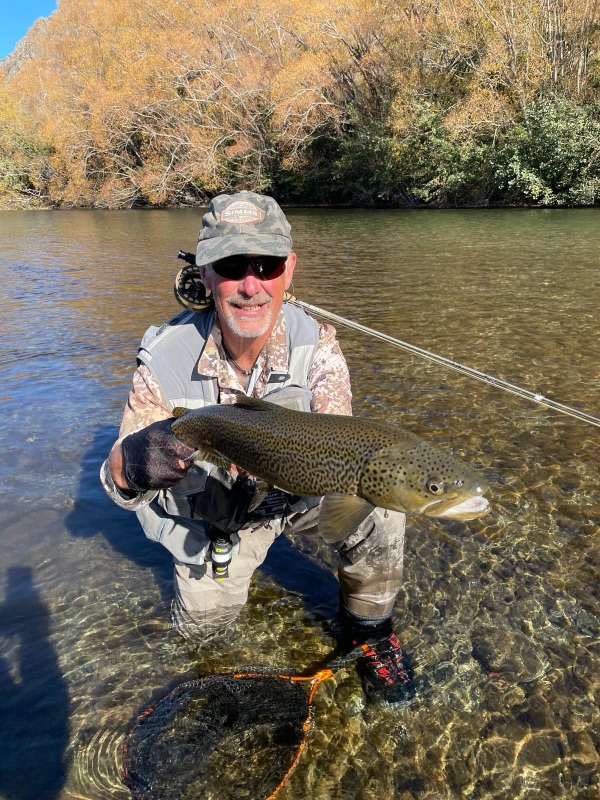
“It’s hard to go past sight fishing to large brown trout in a clear mountain river,” he said. “Spotting a fish, planning your approach, making the cast, and then watching the trout take your fly is an experience most anglers never forget. It perfectly captures what New Zealand fishing is all about.”
I wish I had known that when I was there. And that’s really why I’m writing this. A lot of American hunters probably look at Glen Dene the same way I did. We know about the red stag. We know about the tahr and chamois. We see pictures of the mountains and immediately start thinking about rifles, boots, optics and how badly our knees are going to hurt.
Fishing can become an afterthought. It shouldn’t.
“Many guests come for a hunting adventure and quickly realize the fishing opportunities are too good to pass up,” Burdon said. “It’s not uncommon for hunters to spend a few days pursuing red stag or tahr before adding a drift boat trip, river fishing excursion, or lake fishing experience. The combination of hunting and fishing creates a truly unique New Zealand adventure.”
That makes a lot of sense to me now.
Getting to New Zealand isn’t a casual trip for most Americans. It’s a long way from home, and there’s a good chance you’ll spend more time getting there than you normally spend getting to your favorite hunting camp.
Most of us aren’t going to New Zealand every year. Some of us may only go once. So if you’re already there, why not fish?
Spend a few days chasing red stag or climbing after tahr. Then put the rifle away, grab a fly rod and go find out whether you’re any better at fooling a trout than you were at fooling whatever you were chasing in the mountains.
There’s also something else about these fish that appeals to me.
They’re wild.
“New Zealand places a strong emphasis on protecting fish habitat and maintaining healthy waterways,” Burdon said. “Many fisheries are managed with strict regulations, limited harvest, and a strong catch-and-release culture. Protecting water quality and preserving natural spawning habitat are key factors that help maintain the quality of our fisheries for future generations.”
I like that.
We sometimes use so many complicated words when we talk about conservation that we forget what we’re actually trying to accomplish.
We want these places to still matter tomorrow.
We want someone else to stand where we stood and see what we saw. Maybe we even want to come back years later with somebody we care about and find that the place is still mostly the way we remember it.
Richard told me about one angler who had dreamed about catching a New Zealand brown trout for decades.
“One of the most memorable moments was guiding an angler who had dreamed of catching a New Zealand brown trout for decades,” Burdon recalled. “After spending the morning stalking fish in a remote valley, he landed a beautiful brown trout in a crystal-clear stream. What made the moment special wasn’t just the fish, it was the setting, the journey, and the realization that he had fulfilled a lifelong dream.”
I understand that better than I understand fly fishing.
At some point in our lives, the fish or the animal stops being the entire reason we go. Maybe it never really was.
We go because we want to see what’s over there. We go because we want another story. We go because somebody we care about is going with us. Sometimes we go because we’ve been thinking about a particular mountain, animal, river or fish for 20 years and finally get the chance to find out whether reality looks anything like the picture we’ve been carrying around in our head.
And sometimes we get there and realize we forgot to do something. Like fish.
“What excites me most is that the experience remains authentic,” Burdon said. “New Zealand still offers wild fish, breathtaking landscapes, and genuine adventure. For anglers seeking more than just numbers of fish, it’s a destination that combines challenge, beauty, and unforgettable memories. Every angler should experience New Zealand at least once in their lifetime.”
Richard has convinced me. Not that I needed much convincing to go back to New Zealand.
If I ever get back to Glen Dene, I’m still going to spend a lot of time looking up. It’s impossible not to. There are red stag, tahr and chamois up there, and I’m still a hunter.
But I’ll do one thing differently. I’ll look down occasionally. Because apparently there were world-class trout swimming around down there the entire time. And I somehow missed them.