
Paddlefish and anglers benefit from Sport Fish Restoration funding
Missouri fish biologist, Jeff Finley, penned a piece on paddlefish in the 2021 book, America’s Bountiful Waters. He put his heart on his sleeve, having handled a great many individual paddlefish through a long career, ranging in size from hammer handles to fish so big it took two people to wrangle. The man had a personal and professional connection to what is arguably the oddest fish in all of the United States.
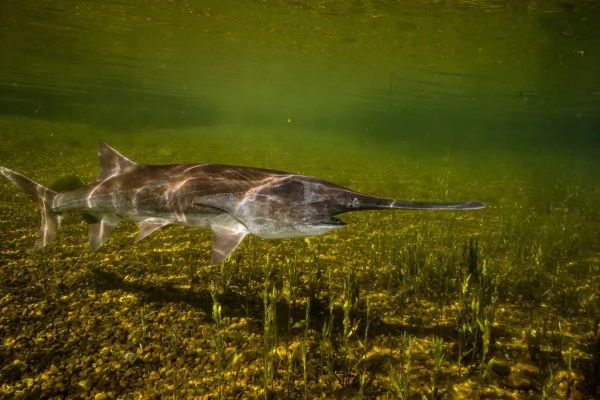
Finley mused on how little was known about the second-largest freshwater fish in the United States, going well into the 20th century. They can reach 200 pounds and seven feet long. It was Charles Puckett with the Missouri Department of Conservation (MDC) who in 1960 discovered how paddlefish spawn, albeit by happenstance.
According to Finley, Puckett “watched paddlefish converge and convulse in rapids over a gravel bar at the juncture of Weaubleau Creek [with the Osage River]. Four days later, he found larval paddlefish in the gravels.”
Much more is now known about how paddlefish make a living over their range in the larger waters of the Mississippi River system, from Louisiana to Montana.
MDC biologist Tom Boersig and colleagues are presently engaged in paddlefish research and management, made possible with consistent and reliable Sport Fish Restoration dollars derived via federal excise taxes paid by fishing tackle manufacturers.
Much of Boersig’s work centers on monitoring populations in three large bodies of water, Lake of the Ozarks, Truman Reservoir, and Table Rock Reservoir that provide trophy paddlefish fisheries.
“Anglers like catching the large, old fish,” said Boersig. “Missouri does not allow catch-and-release of paddlefish so we have to be diligent in our management.” You catch it, you keep it. Paddlefish live a long time and are slow to reach sexual maturity, making them vulnerable to over-harvest. Thus, the lake populations require consistent monitoring to prevent over-harvest to keep up sustainable trophy fisheries that so many enjoy.
Add to that equation, the number of anglers interested in paddlefish is growing, said Boersig.
“We did creel surveys—personal interviews of paddlefish anglers—and asked them about their motivations; we noted gear preferences and technology used. We collected biological information from harvested fish, recorded the size and number of paddlefish harvested, and compared that to what we catch in our winter paddlefish populations surveys.”
Boersig and colleagues put out gill nets in winter when capture is least stressful, place jaw tags on the fish and release them, and look for prior tags to determine if the fish are naturally spawned or hatchery spawned, all to estimate paddlefish population size and age structure.
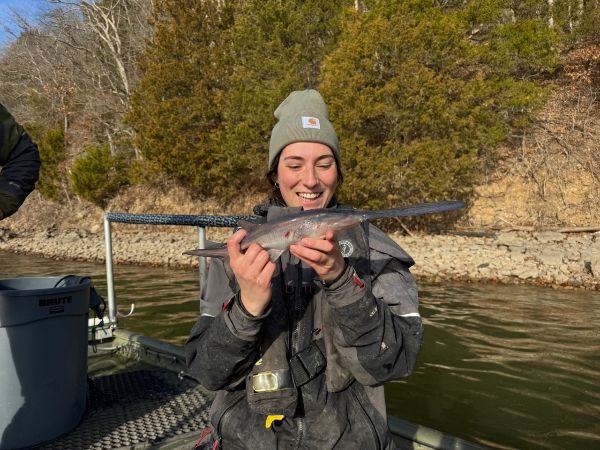
In essence, the work reveals how many smaller, younger fish are coming up behind the larger, older paddlefish. Those data help the biologists at MDC’s Blind Pony Hatchery, also funded with Sport Fish Restoration dollars, plan for paddlefish production for future stocking. Brood fish come from the Osage River near where Puckett first witnessed spawning paddlefish 66 years ago.
MDC biologists are nearing the end of a three-year study that will inform future management actions so as to keep producing trophy paddlefish and fish for dinner plates.
Paddlefish are Jurassic pork—another kind of white meat. The flesh is quite palatable and its roe makes fine caviar. A big paddlefish can provide a lot of locally sourced meals.
While coal and oil formed beneath our feet eons ago, paddlefish swam about, mouth agape, raking microscopic plants and animals into its maw. Today, the primitive fish is a marvel to behold—especially on the end of a stout fishing rod that can haul in a 100-pound fish.
Paddlefish are also known as oarfish and spoonbill cat for self-evident reasons. That long spatula of a snout is profusely endowed with nerves to detect the presence of its favored fare: plankton. They are survivors and have long been sought by anglers.
“An 85-year-old man we encountered in our creel surveys has been catching paddlefish nearly all of his life,” said Boersig. “We want to make sure paddlefish are there for future generations to enjoy like that seasoned angler.”
The paddlefish, the oddest of American fishes, has an allure.
—Craig Springer, for the USFWS, Office of Conservation Investment