
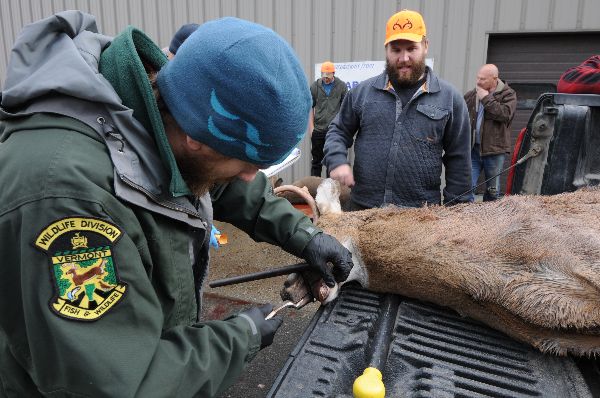
Hunters are gearing up for the start of Vermont's traditionally popular 16-day regular deer season that begins Saturday, November 14 and ends Sunday, November 29.
New rules this year allow hunters with an antlerless deer permit to take antlerless deer during this season. Antlerless permits were distributed by lottery earlier this year. Hunters without an antlerless deer permit cannot take antlerless deer during this season.
Vermont hunting licenses include a buck tag for this season and a late season bear tag for Nov. 14-22.
Information on the use of tags is included with other rules on Fish and Wildlife's website home page under White-tailed Deer Hunting.
The definition of a legal buck depends on the Wildlife Management Unit (WMU). A map of the WMUs is on pages 24 and 25 of the 2026 Vermont Hunting & Trapping Guide available from license agents and highway rest areas.
In WMUs C, D2, E1, E2, G, I, L, M, P, and Q a legal buck is any deer with at least one antler three inches or more in length.
In WMUs A, B, D1, F1, F2, H, J1, J2, K, N, and O a legal buck is any deer with at least one antler with two or more antler points one inch in length or longer.
A 2026 Deer Season Hunting Guide can be downloaded from the department's website. The guide includes a map of the Wildlife Management Units (WMUs), season dates, regulations, and other helpful information.
"The greatest numbers of deer continue to be in western regions of the state and other valley areas," said Vermont Fish and Wildlife's deer biologist Nick Fortin. "The Green Mountains and Northeast Kingdom offer more of a big woods experience with fewer, but often larger, deer."
"I encourage all hunters to wear fluorescent orange to help maintain Vermont's very good hunting season safety record, added Fortin."
Hunters are required to report all deer taken from November 14-29 in person at a big game reporting station. This includes archery season deer reported during these dates. Online reporting will not be available. This requirement allows biologists to collect important information from as many deer as possible.
Hunters who get a deer on November 14 or 15 can help Vermont's deer management program by reporting their deer at one of the biological check stations operated by Fish and Wildlife Department personnel listed below:
Back Country Sports – St. Albans
West Enosburg Country Store – Enosburg Falls
Wright's Sport Shop – Derby
The Concord Station – Concord
Maplefields – Plainfield
R&L Archery – Barre
Village Grocery & Deli – Waitsfield
Rack N Reel – New Haven
Keith's Country Store – Pittsford
Middletown Springs Country Store – Middletown Springs
Singleton's Store – Proctorsville
Windsor Fire Department – Windsor
Bennington Fish Hatchery – Bennington
Guilford Country Store – Guilford
Hunters who do not go to a biological reporting station are asked to provide a tooth from their deer. Tooth envelopes and tooth removal instructions are available at all big game reporting stations. Each tooth will be cross sectioned to accurately determine the deer's age, and the results will be posted on the Fish and Wildlife website next spring.