
Project looked at how hunter access, harvest regulations affect animal movement
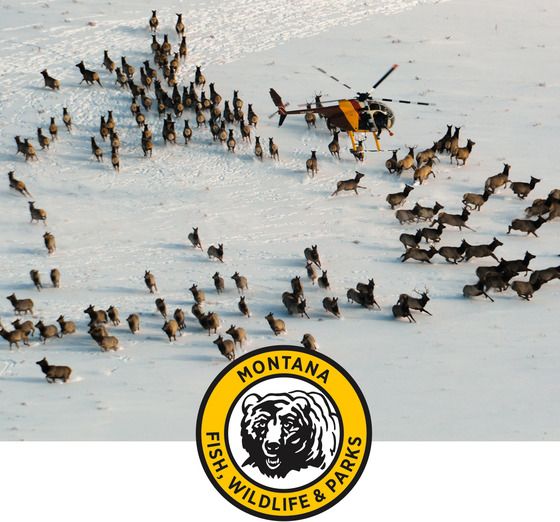
HELENA – During the winter of 2019/2020 and 2020/2021, Montana Fish, Wildlife & Parks wildlife staff captured and collared about 60 female elk in the Devil's Kitchen Elk Management Unit in central Montana. The study area encompassed several large working ranches and the Beartooth Wildlife Management Area, including hunting districts (HDs) 445, 446, and 455.
"The overall purpose was to better understand how hunter access management and harvest regulation approaches in this area are impacting elk movement," said Nicole Bealer, a graduate student at Montana State University who was working with FWP at the time. "This particular area gave us a unique opportunity to answer these questions."
Data was collected through the GPS collars to provide collared elk locations for three years, after which drop‐off devices released collars from their necks. Only the data collected during daylight hours during the hunting seasons were used for the study.
Although elk shifted toward less accessible private lands during the early shoulder and archery seasons, restrictive harvest regulations on publicly accessible lands during the general season appeared to attract elk back to those areas, Bealer said. The combination of limited hunter access and restrictive harvest regulations helped retain elk on public lands through the late shoulder season, reducing conflicts with private landowners.
"Elk are very smart and respond to gradients of hunting pressure quite strongly," Bealer said. "When possible, we can use those responses to achieve the distributions we want on the landscape."
Bealer pointed to the fact that the Beartooth WMA has more restrictive regulations than surrounding hunting districts (limited entry licenses and no early/late shoulder seasons). "That regulation approach is effective at getting elk to spend time on that WMA," she said.
But while the study showed that restricted harvest regulations or limited hunter access may successfully increase elk presence in desired areas, such as the WMA, they may have other consequences. Decreasing harvest risk in these areas may limit hunter harvest and make it more difficult to achieve population objectives.
"In this area, landowners, biologists and hunters are working together to find elk management strategies that balance the needs of diverse stakeholders," Bealer said.