
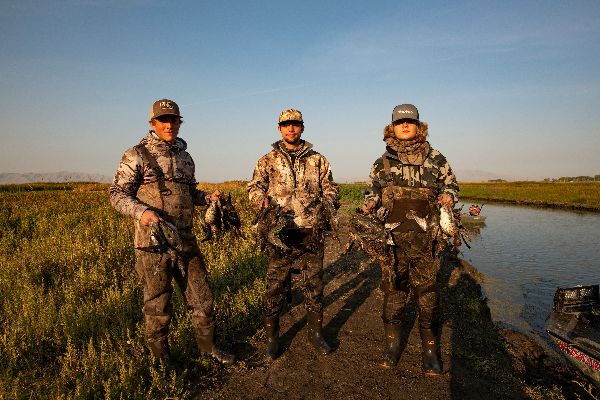
It's a quiet, still morning as you sit near the edge of a lake in your blind. You hear some birds in the distance and turn your head to see several ducks flying toward you. Your heartbeat quickens, and you slowly raise your shotgun. Waterfowl hunting season is finally here.
Requirements
With the exception of tundra swans (which require a permit from the hunt drawing that ended July 14), the rest of the waterfowl hunts in Utah are open to anyone with a hunting or combination license. However, you are also required to have a Harvest Information Program (HIP) number to hunt any waterfowl or migratory game bird species. You can register for a free HIP number on the Utah Division of Wildlife Resources website.
If you're 16 years old or older, you must also obtain a federal migratory bird hunting and conservation stamp (duck stamp) annually to hunt ducks, geese and tundra swans. You can choose to purchase either a printed or electronic duck stamp before you go into the field to hunt. Duck stamps are valid July 1 through June 30 each hunting season.
There are a few options for purchasing a duck stamp:
- Printed stamp: Purchase a printed duck stamp from your local post office, some license agents or by phone at 800-782-6724.
- Electronic stamp: Purchase an electronic duck stamp through the DWR license sales site. If you purchase an e-duck stamp through the DWR website, you can download it to your Utah Hunting and Fishing app to show proof of purchase.
- Duckstamp.com and digital wallet download: Purchase an electronic duck stamp through this third-party online vendor. If you purchase an e-duck stamp from duckstamp.com, you can download it to your Google or Apple wallet.
"Federal duck stamps help fund wildlife conservation across the U.S., with 98% of the purchase fee going directly to help acquire and protect wetland habitat and purchase conservation easements for the National Wildlife Refuge System," DWR Waterfowl and Migratory Game Birds Coordinator Jason Jones said.
If you are planning to hunt ducks, geese or tundra swans this fall, here is some information to be aware of:
Duck hunting tips
Habitat conditions for ducks in regions of North America improved slightly in 2026, compared to last year, with pond numbers in the traditional survey area increasing by nearly 14%. Despite the improved habitat conditions, the total duck estimate declined slightly, from 33,980,409 ducks in 2025 to 33,439,490 in 2026. Most dabbling duck species were down slightly, with the exception of shovelers, while some diving duck species increased slightly.
"Habitat conditions improved this year across the prairie breeding areas, but overall duck numbers were still down slightly from last year," Jones said. "Conditions around the Great Salt Lake have remained very dry, which means less wetland habitat and fewer places for migratory birds to stop and feed. Local duck production was also down from last year. Waterfowl numbers usually peak in mid-September in Utah, with dabbling ducks arriving first and diving ducks generally migrating through later in October. Weather conditions throughout the Pacific Flyway also play an important role in when and where birds migrate, so the number of birds that hunters see in Utah can vary considerably from year to year. Hunters should be prepared for challenging conditions for waterfowl hunting across Utah this year."
Typically, about 15 duck species can be found in Utah. Each duck species uses different types of habitats:
- Diving ducks, like canvasbacks and redheads, can be found in big, open waterbodies.
- Puddle ducks, like teal and shovelers, are generally found in shallow water.
- Species like mallards can be found just about anywhere.
"Hunters can greatly improve their success during the duck hunt by spending some time scouting before each hunt," Jones said. "Learning where and when birds are in a specific location can allow hunters to be where the birds want to be, when they want to be there, and will greatly increase the number of birds they harvest. Think about the species you are hunting and then look for them in the habitats they want to be in. If you aren't finding the species you are targeting, move around to different areas until you find them."
Details of each species can be found in the online 2026-27 Utah Waterfowl, Upland Game and Turkey Guidebook. Additional resources to help with bird identification can be found on the DWR website.
"Calls are also an effective tool for helping hunters be successful during duck hunts," Jones said. "Most hunters use a traditional duck call that sounds like a mallard hen, but trying other sounds, such as wigeon or pintail whistles, can also help. Hunting with a dog is another long-standing part of waterfowl hunting for many people. There's something special about having a good dog along, and a good retriever can be an invaluable hunting partner by helping find downed birds in thick cover and increasing the chances that every harvested bird is recovered."
The season dates for the duck hunts are:
- Northern zone general-season hunt: Oct. 3 to Jan. 16, 2027
- Northern zone youth hunt: Saturday, Sept. 19
- Southern zone general-season hunt: Oct. 10 to Jan. 23, 2027
- Southern zone youth hunt: Saturday, Sept. 26
Check page 64 of the Utah Waterfowl, Upland Game and Turkey Guidebook for the boundaries of the two zones and to see the bag limits for ducks.
Geese hunting tips
Canada goose numbers in the Pacific Flyway, which includes Utah, declined this year. The 2026 population index was 350,624 birds, a decrease of 17.6% from 2025. Despite the decline, the three-year average remains well above the minimum population objective of 200,000 birds. Goose production and numbers in Utah were also down this year, likely reflecting dry conditions in some areas.
"Despite the declines, hunters should still see geese throughout the season," Jones said. "Migrating birds generally begin to show up around mid-to-late November. Weather and local conditions will influence when and where those birds migrate through Utah, so hunters should be prepared for conditions to vary throughout the season."
An important tip for success while hunting geese is to use a good call.
"Calling is a very important part of goose hunting," Jones said. "Geese are very social birds, so being able to sound like a goose can help hunters harvest more birds."
Dark and white-fronted geese season dates:
- Northern area: Oct. 3-10 and Oct. 26 to Jan. 31, 2027
- Wasatch Front area: Oct. 3-10 and Nov. 10 to Feb. 15, 2027
- Eastern Box Elder area: Oct. 3 to Jan. 16, 2027
- Southern area: Oct. 10 to Jan. 23, 2027
Light geese season dates:
- Eastern Box Elder, Northern and Wasatch Front goose areas: Oct. 15 to Dec. 22 and Feb. 1 to March 10, 2027
- Southern goose area: Oct. 26 to Dec. 15 and Jan. 15 to March 10, 2027
Hunters should also note that most light goose hunting takes place on private property. Make sure to get documented permission from landowners before hunting on their property.
The youth waterfowl hunt will be held on Sept. 26 in the southern zone. Check page 65 of the Utah Waterfowl, Upland Game and Turkey Guidebook for the boundaries of the four goose areas and to see the bag limits for geese.
Swan hunting tips and requirements
Tens of thousands of tundra swans move through Utah every fall on their way to their wintering grounds in California. Tundra swan populations in the Pacific Flyway are still doing well, and hunters can expect to see similar numbers as in previous years in Utah.
"Swans migrate and stop over at the same locations each year," Jones said. "Traditional staging areas, such as Public Shooting Grounds WMA and the Bear River Migratory Bird Refuge, will hold swans beginning in late October and early November, and they typically stay in the area until the wetlands freeze and food becomes difficult to find."
Tundra swans will leave resting areas to feed during the morning and late afternoon, and also throughout the day as temperatures get colder. So scouting before the hunt can help hunters determine when swans are moving and know what times of day to hunt.
"Hunting along a swan's flight path, or in their feeding locations, will increase your odds of harvesting a swan," Jones said.
Within 72 hours of harvesting a swan, hunters are required to check in the bird at a DWR office or at the Bear River Migratory Bird Refuge (open on Fridays and Saturdays from 9 a.m. to noon and 2-7 p.m.). Hunters must also complete a mandatory harvest survey within 30 days of the season ending, even if they didn't harvest a swan or go hunting. New this year, hunters were given the option when applying for a swan permit to opt in to electronic tagging for their harvested swan, which would fulfill the required harvest survey.
Hunters should also be sure of the swan species they are targeting before attempting to harvest one. Trumpeter and tundra swans both migrate through the state, but as of 2023, it is illegal to harvest trumpeter swans in Utah — only tundra swan hunting permits are issued to hunters.
Any harvested trumpeter swans will be seized, and the hunter may face a citation. In addition, hunters who harvest a trumpeter swan will also be prohibited from being able to apply for a tundra swan hunting permit for several years. Youth who harvest a trumpeter swan must wait three years until they can apply for a tundra swan permit, and adults must wait five years.
"Each swan species can be identified by size and sound," Jones said. "Trumpeter swans are significantly larger than tundra swans. Trumpeter swans do not have a yellow-colored area near their eyes, and they also make a distinctive trumpet-like sound, hence their name."
Utah is one of only nine states in the U.S. that allows hunting for swans.
The tundra swan season runs from Oct. 3 to Dec. 13. However, if the federal quota of 20 trumpeter swans is met before Dec. 13, the swan hunting season will close early. Those with a tundra swan permit may harvest only one tundra swan during the 2026 hunting season.
Places to go waterfowl hunting
There are more than 20 waterfowl management areas throughout Utah that are owned and managed by the DWR. Waterfowl management areas in Utah typically open for scouting on the Thursday before the northern zone youth waterfowl hunt, which is Sept. 17 this year.
Access and water conditions at the majority of the waterfowl management areas are fair this year, but have declined from last year due to drought conditions. For specific details and condition reports about each WMA, visit the DWR website. Be sure to check the conditions before attempting to launch an airboat at a WMA. Hunters should note that some current improvement projects at the Ogden Bay WMA will restrict access during the first youth hunt.
"Food resources and access around the associated wetlands of the Great Salt Lake are still suffering, due to long-term drought conditions," Jones said. "Because of that, waterfowl may migrate through Utah quicker this year, which will make hunting more difficult later in the season."
The Bear River Migratory Bird Refuge — managed by the U.S. Fish and Wildlife Service — is another great location for waterfowl hunting in Utah.
As a reminder, hunters cannot transport unsecured phragmites plants to use as blind covers. Utah law prohibits the transportation of weed seeds that are not contained, in an effort to prevent the spread of invasive plants.
Utah Waterfowl Slam
If you'd like to add some fun and challenge to your hunt, consider completing the Utah Waterfowl Slam. Hunters earn a slam by completing different requirements, such as harvesting a group of species in a certain time period or location. There are currently 10 slams with different levels of difficulty, so you can find a variety of fun, unique challenges. Along with trying something new, hunters who complete the slam can also earn colorful, collectible leg bands.
The money earned from the slam is used to complete habitat-improvement projects on the different WMAs across the state. Learn more about the Utah Waterfowl Slam on the DWR website.