
Michigan's highly coveted elk hunt gets underway Wednesday in the northern Lower Peninsula with some key changes in store for hunters this year:
- The first hunt period is Sept. 23 – Oct. 4. Previously, the first hunt period was broken up into three, four-day sessions beginning in August. The new contiguous period and later start date are geared toward hunter convenience and avoiding hot weather conditions frequently encountered on August hunting dates, all with the intent to improve opportunities to harvest an iconic elk.
- The second hunt period, Dec. 1 – 15, totals 15 days, which equates to an extra six days of hunting compared to last year.
- Successful hunters must report their take on the day of harvest but now have 72 hours to present the elk head or entire animal for registration as directed by Michigan Department of Natural Resources personnel. Previously, hunters were required to present the entire elk for registration within 24 hours of harvest.
The state is issuing 200 elk licenses this year – 100 for each of the two hunt periods – through an annual drawing that uses a weighted chance system. The elk hunt is open only to Michigan residents.
The DNR uses the elk hunt as the primary tool to manage Michigan's elk herd, which is estimated at 733 animals. The elk hunt takes place in all or part of 10 counties, with the heart of the elk range encompassing Cheboygan, Montmorency, Otsego and Presque Isle counties.
There are three elk management units: X, H and I. For the first hunt period, starting Wednesday, only Unit X is open for elk hunting:
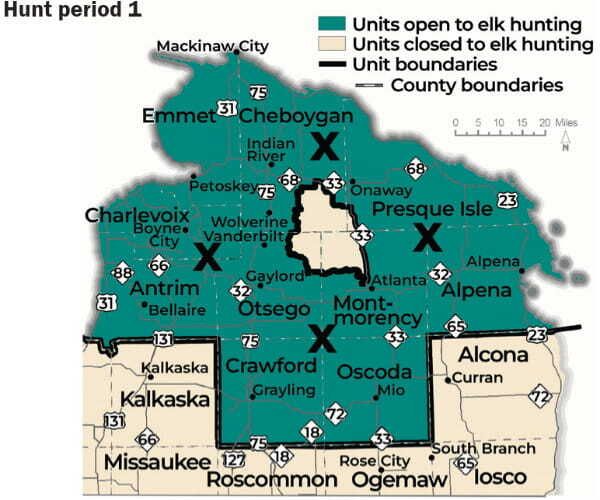
Here's a more detailed look at the 2026 Michigan elk hunt period 1 boundaries.
For the second hunt period, in December, all three elk management units are open for hunting. Licenses are valid either for unit H or I, and all licenses are valid for unit X as well:
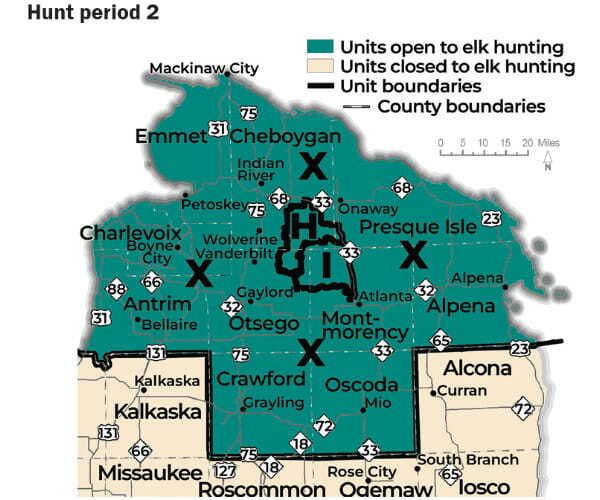
Here's a more detailed look at the 2026 Michigan elk hunt period 2 boundaries.
For more information on elk hunting in Michigan, see the 2026 elk hunting regulations summary.