
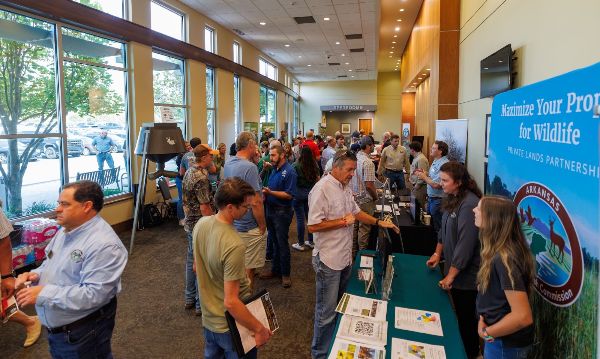
Six standout individuals and organizations were honored by the Arkansas Game and Fish Commission for their contributions to improving wildlife habitat and outdoor recreation culture on private land on Aug. 28 at the second annual Natural State Private Lands Expo at the Benton Event Center.
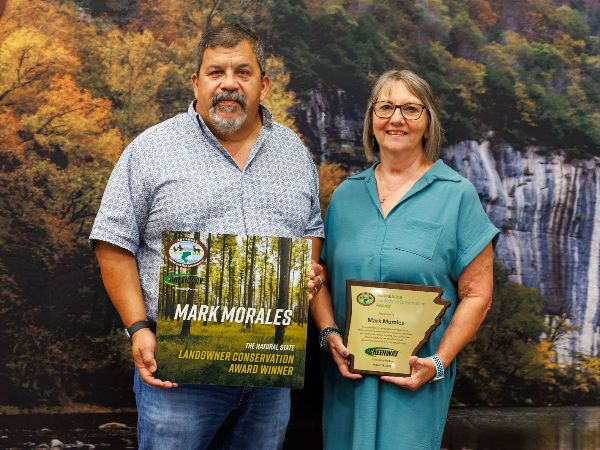
Mark Morales received the Wildlife Habitat Landowner Award, not only for the amazing transformation of his 40-acre property at the base of Mount Magazine, but also for his extensive work advocating for prescribed fire and prescribed burn associations in Arkansas.
"Mark is a shining example of how people can team up, even in private land management, to benefit the greater good," Garrick Dugger, chief of the AGFC's Private Lands Habitat Division, said. "He teaches at the burn school at Camp Robinson and the Fire Academy at Arkansas Tech. There's no telling just how many people he's influenced into learning more about how valuable managed fire can be for wildlife habitat."
John Chapman and Flow State LLC received the agency's Partner-Nominated Award, having been nominated by the Beaver Watershed Alliance.
"John has played a key role in a number of major restoration projects in Northwest Arkansas, including the recent restoration of more than a mile of streambank on War Eagle Creek, under an America the Beautiful Challenge grant project," Becky Roark of BWA wrote in a nominating letter. "The bank restoration and Flow State's subsequent development of an adjacent wetland complex were the first steps in a larger overall restoration project that will reconnect more than 500 miles of streams."
Although Chapman's work relied on fisheries improvements, it was Lance and Audra Coffman who took home the agency's Fisheries Habitat Landowner Award. The Coffmans both work full time for the U.S. Forest Service, but they don't leave their conservation spirit at work when it's time to clock out for the day. They have transformed an overgrazed Montgomery County farm with unrestricted livestock access to the Caddo River to a wildlife and fish paradise, using fencing to keep cattle away from the water and more than 1,200 native trees and shrubs to stabilize 600 feet of eroding streambank and filter runoff from their property.
Joe Woolbright received this year's Conservation Contractor of the Year Award. Woolbright is a professional with technical expertise accumulated through decades of fieldwork. He has successful projects all across Arkansas and neighboring states as evidence of his capabilities, especially in prairie restoration. He works with more than 200 partners in both the public and private sectors and established the nonprofit Ozark Ecological Restoration Inc., through which he and his team restore native ecosystems with prescribed fire, native planting, invasive plant control and timber stand improvement.
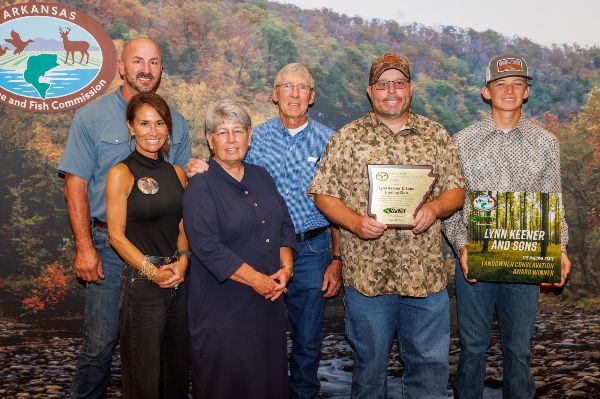
Lynn Keener and Sons was awarded the Deer Management Assistance Program's Deer Club of the Year. By balancing their deer herd and improving the habitat on their property through prescribed burns and opening the forest canopy, Keener and his family have revitalized their club into an excellent example of overcoming the odds despite a high prevalence of chronic wasting disease being documented in their county. By managing their property extensively, they are continuing to provide ideal habitat conditions for wildlife throughout the setback of CWD, and still see excellent results in their annual harvest.
A well-known partner of the AGFC — Arkansas Hunters Feeding the Hungry — received the Corporate or Group Award to wrap up the awards presentation. AHFH bridges the gap between land stewardship and community service — converting donated venison into millions of meals for local pantries and supplying shelf-stable Wild Game Snack Sticks to school backpack programs statewide. Executive Director Ronnie Ritter coordinates with game processors, food banks and deer clubs throughout 75 counties to ensure no harvest goes to waste and no child goes hungry in Arkansas.
The event, which began as a simple dinner to recognize leaders in conservation, has blossomed into a full show for landowners to learn about wildlife management techniques, make contacts with vendors and contractors to help with boots-on-the-ground work, and connect with agency private lands habitat biologists to begin evaluating their property and plan conservation enhancement opportunities.
"We realized if we were only having an awards ceremony, we were missing a golden opportunity to increase the conservation footprint in Arkansas," Dugger said. "Who better to be spokespeople for conservation to newcomers than the very people we saw as deserving of these awards."
Jason Hooks, the AGFC biologist who coordinated this year's vendors and sponsors and program, said the event has grown immensely in two years.
"We actually sold out of tickets the week before the event, and we still had a few people come anyway, willing to pay at the door to eat and see a few of the seminars," Hooks said. "In all, we probably had more than 450 people at the event, including vendors, presenters, sponsors and guests. We're even looking at the possibility of moving the event to a new location because we've about reached the capacity of the event center we have been using."
In addition to Greenway Equipment, the cultivating partner of the AGFC's Private Lands Habitat Division, many more sponsors stepped up to be a part of this year's event.
"We had Green Habitat Consulting, Helena Ag Herbicide Sales, NativState Carbon Development, Azelis Heribicides and even Camping World of Benton all step up and sponsor this event because they saw the value in working more closely with these landowners," Hooks said. "That's in addition to our longtime partner, the Arkansas Game and Fish Foundation."
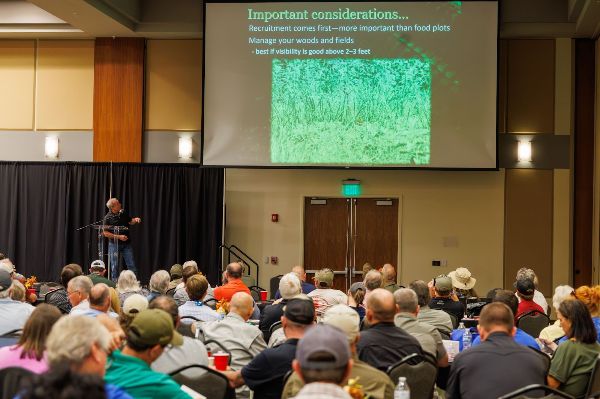
Hooks says nearly every educational session was packed, with Craig Harper's keynote and working group breakouts on his recent turkey management research taking top billing.
"Dr. Harper was definitely a big draw for the event," Hooks said. "He's a professor of Wildlife Management and extension wildlife specialist at the University of Tennessee, and his work includes more than 200 peer-reviewed articles, books and manuals on deer and turkey management, among other wildlife subjects."
Hooks said quite a few people attended seminars focused on fisheries as well, especially a breakout session on farm pond management.
"With the keynote being on terrestrial management, it was great to see so many people interested in some of the aquatic habitat side of things," Hooks said. "Landowners play a critical role in watershed management through their actions, and it was great to see so many recognize that link on their own property."
Hooks says biologists are already planning for next year's expo. The event may have outgrown its current home, but he wants to keep it in central Arkansas.
"We had folks from north-central Arkansas, Fort Smith, really all over the state," Hooks said. "Keeping it centrally located enabled us to have a good showing from just about every corner of the state. We'll also continue pursuing big names in the conservation industry for presentations. We have experts on staff, but we want attendees to get their information from a variety of well-known sources so they can make the most informed decisions with their land moving forward."