
Ten-year-old Vivi Veitch was paddling her small boat across a pond last month when something floating near the water's surface made her bring the boat to a stop.
"I thought I was seeing lots of plastic, so I tried to pick it up because you don't want plastic in the lake," Vivi recalled. "But it was really hard to pick up because it was slimy."
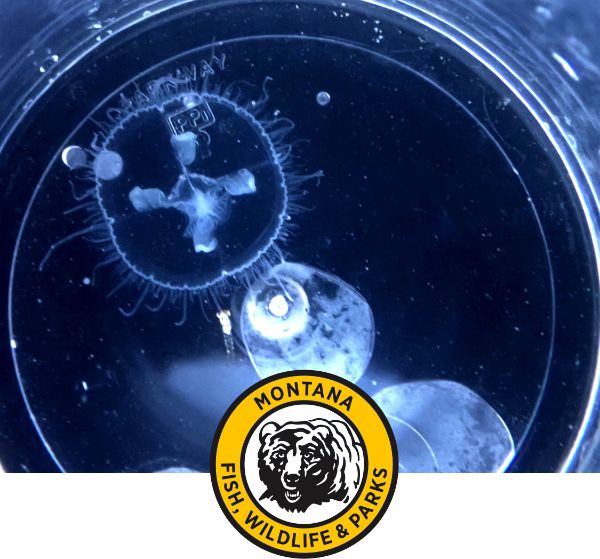
Vivi kept her boat motionless as she leaned in for a closer look at the penny-sized blob, whose tiny movements were barely noticeable. Puzzling at this translucent floating mystery, Vivi soon found dozens more just like it, and they started to look familiar.
"I knew that jellyfish move pretty much like that, and plastic doesn't," she said. "I started talking myself into it."
With help from her dad, Vivi reported the find to Montana Fish, Wildlife & Parks. FWP's invasive species early detection team collected samples from the small pond, which is adjacent and connected to the northwest corner of Canyon Ferry Reservoir near the dam. While the find wasn't the first time such a species was detected in Montana, FWP staff did confirm Vivi's hunch.
Craspedacusta sowerbii, known as the common freshwater jellyfish, was first sighted in Montana in a pond adjacent to the Missouri River near Great Falls in 2009. Since then, no other major sightings have been reported in the state until this summer. The species is native to eastern Asia and is now found on almost every continent, as well as most states in the U.S.
The familiar free-floating "medusa" phase of this jellyfish's life cycle only appears sporadically during warm summer months, while most of their life is spent attached to underwater surfaces as microscopic polyps that go dormant in winter. Like some fish in Montana such as paddlefish and cisco, the freshwater jellyfish feeds on zooplankton, an important foundational component of aquatic food webs.
Unlike some of its well-known marine counterparts, the freshwater jellyfish is harmless to humans.
It's unknown how the species made its way to Montana or whether the discovery near Canyon Ferry is related to the state's initial sighting 17 years earlier. Also unclear are the possible ecological impacts of the jellyfish's presence in Montana waters as a non-native species, though it does not appear to have had significant impacts in other states.
FWP will continue to monitor the presence and effects of this and other introduced species. Craig McLane, FWP's aquatic invasive species early detection and monitoring coordinator, says this case offers several important reminders.
"This is a great example why cleaning, draining and drying all watercraft and equipment are critical steps in preventing the spread of aquatic invasive species," McLane said. "We're grateful for the public's help in keeping Montana's waterways healthy and giving us a call promptly when they see something that doesn't look right."
For her part, Vivi says the only other surprise of her story that compares with the jellyfish itself is that "people actually believed me."
To learn more about FWP's efforts to protect Montana waters, click here.