
Each year, Idaho Fish and Game brings you the annual Deer and Elk Hunting Outlook, a must-read, handy guide that lays out everything — and I mean everything — hunters need and should want to know about deer and elk trends leading up to the fall opener.
The more you read, the better understanding you'll have of this year's deer and elk season. But for all you headline skimmers out there, the biggest theme in this year's outlook is best exemplified in the words of Idaho Fish and Game Deer and Elk Coordinator, Toby Boudreau.
"Highly promising."
What determines a highly promising season? A lot of factors, but none more so than a mild winter. And for those counting, this will be our third in a row.
"Overwinter survival was better than average," Boudreau said. "And when you have better-than-average overwinter survival, it means earlier antler growth, heavier fawns and calves, and more robust herds."
Most Westerners will be quick to point out that a winter that brings little to no precipitation equals a summer that could bring wildfires — and they'd be correct. Wildfires will certainly play a role in this year's forecast (more on that later), but remember that the single biggest factor that determines deer and elk survival heading into fall is how they navigate the previous winter, and last year's winter could pay off immensely for herd numbers this fall.
Statewide, 83% of collared mule deer fawns and 95% of collared elk calves survived the 2025-2026 winter. Considering, on average, roughly 57% of collared fawns survive winter, that's huge. Mule deer does, the fawn-making factories, accounted for 95% survival last winter thanks to ample nutrition and mild conditions.
How about whitetails, though?
The headlines preceding last year's white-tailed deer season were once again concerned with three ominous letters: E-H-D.
Epizootic hemorrhagic disease once again reared its ugly head in August 2025. By Oct. 27, biologists had received reports of roughly 1,080 white-tailed deer mortalities in the Clearwater Region and 386 in the Panhandle Region most likely caused by EHD. About 72% of the Clearwater's reports came from Units 8 and 8A, and approximately 18% came from Units 11A and 14. In other units only a handful of suspected cases were reported.
Estimating how many deer die during an EHD outbreak is extremely difficult. However, based on the number of reports, the 2025 outbreak appeared similar in severity to the 2021 event, though centered in a different part of the region.
Despite last year's outbreak, Fish and Game stuck by the science and did not recommended altering current deer seasons. White-tailed deer populations in the Clearwater Region remain strong overall, and while EHD has caused localized losses, deer numbers across much of the region remain robust and well above conservation concern.
Final note worth mentioning on whitetails: The publication of this outlook makes it difficult to time just where (or if) EHD will make an appearance in the early days of fall. Biologists are currently monitoring white-tailed deer populations for signs of EHD and will continue to do so even after this deer and elk hunting outlook hits the streets. If any clues do begin to indicate another EHD outbreak, that news will be released separately and at a later date.
LAST YEAR’S HARVEST
We'll kick off last year's harvest summary with the one species that didn't see an increase from the previous year: whitetails.
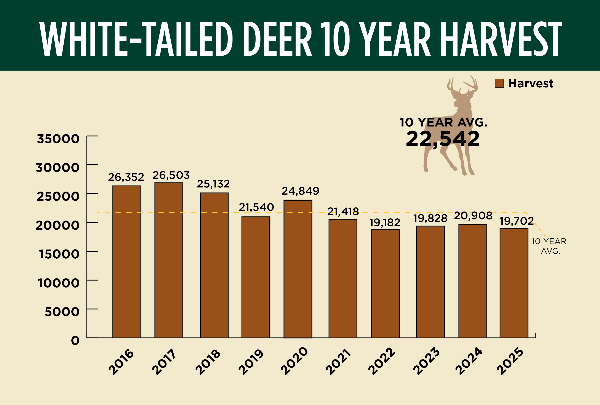
White-tailed deer harvest typically hovers around the 22,000 mark, and last year's harvest wasn't too far off from that. Hunters still have room for celebration, as the year's harvest could've looked a lot different — but more on that in a bit.
Last year's 19,702 whitetail harvest still sits right in line with the 10-year average, which despite a handful of EHD outbreaks during the past decade, still continue to flourish. Despite slipping a bit from the 2024 hunter harvest, last fall's harvest has Fish and Game biologists nodding their heads with optimism as we round out the final weeks of summer and approach this year's hunting season.
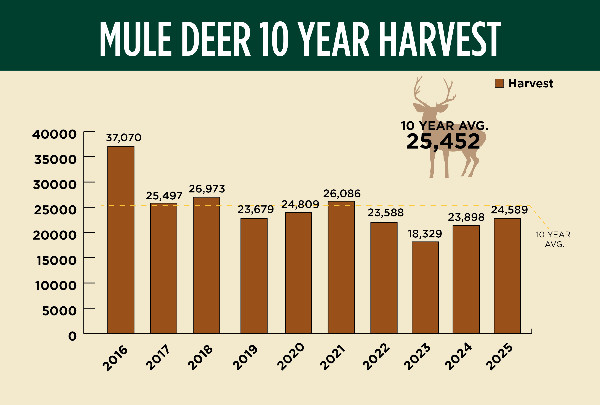
Mule deer (or, technically speaking, mule deer hunters) are the biggest winners from the 2025 fall season. Harvest of muleys jumped 2.8% from 2024 — or put another way, 691 more animals during this past year's harvest. That's worth noting, considering some mule deer populations had a rough go of it during the winter of '22 and '23.
Fortunately for them, the past few Idaho winters have been some of the mildest in recent years, including this past winter, which was Club Med for mule deer herds.
Finally, on to elk.
Elk hunters also had a successful fall, accounting for a 2.4% increase (or 509 animals) from 2024. As we've covered every year in these annual reports, elk don't feel the impact of weather nearly as bad as their long-eared or white-tailed cousins.
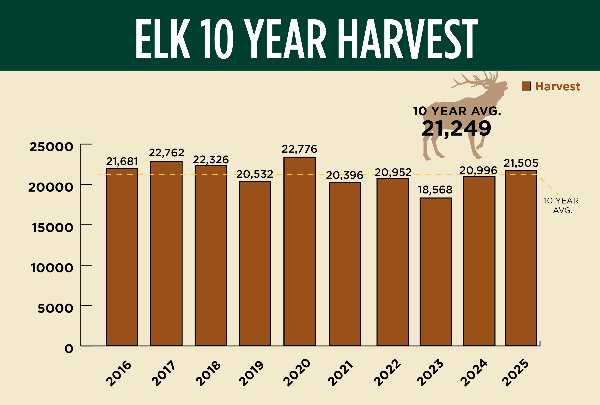
Last year's harvest landed at 101% of the 10-year average (21,249), which makes it about as close to a "normal" harvest as you can get with fluctuating annual harvests.
ELK HUNTING
Overwinter survival and collar data concluded in May, indicating that Idaho's elk were heading into summer in outstanding condition. Remember that every year Fish and Game wildlife biologists collar and track deer and elk survival throughout the winter, paying especially close attention to that data in April and May when the animals are at the end of their rope nutrition-wise.
Like previously mentioned with mule deer winter survival, elk exiting the winter in solid shape means bigger, healthier herds heading into the fall. Likewise, antler growth also gets a jumpstart on the year, which is good news if you're a rutting elk — and an elk hunter.
"Fawns and calves that come out of winter weighing more than average is a great sign that herds will grow in the remainder of the year," Boudreau said.
Because of this, biologists are optimistic that this could be a higher-than-average year for elk hunting. But there's a caveat.
While the number of elk on the landscape looks quite promising, the status of the landscape itself could play a role in their distribution. You don't have to be Nostradamus to see that this has been one of the hottest, driest summers on record. With fires already taking full advantage of those conditions, hunters might have to work a little harder to locate their elk.
In years past, fall moisture has noticeably played a role in elk distribution. Recall that head-scratcher season of '23? That's exactly what can (and could) happen if September and October see rain (or snow), causing higher elevations to green up. When that happens, the elk have all the groceries they need at those higher elevations and become more challenging to locate down lower.
But, weather aside, look forward to another average to above-average season in the mountains chasing after Rocky Mountain elk. They will be there — just maybe not where you've seen them in the past.
Last year's numbers
- Total elk harvest in 2025: 21,505
- 2024 harvest total: 20,996
- Overall hunter success rate: 23%
- Antlered: 13,263
- Antlerless: 8,242
- Taken during general hunts: 13,524 (18% success rate)
- Taken during controlled hunts: 7,981 (40% success rate)
MULE DEER HUNTING
Mule deer populations continue to head in the right direction, figuratively speaking.
It has been three and a half years since eastern Idaho's mule deer populations were rocked by one of the most catastrophic winters on record, and during that time, we have witnessed consecutive mild winters — a magical potion if you're an Idaho muley.
As biologists have pointed out countless times before, mule deer need mild conditions to get through winters in good shape and — more importantly — rebuild. One of the best indicators of mule deer health is fawn weight heading into and out of winter. And this year, Boudreau argues, has demonstrated some incredibly high fawn weights.
Over the last four years, collared mule deer fawns' weights have increased roughly 10.6% in males and 12% for females. (Remember, those weights are collected in December and January when biologists trap and collar fawns and does to monitor throughout the winter and spring.)
Heading into 2026, male mule deer fawns weighed an average of 85.5 pounds, and females weighed an average of 77.9 pounds.
"Healthy fawn crop that survived winter means more young antlered bucks that will be sporting spikes, forked-horn antlers, and a small percentage will be three-points. Those young bucks represent a large portion of the annual buck harvest, so it's likely hunters will see an uptick in the fall harvest," Boudreau said.
Seeing numbers like 83% of statewide collared mule deer fawns surviving this past winter is a huge gold star on this year's deer hunting forecast. Not to overstate the obvious, but more deer in the fields and woods means better chances for a higher harvest. And things get better because consecutive normal winters also mean more bucks are likely reaching maturity, so there may be more larger bucks available.
Like with any season, folks should monitor weather as we get further into September and deep into October. Early snows tend to push muleys around and down into lower elevations sooner than elk, so closely follow the weather forecasts when planning your hunt.
Last year's numbers
- Total mule deer harvest in 2025: 24,588
- 2024 harvest total: 23,898
- Overall hunter success rate: 32%
- Antlered: 21,539
- Antlerless: 3,050
- Taken during general hunts: 18,655 (28% success rate)
- Taken during controlled hunts: 5,933 (52% success rate)
WHITE-TAILED DEER HUNTING
At the time of writing this forecast, the three ugliest letters in the white-tailed deer world have yet to appear. Biologists continue to monitor for EHD, which proved to be a factor in last year's hunting season in the Panhandle and Clearwater regions (most notably in Units 8, 8A, and portions of Units 11A and 14).
Last year's EHD outbreak popped up in late July and August, which accounted for a slight dip in overall harvest; however, statewide harvest held steady, which was to be expected.
So, what can hunters expect this year?
So far, EHD has not popped up and herd numbers continue to be strong. While it may take a year or two for those previously mentioned units to build back herd numbers, Idaho's whitetails as a whole are doing just fine based on the seasonal conditions mentioned already with elk and mule deer.
White-tailed deer populations typically fare very well in Idaho. They are arguably the most adaptable species and are able to bounce back quicker than mule deer.
"Hunters can anticipate a good whitetail hunt this year," Boudreau said.
Tooth and consequences
Last thing worth mentioning here. Back in 2023, Fish and Game wildlife biologists began a comprehensive tooth collection project (that's deer teeth) to help determine the age structure of white-tailed deer in a few north Idaho hunting units.
Teeth collected from whitetails — specifically the front teeth — are sent to a lab and aged to determine a range of how old or young harvested deer are, and by extension, the age structure of the rest of the deer out there on the landscape.
Additionally, in 2024 and 2025, biologists asked hunters to measure the circumference of buck antlers harvested that season.
The 1,100 white-tailed deer teeth collected in the project's inaugural year combined with last season's 1,229 teeth and 472 antler measurements have helped our biologists measure a wider spread of ages among deer than previously thought.
"It was originally thought that buck ages were down, or in other words, we were seeing more younger bucks out there in the field," Boudreau said. "But thanks to our tooth data and the hunters who submitted those teeth, the data shows there's actually quite a bigger spread of buck ages from 1.5 to 15.5 years old in the harvest."
Our biologists are once again looking for white-tailed deer tooth submissions during the 2026 hunting season. For more information, check out this article or contact the Panhandle and Clearwater regional offices.
Last year's numbers
- Total white-tailed deer harvest in 2025: 19,702
- 2024 harvest total: 20,908
- Overall hunter success rate: 38%
- Antlered: 13,302
- Antlerless: 6,400
- Taken during general hunts: 18,237 (37% success rate)
- Taken during controlled hunts: 1,465 (40% success rate)
WILDFIRE INFORMATION
This year's hunting outlook wouldn't be complete without mentioning the impact of wildfires.
As wildfire activity continues across Idaho, hunters preparing for upcoming seasons should be aware of potential impacts to their hunting areas and know what options are available if a fire affects their hunt.
In most cases, Fish and Game will not close an entire hunt or change a season because of a temporary wildfire closure. Most wildfires do not affect an entire hunt unit, elk zone, or controlled hunt area for the entire duration of a hunt.
It's understandable that hunters want to maximize their hunt opportunity. It's that one sliver of the year circled red on the calendar. From pretty much the conclusion of the previous season, you've been dropping pins, scouring maps, and dialing in gear aimed at getting after it the following hunting season.
But one thunderous day in summer can suddenly throw a wrench in those plans, leaving hunters feeling frustrated and uncertain about their hunt plans.
Fortunately, hunters do have a few options, including hitting another part of the hunt area or hunting later in the season. If you find yourself frantically picking up the pieces of a fire-impacted hunt, read our Fire and Fall Hunting Guide article on our website.
Hunters can also see current fire closures and restrictions on InciWeb.wildfire.gov.
NOTE: Beginning July 1, 2026, rules related to eligibility for license and tag refunds and rainchecks have changed. Please visit our refund webpage for more information.
MANDATORY HUNTER REPORTS
Reminder for all big game tag holders: Hunters must complete a Mandatory Hunter Report within 10 days of harvest. If you did not hunt or did not harvest (deer, elk, and pronghorn only), you must submit your report within 10 days after your hunting season closes for each tag purchased.
Mandatory Hunter Reports provide critical hunt and harvest information to wildlife managers to maximize and sustain healthy herds. Help us collect this vital information and conserve your hunting, fishing, and trapping dollars.
For reporting requirements, FAQs, and access to online reporting, visit Fish and Game's Mandatory Hunter Report webpage.