
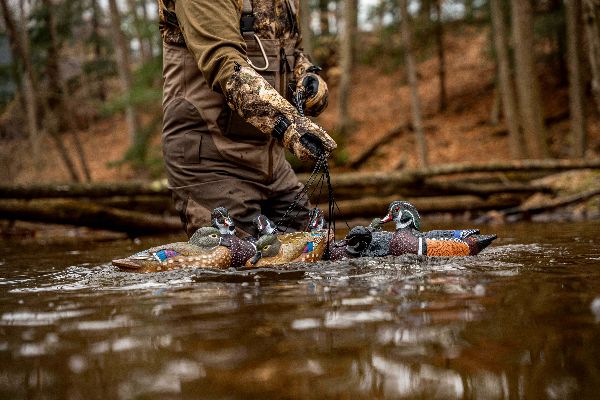
Hardcore Waterfowl's Rugged Series Wood Duck Decoys
MUSKEGON, Mich. – Wood ducks don't fly in from the prairies like teal or work a big spread from altitude like divers. They live in the timber. Flooded oaks, beaver ponds, backwater sloughs, little tucked-away holes barely big enough to swing a gun in.
That's a different game entirely. When you're hunting wood ducks, they're not passing over your spread from 200 feet up. They're dropping in tight, low, and close, sometimes right on top of you before you even hear the whistle.
Close range means close inspection. A decoy that gets away with a color crayon paintjob out on open water gets picked apart in a wood duck hole, because there's nowhere for a bad detail to hide.
Hardcore's Rugged Series Wood Duck Decoys were built with that in mind. Six to a pack, four drakes and two hens, each one carrying the kind of paint and feather detail that must hold up at arm's length, not just from a distance.
The Look That Started It All
Ask any duck hunter to name the most striking bird in North America, and wood ducks usually win without much debate. The drake alone is almost too much: an iridescent green-and-purple head, white racing stripes, a blood-red eye, and a chestnut breast dappled in white. Nothing else on the water looks like it.
That kind of detail is hard to fake and easy to get wrong. Hardcore decoys are painted true to life, drake and hen alike, capturing the sheen and pattern that makes a wood duck a wood duck instead of just another dark shape on the water.
"Wood ducks get hunted up close more than any other bird out there," said Doug Veldhuizen, Merchandise Manager for Hardcore. "You can't hide behind distance in a flooded timber hole. The paint must be right, the size must be right, and it must look alive sitting still. That's what we built this decoy around."
Around Longer Than Most
Unlike blue-wings and green-wings, wood ducks don't disappear on a hard migration schedule. Plenty of birds stick close to home year-round, especially across the Southeast, the Mississippi Flyway, and parts of the Pacific Coast, which means hunters aren't always racing a calendar to catch them passing through.
That's part of why wood ducks show up so early on the schedule. In many states they're paired with teal for the first split of the season, giving hunters a shot at them well before the rest of the puddle ducks arrive.
They stick around, too. Wood ducks are common well into the regular season across the East and South, working the same flooded timber and beaver ponds from opening weekend through the late splits. Where a lot of species come and go with the front, wood ducks are often just there, holding tight to the timber hunters already know.
That kind of local, season-long presence is exactly why the detail on these decoys matters. A bird that gets hunted the same hole a dozen times over a season isn't fooled by anything less than the real thing.
Find the Hole, Find the Birds
Wood ducks aren't spread across open water waiting to be found. They're tucked into specific places, and the best spots tend to share the same short list of ingredients.
Timber with standing water is the classic setup: flooded hardwoods, acorns dropping into a few inches of water, enough overhead cover that a duck can drop straight down through a hole in the canopy and feel safe doing it. Beaver ponds work the same way, especially smaller, brushy ones tucked off the main river where a dozen birds can sit undisturbed.
Slow, narrow water matters more than a lot of water. Backwater sloughs, oxbows, and quiet creek bends draw wood ducks looking to loaf and feed away from bigger, more pressured water. So do farm ponds and drainage ditches near a hardwood bottom, especially early and late in the day when birds are moving between roost and feed.
The common thread is cover and quiet. Wood ducks want a tight, sheltered spot they can drop into fast, not a wide-open flight line. Find that kind of hole and you've usually found the birds.
One Piece, Built to Take a Beating
Every decoy in the Rugged Series shares the same foundation: FowlFlex™ Technology. It's one-piece construction, so there's no head-and-body seam to snap after getting hauled through brush, dropped in the boat, or crammed into a bag with a dozen other decoys.
Cheap decoys fail at that seam first. FowlFlex doesn't have one to fail. The material flexes instead of cracking, and the finish shrugs off UV and season after season of getting dragged in and out of the timber.
Movement in the Smallest Water
Wood duck water isn't always moving. Beaver ponds and flooded timber can sit dead calm, which is exactly where a lifeless decoy gets exposed fastest.
That's where the WhaleTail™ Keel comes in. It's shaped to catch even the faintest breath of current and turn it into natural rocking and swimming motion, the kind of subtle movement that separates a living bird from a plastic one. In small, tight water, that little bit of life can be the difference between wood ducks committing or flaring at the last second.
"We didn't want hunters choosing between durability and realism," Veldhuizen said. "FowlFlex and WhaleTail let us deliver both, whether you're setting up in three inches of flooded timber or a beaver pond you've hunted for years."
Six Birds, Built for the Hole
The pack breaks down into four Drakes and two Hens, sized true to scale at 13.5 inches long, giving hunters a realistic, versatile grouping for tight-quarters setups where a handful of decoys can do more work than a big spread.
Wood ducks decoy in small numbers more often than not, and this pack is built to match that.
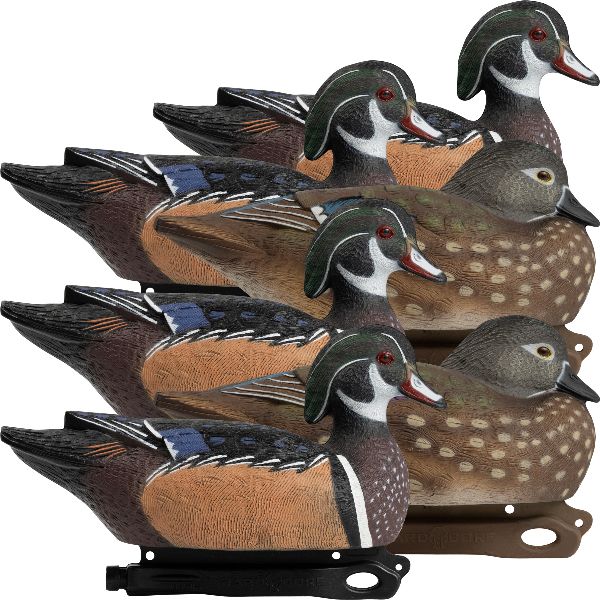
Rugged Series Wood Duck Decoys FEATURES:
- True-to-life paint and feather detail on both Drakes and Hens
- WhaleTail™ Keel for natural rocking and swimming motion in minimal current
- One-piece FowlFlex™ construction — no head-and-body seam to snap or crack
- True-to-scale sizing at 13.5" L x 6" W
- Six-pack: four Drakes, two Hens
MSRP $79.99