As we hit the heat of the summer, fishing restrictions seem to be a weekly news story, and the term "hoot owls" – referring to hoot owl fishing restrictions – becomes common in conversations about angling. A hoot owl restriction prohibits fishing from 2 p.m. to midnight daily.
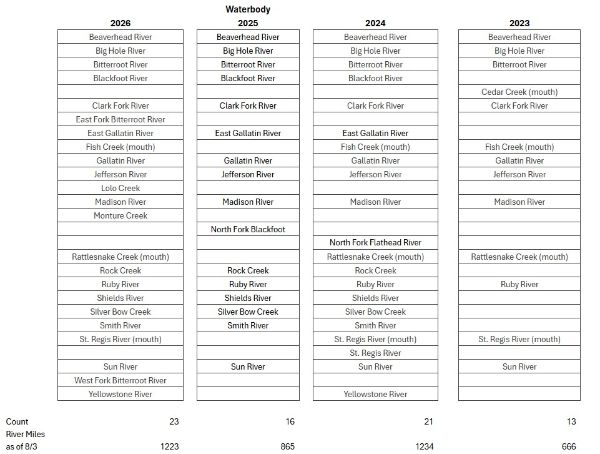
The 2026 season looks a lot like 2024. Currently, there are 23 waterbodies under a fishing restriction, which equates to 1,223 stream miles. In 2024, the season included 21 waterbodies and 1,234 stream miles of restrictions. Both years experienced winters with below-normal snowpack and summers with hotter-than-normal temperatures and below-average precipitation.
In 2023 and 2025, fishing restrictions were enacted on 13 and 16 waterbodies, respectively, which equated to 665 and 865 stream miles. Those years had near-normal snowpack, near-normal summer temperatures and some nicely timed or above-average precipitation.
FWP implements hoot owls as a conservative measure to protect trout when environmental conditions are stressful and angling may be high. Warm water temperatures are known to negatively affect trout, and hoot owls can eliminate one more stressor – being caught and handled by an angler. FWP staff monitor temperatures on a wide range of streams daily and are thoughtful about when restrictions are recommended for the Fish and Wildlife Commission's approval – balancing angler opportunity with protection of the fishery.
Hoot owl restrictions take into account many factors but include a trigger of stream temperatures of 73 degrees for three days in a non-native trout fishery, 66 degrees for cutthroat trout and 60 degrees for bull trout. There is some nuance with implementation to allow for approvals, clear communication to the public and even favorable weather forecasts that could drop temperatures in the coming days.
Fishing closures may also be implemented, which prohibit angling for the entire day. This happens when conditions continue to degrade, including low dissolved oxygen or streamflow, and angling could be detrimental to the fishery. Several streams in Montana also have drought plans that guide decision-making.
The term "hoot owl" comes from the logging industry, where loggers shifted their work to the cool hours of the day when owls were still hooting and equipment sparks were less common during a dry summer. FWP adopted the term to restrict angling during the warmest part of the day, when water temperatures are high.
In most years, hoot owls go into place in July and are lifted when conditions improve in late August or early September. August can be marked by fishing closures, especially when a drought plan is in place.
We don't know what the rest of the season holds, but we are hoping for good rains and cooler weather that will reduce stress on fish and get anglers back on the water in the afternoon.
For the latest waterbody restrictions and closures, visit fwp.mt.gov/news/current-closures-restrictions/waterbody-closures.
To read more about hoot owl restrictions, click here.
This table shows comparisons of fishing restrictions from 2023 to 2026.