
KALISPELL – Swan Lake is one of the last remaining homes to a native Montana fish species, the bull trout. The bull trout of the Swan River basin spend much of their lives in Swan Lake, but every one of them has a home stream where their story begins. Now, thanks to groundbreaking research led by Montana Fish, Wildlife & Parks biologists, scientists can identify where many of those fish were hatched, providing new insight into which tributaries are most critical to the species' recovery.
Bull trout have a complex life cycle. After hatching in cold, clean mountain streams, young fish typically spend one to three years growing in these tributaries before migrating downstream to larger rivers and lakes like Swan Lake. While bull trout return to spawn, not all choose the same stream, making the population a patchwork of subgroups tied to different tributaries. Over the past several decades, bull trout numbers have declined due to habitat loss, warming stream temperatures, competition and predation from non-native fish, and barriers that limit migration. These challenges make it increasingly important to answer a key question: Which streams are producing the most young bull trout that survive to adulthood and migrate to the lake?
For decades, biologists have counted bull trout nests, called redds, to estimate how different streams contribute to the overall population. The assumption has been that more redds within a stream equaled more fish being added into the population. However, the recently published study in the journal Ecology of Freshwater Fish titled Estimates of Spawning Stream Contributions to an Imperilled Bull Trout Metapopulation Utilizing Otolith Geochemistry and Redd Counts used advanced methods to test if that assumption was true.
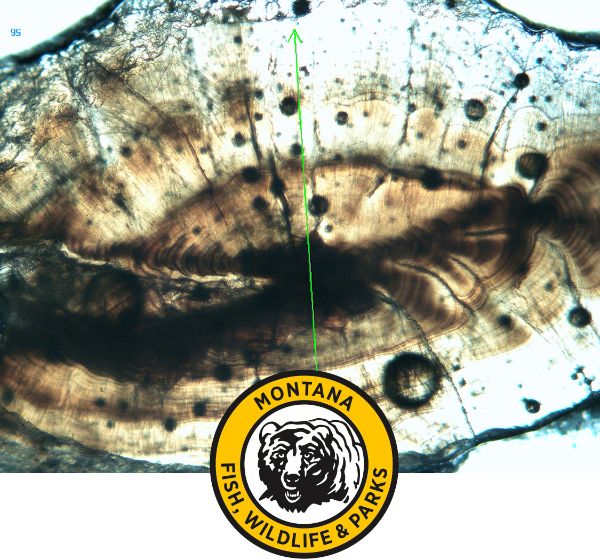
The study used tiny structures called otoliths, which are calcium carbonate structures located in the inner ear of fish. Much like a tree trunk with growth rings, these otoliths grow as the fish grows. Even more remarkably, each stream has its own unique fingerprint, a product of naturally occurring isotopes and elements based on its surrounding geology. As a juvenile fish develops in its home stream, the unique fingerprint is permanently recorded in the otolith. Years later, even after the fish has moved into Swan Lake, scientists can examine the center of the otolith and identify which stream the fish grew up in, almost like looking at a birth certificate written in chemistry.
By analyzing otoliths collected from bull trout that were unintentionally caught during lake trout suppression efforts, researchers were able to pinpoint which spawning tributaries contribute the most fish to the Swan Lake population. The team then compared those findings with decades of bull trout redd counts. While redd counts remain an important tool for monitoring spawning activity, the study found that some streams produce more surviving bull trout than redd numbers alone would suggest, while others contribute fewer fish despite having similar spawning activity.
These findings give fisheries managers a clearer picture of which tributaries are the most productive and where conservation efforts may have the greatest benefit. In some streams, protecting spawning habitat may be the best strategy. In others, additional research may be needed to understand why fewer young fish are surviving.
With bull trout populations in the Swan River basin having declined significantly over the past several decades, studies like this provide valuable information to help guide future restoration and recovery efforts. By combining innovative science with long-term monitoring data, researchers are helping ensure conservation decisions are based on a better understanding of how this important native species uses the watershed.
As FWP fisheries biologist and lead author to the study, Sam Bourret, put it, "bull trout continue to decline across their range, and we need the best possible information to guide recovery. These results show where young fish are thriving and where they're not, giving us a roadmap for targeted, effective conservation."