
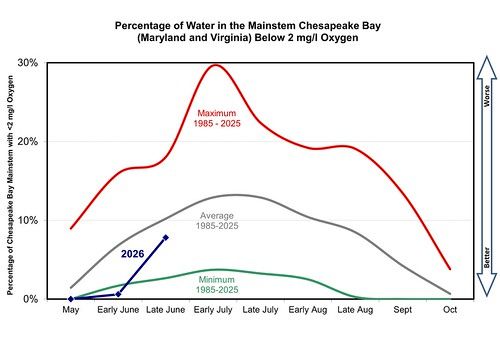
Data collected by the Maryland Department of Natural Resources and Old Dominion University show lower than average volumes of hypoxia—waters with less than 2 mg/l of oxygen—in the Chesapeake Bay mainstem of Maryland and Virginia from May to late June 2026.
No hypoxia was observed in May, one of ten years with no monitored hypoxia in May during the past 42 years. Early June had the lowest hypoxic volume ever measured for the time period with less than a tenth of a cubic mile. Late June hypoxia rose to just under one cubic mile, but was still below the historical average. May and early June had no anoxia – waters with less than 0.2 mg/l of oxygen – while 0.05 cubic miles were observed in late June.
Summary results from combined Maryland and Virginia mainstem Bay monitoring cruises are as follows, with volumes in cubic miles. Rank is in order of lowest (better conditions) to highest hypoxia volume (worse conditions).
| 2026 Cruise | Hypoxic Volume | Average Volume (1985-2025) | 2026 Rank | Graphic |
| May | 0.0 | 0.18 | 1st (tied) / 42 | Chart or Map |
| Early June | 0.076 | 0.85 | 1st / 38 | Chart or Map |
| Late June | 0.97 | 1.27 | 14th / 36 | Chart or Map |


The better-than-average dissolved oxygen conditions are in part attributable to the recent and persistent drought conditions experienced in the watershed. This has led to below average water flow into the Bay since August 2025, according to the U.S. Geological Survey (USGS), which means less nutrient pollution from phosphorus and nitrogen that fuels algal blooms that cause hypoxia in deeper Bay waters.
The Chesapeake Bay Program partners' seasonal dissolved oxygen forecast states "from January through April 2026, the amount of water entering the Bay from rivers was 32% below the long-term average, while the amount of nitrogen was 39% lower than average, totaling about 59 million pounds of nitrogen, according to estimates from monitoring stations."
Monitoring results thus far align with the seasonal forecast, which predicted Bay hypoxia volumes will be about 31% below the long-term average.
Since the late June results, air temperatures in the watershed reached record highs, and seasonal rain storms are expected to increase, which could impact future conditions. Warmer waters hold less oxygen and freshwater flow into the Bay could increase stratification which inhibits dissolved oxygen from mixing into deeper waters and could introduce additional nutrients.
Crabs, fish, oysters, and other creatures in the Chesapeake Bay require dissolved oxygen to survive. Scientists and natural resource managers study the volume and duration of Bay hypoxia to determine possible impacts to Bay life.
Ongoing efforts to reduce nitrogen and phosphorus pollution from industrial and wastewater sources, agricultural land, and cities and towns are aimed at reducing hypoxic conditions in the Bay. In the water, nitrogen and phosphorus fuel algal blooms that remove oxygen from the water when they die off and decompose.
Each year from May through October, the Department of Natural Resources computes hypoxia volumes from the water quality data managed by department staff and the Virginia Department of Environmental Quality. Data collection is funded by these states and the Chesapeake Bay Program. Bay hypoxia monitoring and reporting will continue through the summer. Additional Maryland water quality data and information, including the Department of Natural Resources hypoxic volume calculation methods, can be found on the Eyes on the Bay website.