
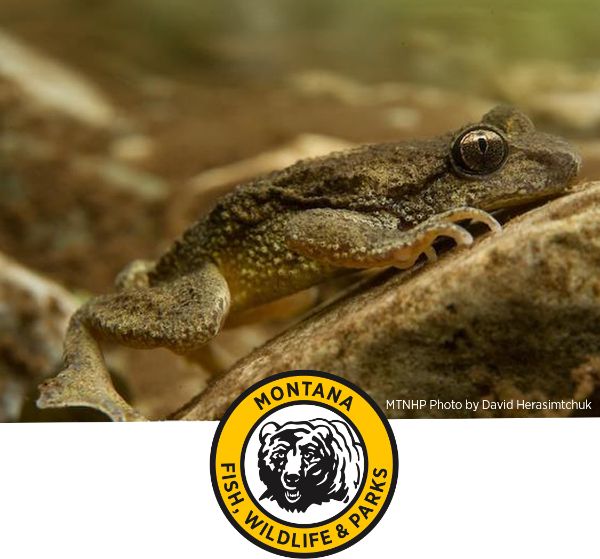
HELENA – Picture a frog. Now picture a frog sitting happily in frog habitat. What do you see? Maybe a frog sitting in lily pads or plopping into a pond? When I think about Montana frogs, I tend to think about them being in a place like that since they breed and reside in mostly still water, such as ponds, lakes or calm backwaters of rivers and streams. That is, all but one species.
The Rocky Mountain tailed frog (or just tailed frog for short) is the exception, and this Species of Greatest Conservation Need is an exceptionally cool specialist of cold mountain stream habitats. Because they specialize in a very different habitat type than our other frogs, the tailed frog goes about life a bit differently. They have evolved unique physical and behavioral characteristics to thrive in cold, fast-moving montane stream ecosystems.
First thing's first: breeding. Most frogs call to locate mates at their breeding ponds, but tailed frogs don't bother, likely because it's not worth trying to compete with the overwhelming sound of rushing water. They manage to find each other just fine without calling and will then proceed to mate. For most frogs, first the female lays eggs and then the male comes by and adds his sperm to fertilize them. But the moving water habitat of tailed frogs would wash away sperm if it were applied to eggs externally. Male tailed frogs have evolved a fancy external cloaca (the "tail" in the tailed frog) to transfer sperm to the female. She then internally fertilizes her eggs before laying them. This is kind of a big deal as there is only one other species of frog or toad in the world known to internally fertilize its eggs.
Tadpoles are tiny creatures and can hardly outswim swift-moving water. Again, the tailed frog has evolved a unique solution to thrive in their stream habitat. The tadpoles have a flat suction cup like mouth, very similar to those little sucker fish you may have seen cleaning the glass of aquariums. With this fancy mouth, they latch onto rocks in the streambed to not get swept away by the current. They scoot along and under rocks with their suction mouth as they graze on diatoms and insect larvae. In Montana they remain as tadpoles for three years before metamorphizing into adult frogs, which is incredible since our other native frogs all complete metamorphosis during their first year. Nobody quite understands how those little tadpoles survive in streams that may freeze solid each winter. A tadpole keeps its secrets.
In its adult form, the tailed frog appears much more similar to our other frog species. They can now negotiate their habitat without radically different physical traits from other frogs. But they still have some unique life history traits that set them apart. They don't breed until their fourth or fifth summer as an adult (which means they don't breed until their seventh or eighth year of life) and they can live up to 15 to 20 years. This means they have both the longest time to maturity and longest lifespan of any frog in North America. This reason behind this long and slow reproductive life history is not well understood; although it is not uncommon for species living in cold water to have a slower and longer life history.
If you happen to see a tailed frog, snap a photo. It's true, adults are mostly nocturnal and infrequently seen, but those rock sucking tadpoles sure are charismatic and easily photographed in low water without being disturbed. Submit your photo observation via free nature identification and data services such as iNaturalist (Citizen Science) to contribute valuable data on this unique species.