
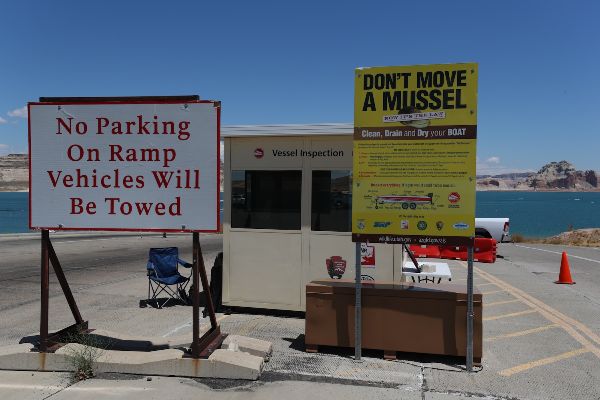
SALT LAKE CITY — Memorial Day weekend often kicks off the summer boating season, and over the weekend, Utah Department of Natural Resources officers, Utah Division of Wildlife Resources technicians and other agency staff were hard at work inspecting and decontaminating watercraft. The main goal of this effort was to prevent quagga mussels and other aquatic invasive species — including Eurasian watermilfoil — from Lake Powell and from infested reservoirs outside the state from spreading to other waterbodies in Utah.
Statewide, aquatic invasive species technicians with the DWR, Utah State Parks, Arizona Game and Fish Department and the National Park Service, as well as DNR natural resources officers, inspected 8,276 boats and performed 195 decontaminations from Friday to Monday. Of those total numbers, 1,343 of the boat inspections and 74 of the decontaminations took place at inspection stations in the Lake Powell area.
Statewide, DNR officers detected several violations of Utah laws established to prevent the spread of invasive mussels. The majority of the violations over the weekend were due to:
- Watercraft users failing to take the mandatory mussel-aware boater program course
- Boaters failing to pay the associated aquatic invasive species fee for motorized boats
- Boaters failing to remove drain plugs while transporting their watercraft
"We want to thank all the boaters for their support and cooperation with our aquatic invasive species staff — we really appreciate those who take the time to be aware and prepared before hitting the water," Utah Department of Natural Resources Law Enforcement Aquatic Invasive Species Statewide Operations Lt. Bruce Johnson said. "It takes all of us to prevent the spread of aquatic invasive species in Utah."
There are over 40 inspection stations located around Utah, with some located at boat launch ramps and others along highways. There are also five dip tanks operating in Utah, and two more are scheduled to open this year. The dip tanks are located at the following locations:
- Lake Powell — Stateline Launch Ramp at Wahweap Marina
- Utah Lake State Park
- Sand Hollow State Park
- Lake Powell — Bullfrog Marina
- Willard Bay State Park
- Jordanelle State Park (a new dip tank will be operational in 2026)
- Lucerne Valley Marina at Flaming Gorge (a new dip tank will be operational in 2026)
Negative impacts of quagga mussels
- They plug water lines, even lines that are large in diameter.
- If they get into water delivery systems, it will cost millions of dollars annually to remove them and keep the pipes free, which can result in higher utility bills.
- They remove plankton from the water, which hurts fish species.
- Mussels can get into your boat's engine cooling system. If they do, they'll foul the system and damage the engine.
- When mussels die in large numbers, they stink and the sharp shells of dead mussels also cut your feet as you walk along the beaches.
Negative impacts of Eurasian watermilfoil
- This invasive plant is detrimental to aquatic ecosystems because it spreads quickly and forms thick mats. Its density blocks out sunlight, and it outcompetes native plants, negatively impacting fish and other native aquatic species.
- Transporting even one piece of milfoil to another waterbody can start a new population of the plant in that waterbody.
- Eurasian watermilfoil (also called milfoil) can clog irrigation pipes.
- It can also tangle around boat propellers and cause damage.
- Removing milfoil from a waterbody once it's found there is extremely expensive.
Visit the STD of the Sea website for a list of all the decontamination stations around the state and for more information about requirements for boaters and others who use nonmotorized watercraft.