
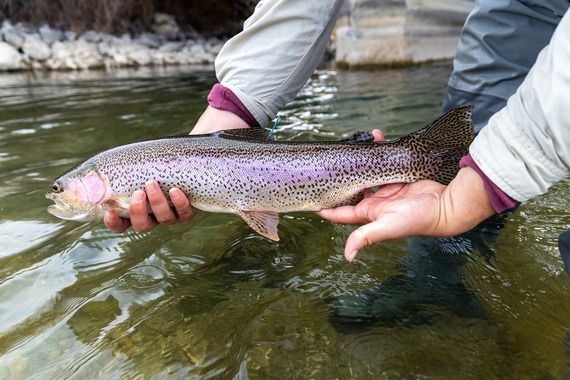
BOZEMAN – Montana Fish, Wildlife & Parks is now in its third season of collaborative research with Montana State University looking at trout recruitment, health and mortality in the upper Jefferson River basin.
Spring trout population sampling, which contributes to that research, is nearing completion for the year, and new trout abundance estimates are now available for the Big Hole River. Estimates for the Beaverhead, Ruby and other rivers will be made available as they are compiled.
Big Hole River estimates
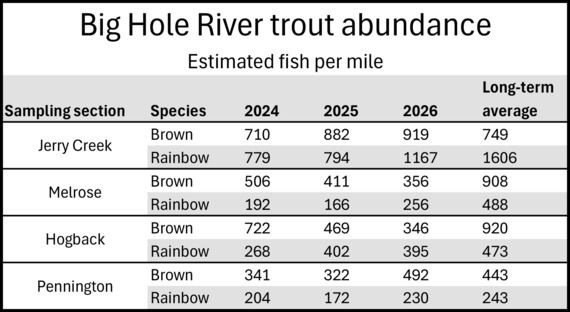
Trout abundances continue to improve in the Jerry Creek section upstream of Divide, with brown trout numbers exceeding the long-term average for the second consecutive year. Rainbow trout abundances in that section are about 27 percent below the long-term average, though this year's estimate shows an increase of about 47 percent from 2025.
The Pennington section, the farthest downstream section on the Big Hole River, also saw increased trout abundances. Brown trout numbers exceeded the long-term average, and rainbow trout increased by about 34 percent from 2025 to just below the long-term average.
Estimates in the Melrose and Hogback sections remain below the long-term averages for both brown and rainbow trout. Brown trout estimates have declined over the past three years, and results for rainbow trout have been mixed.
Based on these estimates, FWP's adaptive management plan for the Big Hole River may provide potential fishing regulation strategies for consideration by the Fish and Wildlife Commission. These regulation recommendations would include the continued closure to all angling from Oct. 1 to March 31, in accordance with the plan.
Collaborative research
FWP and MSU are continuing joint research to better understand the major limiting factors contributing to low trout populations in the Big Hole, Beaverhead and Ruby rivers. Annual interim reports from the past two years of these studies can be found on FWP's website.
Natal origins and recruitment research is providing valuable insight into important spawning and rearing tributaries where FWP hopes to work with landowners to improve and maintain habitats that support nearby mainstem fisheries.
Ongoing fish health sampling has yet to determine a cause of head lesions observed on brown trout and mountain whitefish in recent years. Pathologists with the Big Hole Fish Health Workgroup continue to process tissue samples collected from both sick and apparently healthy fish for new pathogens. FWP plans to hire an epidemiologist specializing in fisheries to provide expertise and capacity to address fish health issues across the state, including the upper Jefferson River basin. In the past three seasons of sampling, fisheries staff have found nearly all sampled trout in the basin to be healthy, with less than 1 percent of captured fish showing signs of infection.
This year's spring sampling marked the third and final year of tagging trout in the Big Hole, Beaverhead, Ruby and lower Madison rivers, with tagging in the upper Madison River slated for this fall. Staff will continue monitoring tagged fish for the coming years to better understand how environmental conditions, such as water temperature and flows, influence survival, as well as potential angling effects.
Anglers who report catching tagged fish substantively contribute to the informed management of these fisheries by helping researchers identify individual fish. FWP and MSU have partnered with Montana Trout Unlimited to host drawings for guided fishing trips, equipment and other prizes for anglers who submit reports of catching fish with blue tags. Yellow tag reports are each worth a prize of $100. Reward opportunities will continue in 2026.
To learn more about the research effort and how to report a tagged fish, click here.
MSU is again collecting surveys of recreationists on the Big Hole, Beaverhead, Ruby, Madison and upper Yellowstone rivers. Anglers and other recreationists may see creel clerks helping collect this information. This study will help FWP and partners better manage recreational use and resources around popular rivers in southwestern Montana.