

More than 1.3 million private ponds dot the Texas landscape, supporting agricultural production, livestock operations, recreation and the aquaculture industry.
When water quality declines, fish fall ill or harmful algal toxins emerge, landowners can turn to the Texas A&M AgriLifeAquatic Diagnostics Laboratory to provide the specialized diagnostic expertise and guidance to put these aquatic resources back on track.
Supported by both the Texas A&M AgriLife Extension Service and Texas A&M AgriLife Research, it is the state's only public laboratory dedicated to private pond and aquaculture diagnostics.
The lab has established itself as a one-stop shop for water quality analysis, nutrient analysis for aquatic vegetation management, fish parasite and disease diagnostics, hard-to-find aquatic tests, and a growing library of educational resources not widely available elsewhere.
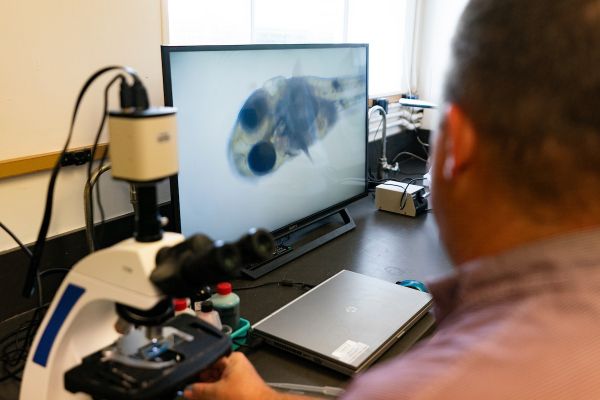

In 2025, the lab completed 149 diagnostic cases across Texas and 14 states as far away as Maine. Those cases supported the management of nearly 10,000 acres of private waters, with an estimated resource value exceeding $26 million.
"We've distinguished ourselves by listening to stakeholders and offering tests critical to pond owners that can't be found elsewhere," said Todd Sink, Ph.D., AgriLife Extension aquaculture specialist and director of the Aquatic Diagnostics Laboratory, Bryan-College Station.
"It's estimated there are between 30,000 and 40,000 new ponds constructed in the state each year — it's critical that pond owners know they have access to the tools and knowledge necessary to tend these resources and achieve their management goals."
Sink is also a professor in the Texas A&M Department of Rangeland, Wildlife and Fisheries Management, where the lab is housed.
Providing detailed guidance from diagnosis to treatment
Currently, the lab offers 13 different testing packages comprised of more than 80 test options and services supporting fisheries and aquaculture, water quality, and parasitology and bacterial histopathology.
The lab is also one of the only facilities in the state capable of testing for cyanotoxins — harmful toxins produced by certain algal blooms that can threaten fish, animal and human health.
Rather than delivering raw laboratory data alone, staff provide detailed interpretations of test results, translating numbers into understandable and actionable management recommendations tailored to each pond or aquaculture operation.
"In a way, we fill the role of doctor and pharmacist," Sink said. "Following diagnosis, we give the prescription for how to fix the issue — we explain everything in the report, then calculate and recommend several different options for remediating the problem."
This personal, detailed approach is one reason the lab maintains a substantial and established client base.
"In so many ways, we owe the success of our ponds to Dr. Sink and lab staff," said Terrell McCombs, a lab patron and pond owner in DeWitt County. "From guidance on fish stocking and management to vegetation identification and control, the laboratory staff has been unbelievably helpful."
The personal site visits and laboratory services are complemented by AgriLife Extension's broader AquaExtension programming, which includes educational webinars, fact sheets and more. McCombs said these resources have helped him and his wife address existing issues while staying one step ahead of potential problems.
Sink said the lab also works closely with pond management companies to provide tests and services they may not be able to access otherwise.
Expanded lab offerings to better serve an evolving Texas
Brittany Chesser, AgriLife Extension aquatic vegetation program specialist and lead diagnostic scientist, also supports the lab.
Chesser performs water quality analysis, helps clients understand the nutrient processes and issues occurring within their pond, and provides practical management recommendations.
In 2024, the laboratory expanded its diagnostic expertise and capacity with the addition of Haitham Mohammed, Ph.D., AgriLife Research assistant professor of fish health and disease management in the Department of Rangeland, Wildlife and Fisheries Management.
Sink said Mohammed's research specializations of virology, veterinary bacteriology and aquatic microbiology strengthen the laboratory's ability to provide a "complete package" of knowledge and tools to steward aquatic resources and continue to support the state's expanding aquaculture industry.
"We built this program by listening to landowners and industry," he said. "As new risks emerge, our responsibility is to ensure Texans have access to reliable, science-based solutions for private waters."