
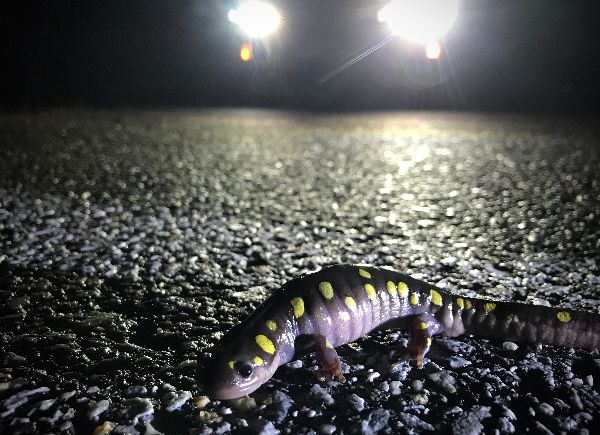
MONTPELIER, Vt. – Vermont Fish and Wildlife is asking drivers to slow down and be cautious when travelling at night in early spring or to take alternate routes to avoid driving roads near wetlands and ponds that salamanders and frogs cross during their breeding season.
Every year, typically in early spring, many of Vermont's amphibians leave their overwintering sites and migrate to the wetlands and ponds where they will breed and lay eggs. The timing of this annual event, termed Big Nights, coincides with melting snowpack, thawing soils, relatively warm evening temperatures, and rainfall.
If you are trying to predict a Big Night, pay attention to the forecast and look for nights with consistent rainfall and temperatures above 40 degrees Fahrenheit after snowmelt has given way to patches of bare ground and ice out has provided access to wetlands and ponds.
"One of the benefits of checking out amphibian road crossings," says Fish and Wildlife herpetologist Luke Groff, "is that you can see many individuals and species in a short period and in a small area, and some species may not be seen the rest of the year."
The spotted and blue-spotted salamanders, for example, belong to a group referred to as "mole salamanders," because after breeding, they retreat underground or under logs or stumps and may not be seen until next spring.
Groff is encouraging Vermonters to explore the roads near their homes and report amphibian road crossings to the Vermont Reptile and Amphibian Atlas. Vermonters can also contact organizations like Bonnyvale Environmental Education Center, The Hartford Salamander Team, and North Branch Nature Center to learn more about coordinated crossing programs in our state.
If it is safe to take pictures of the migrating amphibians, please include them in your report. This information is used by Fish and Wildlife, the Agency of Transportation and other conservation partners to assess the need for wildlife passages and barriers that allow all wildlife, not just frogs and salamanders, to more safely cross roadways.
Vermonters who wish to contribute to the Fish and Wildlife Department's work to conserve frog and salamander populations can donate to the Nongame Wildlife Fund on their state income tax form or on the Vermont Fish and Wildlife website.