
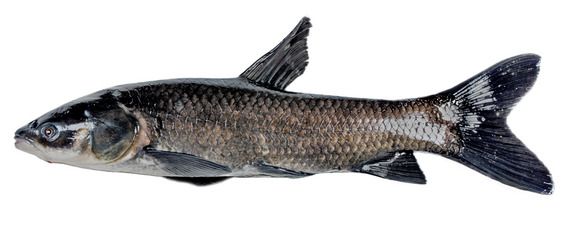
The Oklahoma Department of Wildlife Conservation (ODWC) confirmed the first report of a Black Carp (Mylopharyngodon piceus) within a private pond in McCurtain County. Black Carp are one of the four invasive carp species (i.e. Bighead Carp, Silver Carp, Grass Carp, Black Carp) native to Asia and found within the United States. They were imported into the United States in the 1970s and 1980s as a biological control agent for snail pests in aquaculture ponds. By the 1990s, Black Carp had escaped captivity and were found in natural waters in the Mississippi River Basin where natural reproduction has been documented.
Black Carp are benthic molluscivores that stay close to the bottom of the water column feeding on mussels and snails. They have strong pharyngeal teeth that they use to crush mollusk shells. Black Carp have the potential to seriously impact already imperiled native mussel species and may compete for food resources with other native benthic fishes including Smallmouth Buffalo.
The Illinois Department of Natural Resources launched a bounty program in 2015 to encourage reports of invasive Black Carp and gather initial data from Illinois and nearby waters. Currently, the U.S. Fish and Wildlife Service and the Illinois Department of Natural Resources are tracking the spread of invasive Black Carp across the Mississippi River Basin through the "Keep, Cool, Call" initiative. As part of this effort, anglers in Oklahoma can earn a $100 reward for each fish reported, with a maximum of 10 fish per month eligible for submission. Outside of Oklahoma, the majority of these fish have been caught incidentally when commercial fishers are harvesting other target species. Less than 1% of Black Carp harvested under the bounty program have been caught with recreational fishing gear. You can learn more about the bounty program here.
Other non-native species, including Grass Carp and Common Carp, and native Blue Sucker, Bigmouth Buffalo, Black Buffalo, and Smallmouth Buffalo have been misidentified as Black Carp. Grass Carp tend to be the most common, particularly in ponds where they are regularly stocked as a method for aquatic plant management. Please reference materials for identification prior to euthanizing suspected Black Carp.
Anyone who catches a fish that they believe is a Black Carp should humanely dispatch the fish and keep it on ice. Transporting live invasive carp is illegal in Oklahoma, so the fish must be dead before moving it. Make note of the location (preferably GPS coordinates), the type of fishing gear and bait used, and habitat conditions such as depth, water temperature and current conditions. Photos of the fish's head and mouth as well as total length and weight will be required.
Contact Erika Sarvela, ODWC Invasive Carp Biologist, at erika.sarvela@odwc.ok.gov or call (580) 596-8025 or (918) 200-4815 for fish identification and to submit your entry. Anglers are highly encouraged to keep the carp frozen or on ice so ODWC can arrange to pick up the fish for analysis.