
Michigan wildlife researchers are preparing to conduct the second phase of a collaborative study that aims to figure out why the Upper Peninsula moose population remains stubbornly stagnant.
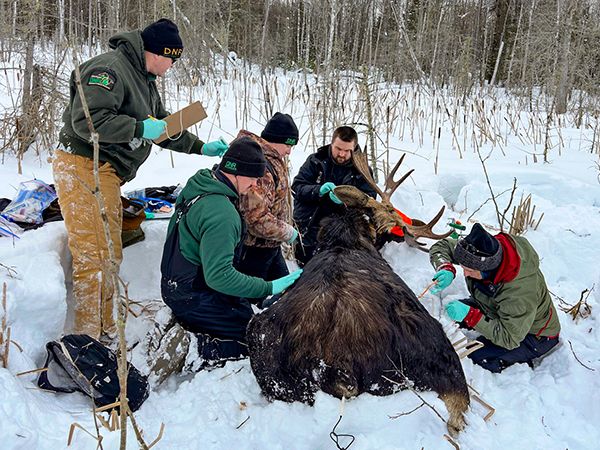
This month, researchers from the Michigan Department of Natural Resources, Keweenaw Bay Indian Community and Northern Michigan University plan to capture up to 43 moose from the animals' core range in the western U.P. and outfit them with GPS tracking collars. In the project's first phase, in early 2025, 20 moose were captured and collared.
The first year of collar data and corresponding drone surveys are providing critical information. Researchers have learned, for example, that 17 of the 20 collared moose are still alive. That eight out of 10 collared females were pregnant and gave birth to 11 calves. And that one moose was killed by a vehicle, two by predators and one by unknown trauma.
Data from the upcoming capture will provide even more insights into why the moose population hasn't reached the 1,000 mark as researchers had hoped when moose were reintroduced to Michigan in the mid-1980s.
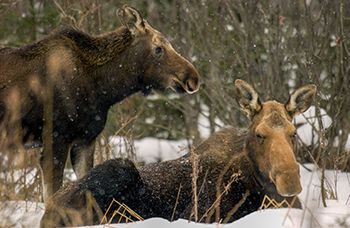
The core moose population is estimated at about 300 animals, based on the DNR's biennial aerial survey of the core moose range in Marquette, Baraga and Iron counties in 2025. That's down from an estimated 426 moose in the 2023 survey. It's not clear, however, whether the lower estimate reflects a population decline, a shift in moose distribution away from historically surveyed areas or a combination of both.
"We're attempting to identify the potential factors that are most likely affecting Michigan's moose herd, including disease, nutrition, reproduction, predation, vehicle collisions and habitat alteration," said Tyler Petroelje, northern Michigan wildlife research specialist for the DNR. "This collaborative research will help us understand the cumulative or compounding effects these factors are having on moose population growth."
Moose predators in the U.P. include wolves and black bears, which primarily target vulnerable calves and weakened adults. Vehicles also pose a risk to the iconic animals; at least 60 moose have been killed in U.P. crashes in the past four years. And moose are susceptible to winter ticks – a single moose can carry up to 100,000 ticks in one season. And while winter ticks do not carry disease, the blood loss, skin irritation and hair loss can be fatal, especially during cold winters.
The research project is funded by the DNR and KBIC, with staff and support from NMU. Only about 1% of project funding comes from the Game and Fish Fund, which is supported by hunting and fishing license sales. The majority of funding comes from federal conservation grants, tribal partnerships and university resources.
KBIC has secured a $684,112 grant from the Bureau of Indian Affairs to support the moose capture and research project for two more years. The funding, which comes through the Great Lakes Restoration Initiative's Distinct Tribal Program, will support field work in 2027 and 2028 and allow the project team to bring on an additional graduate student, expanding research capacity. Continued funding also enables longer-term monitoring of collared moose, which is critical for improving understanding of survival, reproduction and movement over time.
"We hope this effort will lead to a better understanding of what is or is not impacting the long-term sustainability of the Michigan moose population," said Erin Johnston, wildlife and habitat manager for KBIC's Natural Resources Department.
Johnston, who played a key role in securing the new grant, said the partnership between the tribal community, the state and academia bolsters the effort to study and manage moose in Michigan.
"Many times we have similar goals or desired outcomes for wildlife stewardship and management," she said. "We may not always approach the situation in the same way or from the same perspective, but that is what strengthens the collaboration – bringing different experiences, knowledge, perspectives and expertise to the table to explore the natural world."
During the capture operation, spotter planes will report moose locations to nearby helicopters and ground crews. Moose will be sedated, and crews will move in quickly to collect biological information and fit the moose with a tracking collar.
The captures will take place Feb. 13-21 – depending on weather and other conditions – within the moose range in an approximately 500-square-mile block in the Michigamme Highlands.
Project researcher Diana Lafferty is an associate professor of biology and director of the Wildlife Ecology and Conservation Science Lab at NMU. She noted that the project not only provides useful information on the moose population but also benefits up-and-coming wildlife researchers.
"I'm grateful NMU provides graduate student support (i.e., tuition and fees) as well as faculty support for this exciting collaboration that brings together diverse people who have myriad perspectives and expertise in a shared effort to gain a holistic understanding of the factors limiting moose population growth in the U.P.," Lafferty said.
"I'm really proud to be part of a team that values the coupling of research and education to strengthen our knowledge about the nature world while simultaneously helping to train the next generation of leaders in wildlife conservation and management."
Check out previous Showcasing the DNR stories in our archive at Michigan.gov/DNRStories. To subscribe to upcoming Showcasing articles, sign up for free email delivery at Michigan.gov/DNREmail.