HOT SPRINGS — Lake Ouachita anglers dusting off their fishing rods as the winter thaw begins have 77 new reasons to hit the water. Last December, the Arkansas Game and Fish Commission and the Army Corps of Engineers completed a massive joint project, deploying dozens of new fish attractor sites over a two-week period.
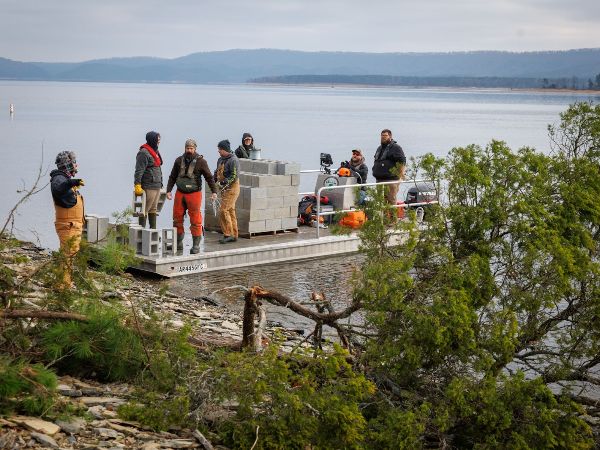
The operation was a major undertaking, involving roughly 35 personnel and five habitat barges.
"We launched out of Crystal Springs, and we really appreciate the marina workers there for letting us tie up between work days," said Andy Yung, AGFC fisheries supervisor in Hot Springs. "It saved us from having to deadhead between boat ramps and parking facilities every evening."
Working with Corps oversight, teams removed hundreds of invasive cedars from the shoreline to create the habitats. Yung stressed that cutting trees on Corps land is strictly prohibited without prior authorization, and the team was careful to place the brushpiles where they would not interfere with boat navigation.
"We targeted about 15 feet of water when the lake was 8 feet low," Yung explained. "That means most of these brushpiles will sit in the 20- to 25-foot range during most of the year."
While the crew removed the occasional sycamore or sweetgum, more than 90 percent of the piles consist of large, invasive cedars. Beyond the ecological benefit of their removal, cedars make for superior fish habitats. Their complex network of branches and twigs creates a labyrinth for baitfish and the perfect ambush cover for predators.
"One of our staff members who dives in Ouachita calls these brushpiles 'gold mines,'" Yung said. "Walleye, bass, crappie, bluegill and catfish use them year-round. You'll even see the occasional striper wandering by the ones near the channels."
These sites are also built to last. Unlike recycled Christmas trees, these large cedars — some with 12-inch-diameter trunks — provide a durable structure that remains effective for years.
The project was one of the AGFC's largest habitat efforts last winter. Each day, at least a dozen participants cut trees, hauled them to the water, and secured cinder blocks to sink them. The work was so intensive that Yung noted they actually wore out both outboards on one of their heavy barges.
"It was a great partnership," Yung said. "The Corps didn't just help us select trees; they were right there alongside us sinking the piles."
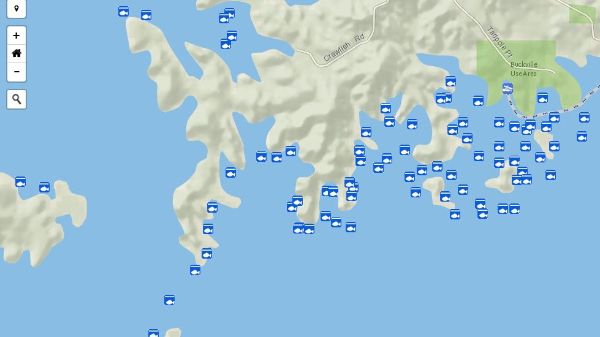
Nearly all of the new sites are located between Island Markers 28 and 36, specifically on main lake points and saddles near the mid-lake islands.
The GPS coordinates for all placed fish attractors are available on the AGFC's interactive map at www.agfc.com/maps. Anglers also are encouraged to download coordinates right to their fishfinders by visiting www.agfc.com/fishattractors. Seventy-six lakes and thousands of fish attractor locations are represented there.