
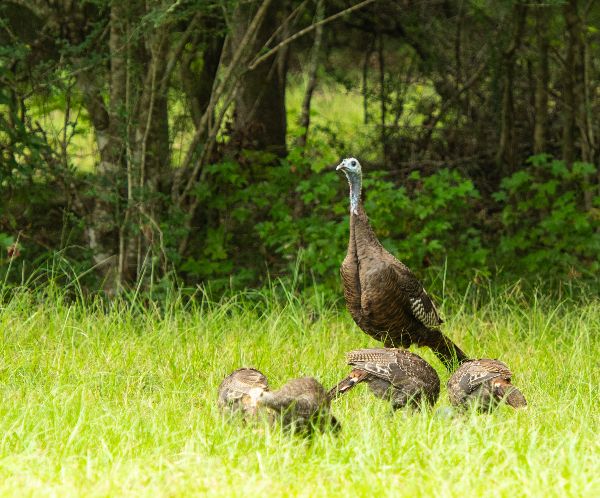
Takeaways from the ongoing wild turkey nesting and land management research efforts in the Lone Star State.
One hen attempts to nest, and another doesn't. Why is that so? This hen nests successfully consistently while another never does. What are the differences? These and many more are questions that TFT-funded research is looking to address. Read on for an overview of some important takeaways.
About the Research
This project, partially funded by TFT, was initiated as a pilot study in February 2025. It involved the capturing of 15 Rio Grande hens and backpack tracking them. The property was and continues to be managed extensively for predators.
Furthermore, this project has been largely overseen by Dr. Nicholas Bakner with the University of Delaware. (When it started, he was a post-doctoral research associate at Tennessee Tech University, working in unison with TFT, LSU, and TPWD.)
"We have GPS locations on these birds within 15 meters of error," Bakner said. "We're within 15 meters of that bird with each data point. Now, we can have more accuracy with nesting locations.
"As it looks from the GPS points, they became concentrated, and whenever those points become concentrated, they stick into an area," Bakner continued. "This is very easy to identify as nesting."
Observation No. 1: Spring Hen Dispersal Mimics a Shotgun Pattern
Each year, hens disperse from winter flocks and establish nesting areas. While habitat structures can impact how and where this occurs, more times than not, it looks a consistent and specific way.
"Around mid-March, you started seeing these birds disperse away from their flocks in a shotgun blast pattern," Bakner said. "This is pretty typical with Rios and eastern wild turkeys. Hens are more or less dominant, and they just want to get away from everybody and nest."
Observation No. 2: Most Hens Didn't Nest Successfully
According to Bakner, around the beginning of April, hens began initiating nests. Of the 15 hens, five of these initiated and successfully nested. Bakner says several other hens appeared to attempt nests but failed. The remaining hens didn't seem to attempt to nest at all.
Observation No. 3: Some Hens Didn't Even Attempt to Nest
A portion of the tracked hens did not seem to nest at all. Bakner believes these were most likely juvenile females.
"Juvenile females typically don't nest the first year," Bakner said. "If they do, it's later in the year."
Observation No. 4: Hens Can Re-Nest Multiple Times (If Needed)
While the re-nesting data with the Texas research is still being analyzed, other research efforts sing a steady tune.
"Oftentimes, wild turkeys can nest multiple times (if needed)," Bakner said. "We had birds in Louisiana nest up to four times."
Observation No. 5: Predator Management and/or Human Presence Seem to Impact Nesting Location Selection
It's highly logical that predator management of nest predators and larger animals that consume wild turkeys positively impacts nesting success. However, while traditionally viewed as a negative, it seems that human presence might also have desired impacts on nesting location selection and overall production.
"These birds aren't nesting far from roadways (trails, four-wheeler paths, gravel roads, etc.)," Bakner said. "They're sticking to the roads. This could be indicative of the predator management program being conducted on the property."
Bakner also points to a different possible correlation. "We found that, with grouse and other species on fracking sites in North Dakota, more human activity deters predators," Bakner said. "Maybe these areas are places that birds are inhabiting because of the human activity. It's weird to think that human activity could actually buffer predators, but it's possible."
Bakner also mentions his brother's work in Rhode Island, who is working with and tracking birds in suburban areas. These turkeys are living daily in close proximity to people.
"These suburban turkeys are doing wonderful," he said. "It's the ones in the forests and on the WMAs that are getting killed."
Observation No. 6: Hens Take Incubation Breaks
There were revelations in feeding breaks in relation to incubation behavior. This helped sustain them for the long durations associated with nesting and brooding.
"They were traveling a good ways off of the nest," Bakner said. "A host of my papers have found that incubation recesses are important to these females.
"They'll take incubation breaks to go forage," he continued. "They travel off the nest, oftentimes using some of the management technique strips that were mowed, which provided the disturbed habitat needed to go in, get insects, forbs, and other food sources on the ground."
Observation No. 7: Hens That Choose Feeding Areas Further from Nesting Sites Are More Successful
According to Bakner, his research and published papers have shown that it's better for hens to move greater distances between food sources and nesting areas. Those that feed further from the nest tend to experience greater nest success.
"If hens move further off of the nest, they're actually taking those predation cues away from the nesting site," he said. "Most of your predators are olfactory-driven. You don't want all your smells at the nest. So, you want that opportunity to go out there and forage.
"From what I'm seeing with the GPS data, and knowing a little bit about the area, that's what the management practices on this property are supporting," he continued. "Plus, there are water sources, and everything that birds need to survive there."
Observation No. 8: Juvenile Hens Might Observe Nesting Behavior of Older Hens
Finally, it seems plausible that juvenile hens might observe nesting behaviors of older birds.
"An interesting point in science that we're looking at — do these juveniles watch the adult females and then go to prospected areas that were successful in nesting?" Bakner said.
In short, do they learn from their mothers, or other adult females in the flock? That's something that Bakner hopes to confirm or debunk in future chapters of this research effort.
Additional Questions Bakner Hopes to Answer with Ongoing Research
What was the final nesting success rate?
Bakner and his team are still analyzing much of the data from 2025 and hopes to have conclusive determinations soon.
How many hens attempted re-nesting, and in doing so, how many times?
This is also information of interest. As they continue processing data, these numbers should become clearer.
How does intensive predator management impact nesting success?
Once data is completely assessed, this research effort will compare data sets produced on two different properties — one that's intensively managed for predators, and one that isn't managed at all.
What happens to wild turkey reproduction during really wet and drought years?
This is something Bakner feels should already be solved. However, we now have advancing technology and more fine skill data. We're not using VHF transmitters anymore, where you had to triangulate and predict. Today, it's all GPS.
Support TFT
Wild turkey populations are on the decline throughout the nation. Established in 2021, TFT is new to the landscape, but it's driven by highly trained professionals with decades of conservation experience. To support TFT, and the complete body of wild turkey research and conservation it's leading, become a member today. An Adult Annual Membership is $50, multi-year Team Turkey Membership is $250, and Life Membership is $2,500. Every dollar counts in the fight for wild turkey preservation.