The Gulf Council is developing an Amendment to establish electronic reporting requirements for federal for-hire reef fish and coastal migratory pelagic vessels. The Council invites public feedback through virtual hearings on August 13 and 17, 2026, where vessel owners and operators can learn about proposed trip declarations, electronic reports, and economic data submissions.
FISHERIES
Montana Fish, Wildlife & Parks implemented hoot-owl fishing restrictions and one complete closure beginning July 15 on the Big Hole, Gallatin, East Gallatin, Jefferson, Madison, and Ruby Rivers in response to warming water temperatures that threaten trout survival.
Utah's Blue Ribbon Fisheries program allocated over $446,000 toward 13 projects to enhance 41 designated waterbodies. Key projects include Jordanelle Reservoir habitat enhancement with Utah State Parks and Muskies Inc., Panguitch Lake hypolimnetic siphon installation, and Duchesne River bank restoration, funded through fishing license sales and partnerships.
Idaho Fish and Game will close Chinook salmon fishing on the Upper Salmon River from Valley Creek to the Sawtooth Hatchery weir at the end of fishing hours on July 15. Fishing remains open on the Lochsa River and South Fork Salmon River.
NOAA Fisheries announces federal waters 9 to 200 nautical miles off Texas will reopen to shrimp trawling on July 15, 2026, at 30 minutes after official sunset. The closure allows brown shrimp to reach larger, more valuable sizes and prevents waste of undersized catch.
Idaho Fish and Game released approximately one million kokanee fingerlings in June from its first captive broodstock program, which raises kokanee to adulthood in hatcheries to stabilize annual stocking numbers. The program, managed by State Hatchery Production Manager Beau Gunter, aims to eventually produce three million fingerlings annually and was modeled after the successful sockeye salmon hatchery program.
Beginning July 8, the Chinook salmon fishing season on the South Fork Salmon River will increase from four days per week to seven days per week to increase the likelihood of reaching the harvest share as water levels drop and temperatures rise.
The North Dakota Game and Fish Department stocked nearly 12 million walleye fingerlings statewide, with approximately 11 million raised at Garrison Dam National Fish Hatchery and 1.1 million at Valley City National Fish Hatchery. Additionally, 1.1 million northern pike fingerlings were stocked into 37 waters statewide.
Montana Fish, Wildlife & Parks implements hoot-owl restrictions starting July 11 at 2 p.m. on the Sun River, Lower Madison River, Madison River above Hebgen Reservoir, and Lower Beaverhead River. Fishing is prohibited from 2 p.m. to midnight daily to protect fish during warm water temperatures that increase disease susceptibility.
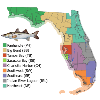
The 2026 recreational bay scallop season in Pasco County opens July 10 through August 18 in state waters south of the Hernando-Pasco County line and north of Anclote Key Lighthouse. Harvesters must follow daily bag limits of two gallons whole scallops or one pint of meat per person, with vessel limits of 10 gallons or four pints per day. A Florida saltwater fishing license is required unless exempt or wading from shore.
The Florida Fish and Wildlife Conservation Commission is holding virtual workshops on July 14 and 16 to gather public input on proposed saltwater fishing regulations for cownose rays, including recreational and commercial bag limits. FWC staff will recommend final rules to the Commission in August based on feedback received.
Montana Fish, Wildlife & Parks biologists led by Sam Bourret used otolith geochemistry to identify which Swan River basin tributaries produce the most surviving bull trout, revealing that redd counts alone don't accurately predict population contributions and providing crucial data for targeted conservation efforts.
The Gulf Council will hold a meeting of its Standing and Shrimp Scientific and Statistical Committees on July 21-22, 2026, in Tampa, Florida. The SSC will review new methodologies for estimating shrimp trawl bycatch, discuss the Fisheries Integrated Modeling System peer review results, and examine Gulf king mackerel landings and tilefish data.
The Maryland Department of Natural Resources and Old Dominion University report record-low hypoxia volumes in the Chesapeake Bay mainstem from May to late June 2026, with drought conditions reducing nutrient pollution. Early June recorded the lowest hypoxic volume ever measured for that period, with conditions aligning with the Chesapeake Bay Program's seasonal forecast predicting hypoxia 31% below long-term average.
The Gulf Council seeks a qualified contractor to evaluate 40 species under Gulf Fishery Management Plans and determine whether each should remain under full federal management, be removed, or designated as ecosystem component species. The project has a maximum budget of $125,000 with completion expected by Summer 2027.
Payette Lake's kokanee population is experiencing lower abundance this year, but the fish are larger than usual. Idaho Fish and Game's lake trout suppression program and renewed kokanee stocking efforts since 2018 have successfully rebuilt the fishery from near-total collapse, with managers now evaluating stocking strategies and natural reproduction to maintain long-term sustainability.
A substantial fish kill affecting all species occurred at Timber Point Wildlife Management Area in Butler County, Nebraska. Nebraska Game and Parks Commission biologists confirmed extremely low dissolved oxygen levels caused by an algal bloom die-off. The Lower Platte South Natural Resources District manages the WMA.
The Utah Division of Wildlife Resources issued emergency changes effective July 2 to increase daily fishing limits at seven waterbodies including Pineview Reservoir, Minersville Reservoir, and Otter Creek Reservoir due to low water levels from construction projects and drought impacts. DWR Director Riley Peck stated the changes aim to allow anglers to harvest additional fish so they are not wasted.
Florida's 2026 recreational bay scallop season opens July 1 through September 24 in Franklin County, northwestern Taylor County, and portions of Levy, Citrus, and Hernando counties. Daily bag limits are two gallons of whole scallops or one pint of meat per person, with vessel limits of 10 gallons whole or four pints shucked per day. Harvesters must follow safety regulations and possess a Florida saltwater fishing license.
The Arkansas Game and Fish Commission's Legacy Lunker program completed its first year by stocking approximately 295,000 fingerlings spawned from angler-donated trophy bass across Arkansas lakes. The fingerlings were produced through collaboration with Red Hills Fishery in Georgia and stocked alongside 2 million additional largemouth and Florida bass from AGFC hatcheries.