
HELENA – Looking for a fall destination? There are several state parks that are spectacular this time of year. Whether you're looking for fall colors or just a pleasant place to celebrate the change of seasons, Montana's state parks have something to offer.
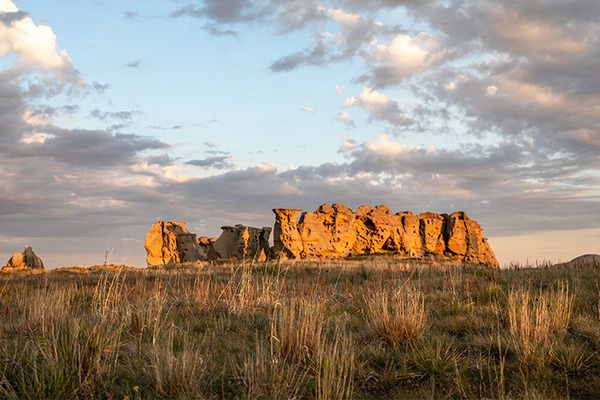
Medicine Rocks State Park in southeastern Montana is a great place to visit this time of year.
"Medicine Rocks is a very nice park throughout the year, but especially in the fall," said Riley Bell, Region 7 recreation manager. "It's very peaceful this time of year. Not a lot of visitation happening so you may have the park to yourself. Nice little spot even for a day trip to get away and be in nature."
Weathering has given the soft sandstone rock formations a Swiss cheese look providing a fascinating landscape filled with meaning and serenity. Visitors can witness thousands of inscriptions on the sandstone pillars dating back centuries.
Another highlight of Medicine Rocks in the fall is the night sky. The nights are longer and a couple meteor shower events will be happening – around Oct. 8 and Oct. 28. The International Dark-Sky Association officially designated Medicine Rocks State Park as a certified International Dark Sky Sanctuary. Medicine Rocks State Park and Glacier National Park are the only certified dark sky sites in the state of Montana. The association promotes night skies that are minimally impacted by human light sources.
"As fantastically beautiful a place as I have ever seen," said one of its first tourists in the late 1800s, a young rancher named Teddy Roosevelt.
The aspen groves at Lost Creek State Park are phenomenal this time of year. This park, near Anaconda, also features spectacular grey limestone cliffs, and pink and white granite formations rise 1,200 feet above the canyon's narrow floor. Lost Creek Falls, in the northwest corner of the park, cascades over a 50-foot drop to provide one of the most scenic and popular spots in the park. Wildlife, golden eagles and bighorn sheep are frequently seen on the cliffs above, and pika are often seen and heard in the rock piles in the upper park. Camping, fishing, picnicking, bicycling and wildlife viewing are available.
Who wouldn't want to visit a ghost town this time of year? Granite Ghost Town State Park, near Philipsburg, showcases remnants of this once thriving 1890s silver boomtown that bears stark witness to Montana's boom-and-bust mining history. Hector Horton first discovered silver in the general area in 1865. In the autumn of 1872, the Granite mine was discovered by a prospector named Holland. The mine was relocated in 1875. This was the richest silver mine on the earth, and it might never have been discovered if a telegram from the east hadn't been delayed.
The miner's backers thought the venture was hopeless and ordered an end to its operation, but since that message was delayed the miners worked on and the last blast on the last shift uncovered a bonanza, which yielded $40,000,000.
In the silver panic of 1893, word came to shut the mine down. The mine was deserted for three years, never again would it reach the population it once had of 3,000 miners. Today there is no one living in the camp. The state park preserves the Granite Mine superintendent's house and ruins of the old miners' Union Hall, which have been included in the Historic American Buildings Survey.