
TFT celebrates extensive efforts to conserve big-woods wild turkeys in the Northeast
Turkeys for Tomorrow (TFT) is excited to announce conservation efforts underway in Pennsylvania's Weiser State Forest. It's an effort to save wild turkeys and other big-woods game birds of the Northeast.
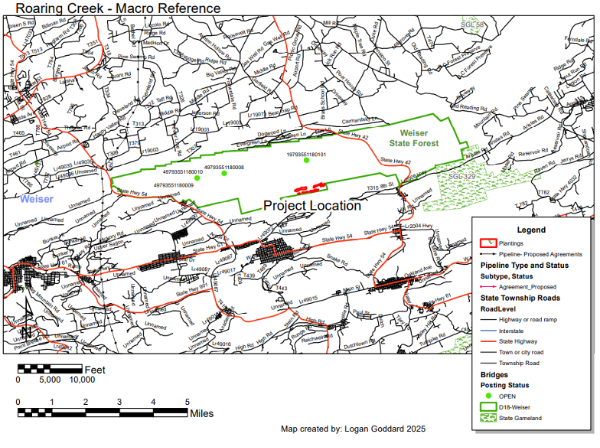
This project is in cooperation with Turkeys for Tomorrow, Ruffed Grouse Society (RGS), and the American Woodcock Society (AWS) on Weiser State Forest. As shown in the project maps, the conservation effort will take place on the south-central side of the state forest east of Weiser.
Introducing the Big Mountain Conservation Project
According to RGS and AWS Pennsylvania Forest Conservation Coordinator Aaron Lewis, Roaring Creek is one of the few remaining locations in the state forest that offers the opportunity to flush grouse. This is in part due to a history of controlled burns, wildlife openings, and lower numbers of mosquitos.
Lewis' project report says that, in recent years, ruffed grouse have suffered because of West Nile Virus. It is spread by mosquitoes. The disease results in a 90% mortality rate in poults. In some areas, turkeys are following similar trends.
The Pennsylvania Game Commission developed the Grouse Priority Area Siting Tool (G-PAST) as a means of allocating resources to areas with lower mosquito intensity and improved poult survival. The upcoming project will overhaul G-PAST Priority 3 areas, as well as adjacent surroundings, into quality feeding, nesting, and brood-rearing habitat.
Ruffed grouse and wild turkeys utilize multiple different habitats throughout the course of a year. Thus, it's crucial to prioritize multiple habitat phases. Some of these must be created or promoted approximately 15-20 years before needed by these animals. This is pivotal for poult survival and adults to flourish.
According to the original project proposal, the last timber harvest that occurred along the Big Mountain ridgeline was in 2007. Now, approximately 18 years later, this area is aging out of the succession phase required by these species.
Lewis says that, as shown in the map reference, there is a series of conifer plantings along Black Trail within the state forest. This area serves as a base for thermal cover, around which more viable habitat can be created.
Interestingly, although it has multiple biking and hiking trails, this remote area is three miles from the nearest parking lot. Thus, it stands to become excellent refuge cover for grouse, wild turkeys, and other wild animals.
"This project can be broken down into three parts," Lewis said. "The first part is the mechanical cutting of the woody plants, which will be completed by December 2026. In some areas, this is to stimulate tree growth that will create a dense understory. These areas will become two-aged forests, one with a tall overstory and a dense midstory. No additional work is needed in these areas after the cutting.
"In other areas, this cutting is to prep for an herbaceous opening," Lewis continued. "In the spring and summer of 2027, these areas will be sprayed with an herbicide. Herbaceous seeds will be spread in the fall of 2027 or spring of 2028 to complete the project."
Felling, spraying, and plantings will help achieve the stated goals. Felling and spraying will be done by contractors, and seeding will be completed by DCNR employees outside of grant compensation.
Why Are Grouse and Turkey Conservation Organizations Working Together?
If you're a TFT member, or came here for the wild turkeys, you might wonder, why are grouse and turkey conservation organizations working together? Furthermore, why so much talk about upland birds?
Simply, ruffed grouse, American woodcock, and wild turkeys thrive in much the same habitat. What helps one, helps the other, and vice-vera. Therefore, it only makes sense for the two organizations to work together and pool resource, especially in overlapping target inhabitation regions.
"We were honored to have our local Pennsylvania TFT Flocks wanting to give back to their community, and this is why we have a project in play at Weiser," said TFT CEO Jason Lupardus.
A Memorandum of Understanding Between TFT and Ruffed Grouse Society (RGS)
This statement of understanding is not a merger, financial partnership, or anything else beyond a combined effort for this specific conservation project.
"This project was member-driven by one of RGS's local chapter leaders," Lewis said. "This member initiated the conversation with the Bureau of Forestry, who provides the technical expertise to create a project plan. RGS is contracting with local contractors to complete the planned work. RGS is funding the two-aged forest work, and TFT is funding the herbaceous openings creation."
According to the project framework, "This MOU establishes cooperation between partners to provide joint planning and accomplishment of mutually beneficial conservation efforts for on-the-ground projects, wildlife management, research activities, education, outreach, and/or policy-driven action. Partners seek to join conservation networks and collaborate on habitat improvement projects for impactful solutions at a landscape scale for management dependent species … This partnership is limited to the funding of herbaceous openings of the Big Mountain Big Bird Betterment project by TFT and limited to $6,000. RGS will administer the TFT funding and will be responsible for ensuring the herbaceous openings meet the specifications set by the Pennsylvania Bureau of Forestry."
What We Hope to Achieve in the Weiser State Forest
TFT, RGS, and AWS each hope to achieve a series of objectives with the project scheduled for the Weiser State Forest.
"Early weed communities are great for grouse and turkeys when managed correctly," Lupardus said. "This is why TFT supports restoration efforts that align for multiple species."
"The goal of this project is to increase the amount of young forest habitat and herbaceous openings on the Roaring Creek tract of the Weiser State Forest," Lewis said. "As a young forest ages, the structure and habitat of that forest changes in a way that some wildlife species find to be no longer suitable.
"By creating young forest patches nearby, the landscape becomes a mosaic of habitats, where multiple forest types and age-classes can be utilized by various wildlife species," Lewis said. "Since forest are dynamic and constantly growing and changing, this mosaic is constantly shifting. In this situation, a 15-year-old timber sale is approaching its end of suitability for grouse, woodcock, and other wildlife that thrive in young forests. Creating young forests and herbaceous openings nearby will provide habitat for these species to further utilize and eventually shift their populations to."
Support TFT
Wild turkey populations are on the decline throughout the nation. Established in 2021, TFT is new to the landscape, but it's driven by highly trained professionals with decades of conservation experience. To support TFT, and the complete body of wild turkey research and conservation it's leading, become a member today. An Adult Annual Membership is $50, multi-year Team Turkey Membership is $250, and Life Membership is $2,500. Every dollar counts in the fight for wild turkey conservation.