
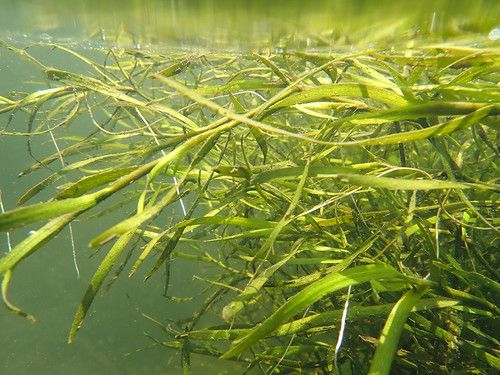
Gains add more than 4,600 acres of critical Chesapeake Bay habitat
Underwater grass abundance increased in the Chesapeake Bay and its tidal tributaries last year. In Maryland's portion of the Bay, underwater grass coverage expanded from 36,799 acres in 2024 to 41,419 acres in 2025, an increase of nearly 13% in a single year. Bay-wide, SAV acreage reached an estimated 89,385 acres – up 7% from 83,252 acres in 2024.
The 2025 acreage represents about 36% of Maryland's 114,065-acre restoration target, demonstrating meaningful progress while underscoring the opportunity for continued recovery.
The annual underwater grass survey is conducted by the Virginia Institute of Marine Science (VIMS), which maps submerged aquatic vegetation, or SAV, throughout the Chesapeake Bay and its tidal tributaries annually. VIMS also produces a report for Virginia's portion of the Bay.
"More underwater grass means more habitat for blue crabs and fish, cleaner water, and a more resilient Chesapeake Bay," said Maryland Department of Natural Resources Secretary Josh Kurtz. "This year's increase is welcome progress, but it also reinforces the work ahead. We need to keep reducing pollution, protecting existing underwater grass beds, and restoring the shallow-water habitats that allow these plants and the Bay life that depends on them to thrive."
Submerged aquatic vegetation beds are among the Chesapeake Bay's most valuable shallow-water habitats, providing food, shelter, and nursery grounds for fish, blue crabs, waterfowl, and other wildlife. They improve water quality by absorbing nutrients and trapping suspended sediment, add oxygen to the water through photosynthesis, help stabilize bottom sediments, and reduce shoreline erosion.
The underwater grass beds also store carbon and can help buffer the effects of coastal acidification, an important benefit to Maryland's shellfish industry. Because these underwater grasses require clear water to survive, their abundance and distribution are closely tied to water quality. Their ability to respond relatively quickly to both improving and deteriorating conditions makes SAV one of the Bay's most important indicators of ecosystem health.
"What is especially encouraging about 2025 is that the gains were not confined to one place," said Brooke Landry, SAV program chief for Maryland DNR and chair of the Chesapeake Bay Program SAV Workgroup. "We saw expansion in both freshwater and moderately salty parts of Maryland's Bay waters."
Tidal Fresh and Oligohaline: Freshwater grasses continue recovery
Maryland's tidal fresh and low-salinity waters gained a combined 1,059 acres of SAV in 2025.
Seven Maryland river or Bay segments met or exceeded their SAV restoration goals last year. These included:
- Northern Chesapeake Bay segment 1 at 102% of its 754-acre goal;
- North East River – 179% of its 89-acre goal
- Upper Chester River – 531% of its 1-acre goal
- Upper Sassafras River – 275% of its 95-acre goal
- Bush River – 158% of its 350-acre goal
- Upper Gunpowder River – 107% of its 572-acre goal
- Back River – 712% of its 30-acre goal
Two additional freshwater segments were close to their restoration goals:
- Northern Chesapeake Bay segment 2, which includes the expansive Susquehanna Flats SAV bed, reached 91% of its 12,149-acre SAV goal.
- Mattawoman Creek, a Potomac River tributary, maintained 85% of its 792-acre goal, despite a 200-acre loss of SAV in the creek.
Freshwater areas of the Chesapeake Bay support a particularly diverse SAV community. Species including wild celery (Vallisneria americana), water stargrass (Heteranthera dubia), several naiads (Najas spp.), pondweeds (Potamogeton spp.), and others contribute to this diversity. Having multiple species with different water-quality tolerances helps make these communities more resilient to changing conditions and better able to recover following disturbance.
Mesohaline: Mid-Bay grasses rebound from previous years' loss
Some of Maryland's largest gains occurred in the moderately salty waters of the mid-Bay, where SAV increased from 20,729 acres in 2024 to 24,289 acres in 2025—a gain of 3,560 acres, or about 17%.
Although no individual mid-Bay river segment reached its SAV restoration goal, Bay grasses expanded across much of the region. Along Maryland's Eastern Shore, eight rivers or river segments increased in SAV acreage by 50% or more.
- On the upper Eastern Shore, the lower Chester River increased in SAV acreage 55%, growing from 321 acres in 2024 to 496 acres in 2025.
- The Middle Central Chesapeake Bay increased 67%, from 14 to 24 acres.
- The mouth of the Choptank as well as the Lower Choptank river segments increased 54% and 157% respectively, as did the Little Choptank River (337% increase).
- At the mouth of the Choptank, SAV expanded from 3,214 acres to 4,951 acres.
- The Lower Choptank expanded from a more modest 10 acres to 25 acres.
- In the Little Choptank, SAV expanded from 157 acres to 684 acres.
- At the mouth of the Manokin River, SAV expanded 125%, increasing from 161 to 361 acres.
- In Tangier Sound segment 2, SAV increased 63%, increasing from 2 to 3 acres.
- The lower Pocomoke River SAV expanded 53% from 148 acres to 227 acres.
On Maryland's western shore, SAV expanded by 50% or more in the South River and in the Lower Patuxent River. In the South River, SAV expanded by over 1000% from 0.3 acres to 3.4 acres. In the Lower Patuxent, SAV expanded from 17 to 52 acres, a 201% increase.
One of Maryland's largest gains occurred in Tangier Sound segment 1, which includes the waters surrounding Smith and Bloodsworth islands. SAV in that area expanded from 6,837 acres in 2024 to 8,241 acres in 2025 — an increase of more than 1,400 acres.
Despite large regional gains in lower Eastern Shore tributaries and mainstem segments, the Honga River, along with the Lower Central Chesapeake Bay segment, lost a combined 1,277 acres of SAV.
Continued recovery requires vigilance
The widespread expansion observed in 2025 represents continued recovery of Maryland's freshwater SAV following losses in 2023 and a rebound of the moderately salt-tolerant mid-Bay community following declines in 2024.
In Maryland's mid-Bay, widgeon grass (Ruppia maritima) and sago pondweed (Stuckenia pectinata) account for much of the SAV community. Widgeon grass is especially widespread because it can tolerate a broad range of salinities and has the ability to reproduce and expand quickly when conditions are favorable. Widgeon grass also experiences rapid declines when environmental conditions become unfavorable, contributing to substantial year-to-year variability in SAV abundance.
"These communities are dynamic: when light, salinity and other growing conditions align, species such as widgeon grass can spread quickly," Landry said. "The flip side is that the same beds can decline just as quickly when conditions deteriorate, which is why long-term monitoring, sustained water-quality improvements, and protection of existing habitat remain so important."
Those fluctuations are an important reminder that a single year of growth does not guarantee continued recovery. SAV depends on sunlight reaching the Bay bottom, making water clarity fundamental to its survival. Nutrient and sediment runoff, algal blooms, storms, temperature, and changing salinity can all influence whether grass beds expand or contract from one year to the next.
Protecting and restoring SAV is therefore essential to the long-term health and resilience of the Chesapeake Bay. Maryland DNR and its partners work to protect existing SAV beds, improve water quality and clarity, restore underwater grass where appropriate, and maintain long-term monitoring needed to understand how these habitats are changing.