
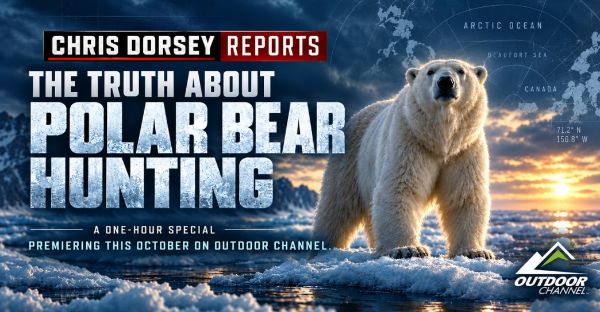
Acclaimed biologist, conservation journalist, author and filmmaker Chris Dorsey travels to the Canadian Arctic to investigate whether polar bear policy is being driven by science—or caught in a global climate advocacy and fundraising war
Few animals on Earth evoke more emotion than the polar bear. For decades, images of bears standing on shrinking ice, struggling through Arctic landscapes or seemingly threatened by a warming planet have become among the most recognizable symbols of global climate change.
But is the story Americans have been told the whole story?
Outdoor Channel examines that question in the new one-hour investigative television special, "Chris Dorsey Reports: The Truth About Polar Bear Hunting," premiering this October 2nd at 8pm & 11 pm, with additional airings Saturday 10/3 at 9 pm, Saturday 10/10 at 10 pm, and Friday 10/16 at 10 pm.
Hosted by acclaimed biologist, conservation thought leader, author and award-winning documentary filmmaker Chris Dorsey, the special takes viewers deep into Nunavut, Canada, where Dorsey investigates one of the most emotionally charged wildlife-management controversies in North America.
At the center of the documentary is a provocative question: Are polar bears being managed primarily by wildlife science, or has one of the world's most iconic animals become entangled in a much larger political, communications and fundraising battle surrounding climate change?
"Polar bears drive powerful emotions around climate change," Dorsey says. "With that emotion comes the ability to raise money. That doesn't mean concerns about climate change or sea ice aren't legitimate. But when an animal becomes enormously valuable to an advocacy narrative, we have to ask whether the public is getting the complete story."
Dorsey brings unusual credentials to the investigation. A trained biologist, journalist, and lifelong conservationist, he has spent decades reporting from some of the world's most remote wildlife regions. He is an acclaimed outdoor and conservation author and has produced hundreds of hours of television programming and documentary films devoted to wildlife, habitat, and conservation. His work has taken him from the Arctic to Africa and across North America, giving him a firsthand perspective on the intersection of wildlife biology, conservation policy, economics and the people who live alongside wild animals.
For "The Truth About Polar Bear Hunting," Dorsey travels to the western shore of Hudson Bay and the Inuit community of Arviat, where polar bears are not distant symbols but everyday realities.
There he joins Inuit hunter and outfitter Ryan St. John, who has spent nearly four decades living among polar bears. St. John provides a perspective rarely heard in climate advertising or fundraising appeals: that of Indigenous people who share the landscape with bears, manage them as a renewable resource and must also contend with the very real dangers of living in polar bear country.
Dorsey also interviews an influential roster of wildlife-management and policy experts, including Brian Nesvik, Director of the U.S. Fish and Wildlife Service; Jeff Crane, President and CEO of the Congressional Sportsmen's Foundation; Canadian Member of Parliament Blaine Calkins; and Alaska Congressman Nick Begich.
Together, their perspectives explore the science, politics and economics behind America's long-standing prohibition on imports of legally harvested Canadian polar bears.
The documentary traces the controversy to 2008, when the United States listed the polar bear as threatened under the Endangered Species Act, largely because of projected future losses of sea-ice habitat. That action effectively ended imports of newly sport-hunted Canadian polar bears into the United States even though Canada continued to authorize carefully regulated harvests through federal, territorial and Indigenous wildlife-management systems.
Dorsey examines an important distinction often lost in the public debate: concerns about long-term sea-ice loss do not mean every polar bear population is currently experiencing the same trend. Approximately 26,000 polar bears are estimated to exist worldwide, with population conditions varying considerably by region and with Western scientific assessments and Inuit knowledge sometimes reaching different conclusions.
The special also investigates how polar bears became one of the most powerful visual icons of the climate movement.
Environmental organizations routinely employ polar bear imagery in advertising, symbolic adoption programs, membership drives and fundraising campaigns. As such, Dorsey asks the obvious simple question: Does an emotionally powerful crisis narrative raise more money than scientific complexity?
"If the polar bear story suddenly became less frightening, what would happen to the fundraising built around that image?" Dorsey asks in the documentary. "That's a fair question whenever advocacy, politics and wildlife science intersect."
The film also examines what rarely appears in the global debate: the economic and cultural consequences of American policy for Inuit communities. Regulated polar bear hunting can generate meat, guiding income, employment, transportation revenue and other economic activity in remote Arctic villages. Yet America's import prohibition does not stop Canada from setting harvest quotas or prevent Inuit hunters from taking bears.
That leads Dorsey to another central question of the film: If the bear may still legally be harvested in Canada, what measurable conservation benefit is achieved by preventing an American hunter from bringing home the legally harvested animal?
Visually spectacular, journalistically provocative and grounded in the realities of life in the Arctic, "Chris Dorsey Reports: The Truth About Polar Bear Hunting" challenges viewers to look beyond slogans and consider the entire conservation equation—population science, climate projections, Indigenous knowledge, wildlife economics, hunting and the enormous power of modern environmental advocacy.
"Science isn't a photograph of one starving bear, and conservation isn't measured by how frightened someone becomes after watching a commercial," Dorsey says. "Real conservation is measured by what happens to wildlife, habitat and the people who live with both."
"Chris Dorsey Reports: The Truth About Polar Bear Hunting" premieres this October exclusively on Outdoor Channel.
ABOUT OUTDOOR CHANNEL: Outdoor Channel is America's premier television destination for outdoor adventure, conservation, hunting, fishing and the people and traditions that define the outdoor lifestyle.