
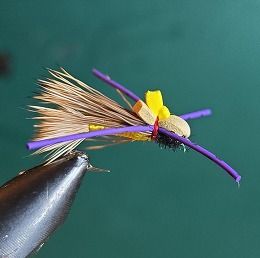
Hook: standard nymph hook, size 8-12 (show as size 10)
Thread: red, 6/0
Tail: blonde elk hair
Body: bright yellow Uni Floss.
Wing: natural elk hair
Thorax: black peacock ice dubbing.
Legs: purple barred medium rubber legs
Head: tan 2mm foam, cut in a strip about a hook gap wide. Yellow 2mm foam for indicator post
Tools: hair stacker, dubbing wax, whip-finisher, head cement
Create the tail and body: Start by putting a thread base on your hook. Move bobbin 2/3 of the way up the hook shank. This is where you'll start tying in your tail.
Cut and stack a small clump of blonde elk hair. This will serve as a tail and underbody. Measure it so the tips are about 1/8 to 1/4 inch beyond the hook bend. Remember that your thread is 2/3 the way up the hook shank. Cut the elk hair so you have the length you need and the cut ends are just past where your thread is hanging. Start tying in your tail by taking a couple of firm wraps right at the cut ends. Without letting go of the hair, work your way back to the tail with wide firm wraps. You want to keep the hair on the top of the hook shank. This can take a bit of practice, so don't rush it. Once you have the tail set, then cover it with thread, tying down the tips and cleaning everything up.
Tie in your floss and move your thread to the head of the underbody. Wrap floss with touching wraps making sure to cover all of the red thread. Tie it off.
Wing: Before you start on the wing, tie in the foam for your bullet head. Take the foam strip and tie in where the body stops. Keep the foam on top of the hook shank and tie it down all the way up to the hook eye. You want to tie it in as close to the hook eye as possible. Leave it hanging off the front of the hook.
Most flies with a deer- or elk-hair wing will have an underwing. This can be a synthetic material, like poly yarn, or natural, like CDC. This under wing can keep the elk hair standing higher, providing better visibility.
However, I leave it off this pattern for two reasons. The yellow foam post makes it easy to see in moving water. The lower wing provides a more enticing profile on the water. I fish this fly on mountain lakes, and I think fish like it because it has the look of a helpless terrestrial bug.
So, the wing is simple. Stack a clump of natural elk hair. You'll want about twice as much as you had for the tail. The tips of the wing should be about at the tips of the tail. Cut the excess hair off before you tie in. Take three or four wraps at your tie-in point with increasing pressure before you let go of the hair. This should help you get the wing set in exactly the right place, just where the body ends on the hook. Use as many thread wraps as you need to clean up the cut ends of the wing hair. Add a bit of head cement to the tie in point.
Thorax: Grab your dubbing wax. This isn't essential, but it helps get a nice tight dubbing noodle when you're using ice dubbing. Rub the wax on your thread and then pull out very small clumps of dubbing. Actually, don't even think of it as a dubbing clump, think of pulling out dubbing wisps. You want to keep this dubbing noodle very thin.
Get a thin, 3-inch dubbing noodle and create your thorax, ending with the thread hanging at the junction of the body and the thorax.
Head/legs/post: Pull the foam strip over the thorax and tie it in with about three tight wraps. You're going to build a red thread collar at this point. That's intentional and adds to the attraction of the fly, but if you don't like it, you can cover it with dubbing right before you whip finish.
Get strand of rubber legs, fold in half so the tips are equal. Put the legs on top of the fly with the tips pointed toward the rear and the loop off the front. Take one loose wrap. Move legs to either side of the foam. Take three more tight wraps.
Add a very small piece of yellow foam for the post.
Clip the foam head material back almost to the tie in point. Clip the post material to the length you want.
Whip finish the fly where the legs tie in and then add head cement to thread wraps on the side of the foam at the point the legs are tied in. Cut legs to length.
How to fish it
I fish this fly as a terrestrial in late summer. I fish it as a stonefly in July. It's very universal and a good one to have in your box if you're fishing rivers like the Big Hole, Bitterroot, Rock Creek and Blackfoot. Don't hesitate to drop a size 12 prince nymph off the back.
I've had really good luck with this pattern on high mountain lakes. Given the heat we're experiencing now, this is probably the best option. When fishing mountain lakes, you can try to target rising fish with a fly like this, or you can work the edges of the lake where fish are cruising and hoping for a clumsy hopper or beetle to fall in. Cast it and twitch it. This fly is meant to move. You'll want to use floatant with this fly, but it should float very well.