
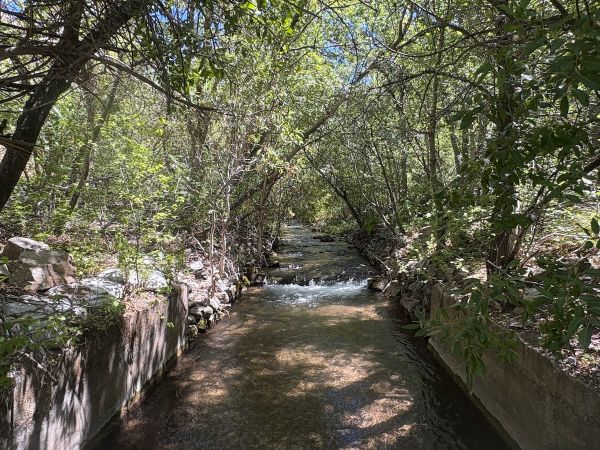
The Utah Division of Wildlife Resources will be coordinating with several partners — including the U.S. Forest Service, the U.S. Fish and Wildlife, and Trout Unlimited — to conduct a treatment on a portion of Mill Creek in the Uinta-Wasatch-Cache National Forest to help restore native Bonneville cutthroat trout.
Nearly a decade ago, DWR biologists successfully treated over 10 miles of Mill Creek to remove non-native rainbow and brown trout and help establish native Bonneville cutthroat trout. Unfortunately, someone illegally introduced brook trout within the canyon, causing threats to native fish species in the area.
"An angler reported catching a brook trout in Mill Creek a few years ago, and we later confirmed them in parts of the creek," DWR Central Region Aquatics Manager Chris Crockett said. "We know these fish were illegally introduced because even before the previous treatments in 2013-2016, there were no brook trout in Mill Creek. The selfish and illegal actions of an individual are now endangering native trout and costing anglers valuable resources that could be used elsewhere."
In Utah, it is illegal to transport live fish or to introduce them into a new location and can result in a class A misdemeanor, which could result in up to one year of jail time and up to a $2,500 fine.
"We will not manage for illegally-introduced species, so any future illegal fish introductions in this area will result in similar removal efforts," DWR Sportfish Coordinator Trina Hedrick said. "We are trying to restore native cutthroat trout to key places around the state, and cutthroat trout and other competing trout species aren't compatible in these identified conservation areas. There are additional fishing opportunities for brook trout in several nearby waterbodies."
Treatment area and timeline
In order to remove the illegally-introduced brook trout, the DWR will be conducting a rotenone treatment in the impacted portions of Mill Creek on Sept. 1, pending poor weather conditions. The full treatment area will include 3.1 miles of the creek, stretching from Church Fork down to the I-215 bridge crossing. Fish mortality will primarily be confined to above the mouth of Mill Creek Canyon. The treatment will last roughly two days.
Rotenone is a natural substance that comes from the roots of a tropical plant in the bean family. It is a respiratory toxin to fish, but it is not dangerous to people, pets or other wildlife, especially in the extremely low quantities that biologists use to treat streams and lakes. However, there will be crews and equipment in the area during the treatments, so the Uinta-Wasatch-Cache National Forest will be temporarily closing the impacted areas (primarily the creek) to public access. The public and their pets should stay out of these areas during the treatments, so that the DWR can safely and effectively complete the projects. The public may also temporarily notice a purple tint to the water downstream of the U.S. Forest Service boundary from a substance used to deactivate the rotenone, so that no fish are lost below the canyon.
"The treatment area (basically the creek) will be temporarily closed, but the closure will not impact access to hiking trails or other recreational amenities," DWR Central Region Outreach Manager Michael Packer said. "Only the lower portion of Mill Creek below Church Fork will be closed during the treatment, and the area will be signed."
A series of two to three treatments is the standard protocol for effective removal of non-native trout. The second Mill Creek treatment will likely occur later in September or will be scheduled for the fall of 2027.
Why rotenone treatments are done
Habitat loss, spawning with non-native trout and competition from non-native trout have caused dramatic declines in native cutthroat trout populations around the West, leading to concerns about the species' future.
"These treatments will help to create a population of cutthroat trout that will contribute to the conservation of native cutthroat trout species and prevent them from being listed under the Endangered Species Act," Crockett said. "In addition to increasing the diversity of angling opportunities, these project treatments will help the native fish and ensure cutthroat trout populations improve."
Fishing opportunities
Before the treatment begins, biologists will safely catch and save as many cutthroat trout as possible. These fish will be held on-site and released back into the creek once the water is safe for fish. The salvaged Bonneville cutthroat trout and fish upstream of the treatment site will quickly repopulate the treated area.
"Anglers will encounter slightly reduced cutthroat trout numbers after the treatment as the fish spread out, but nearby upstream areas will not be impacted," DWR Central Region Sportfish Project Leader Mike Slater said. "Anglers wanting to target cutthroat trout in the area can go above Church Fork to take advantage of higher fish numbers and great small-stream fishing for native cutthroat trout."
After the treatment, the DWR also plans to stock juvenile (fingerling) cutthroat trout this fall throughout the drainage.
If you have questions about the upcoming treatments, you can call the DWR Springville office at 801-491-5678.