
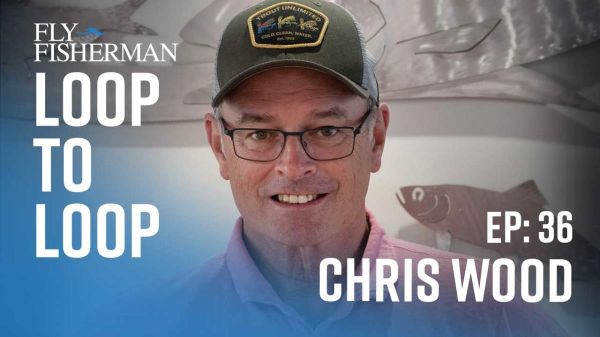
On a recent episode (#36) of the Fly Fisherman Loop to Loop podcast, Ross Purnell, Publisher/Editor of Fly Fisherman Magazine, sits down with Trout Unlimited (TU) President and CEO Chris Wood at the TU headquarters in Arlington, Virginia, to discuss rescinding the Roadless Rule, the impact of data centers, what makes America great, and much more. Wood has led Trout Unlimited (TU), the leading non-profit organization dedicated to conserving, protecting and restoring North America's trout and salmon fisheries and waters since 2001. Previously, he served as a senior policy advisor to the Chief of the U.S. Forest Service, which gives him tremendous insights to the value of America's vast public resources as well as the effects of public policy on those lands and waters. While at TU, Wood has championed protection of public lands and watersheds – especially of vital cold-water sources – and he has successfully advocated for a variety of habitat restoration projects. Wood knows well the realities of forest management, the importance of protecting the backcountry, and both the pressures and ecological impacts of legislative changes. Given his experience at the U.S. Forest Service and his current stalwart defense of the Roadless Area Conservation Rule, which was enacted under the Clinton Administration and currently protects approximately 59 million acres of national forest lands from new road construction, commercial logging and other development, Wood shared the following insights:
"The Roadless Rule is the most conservative conservation measure of all time," began Wood. "If you look at conservation as literally meaning, from the Latin root – conservare: to hold or keep in a safe state – that's what we're doing. We're maintaining decision space for future generations, by leaving those areas alone, by not forgoing options for future generations, or compromising options. And we're staring in the teeth of a nearly $10 billion with a 'b' maintenance backlog on the existing road system. It was the height of conservatism to basically say, 'Why don't we take care of the existing network of roads first, before we try to build roads into these backcountry areas to lose money on timber sales and then later to have those roads fall off the hillsides into the streams below.'"
"…This is not a substantive argument," Wood continued, referring to the current push to rescind the Roadless Rule. "It's a religious argument. It's a deregulatory argument. It's people who hate regulations are advocating for this. That's all this is. This is not about common sense. ...And you know what else? Wood added, "In the intervening quarter-century since the Roadless Rule was promulgated – that's the term of art that we use – the position of the Forest Service has fundamentally changed. You know who wants to go into roadless areas the least? – the U.S. Forest Service!"
One of the current arguments for rescinding the Roadless Rule is forest management, suggesting that removing restrictions will improve wildfire prevention, but Wood was quick to confirm that people start most of the fires. "Eighty-five percent of fires on the national forest system are started by people," he said, "and about the same percentage, 85 percent or so, are started within a half a mile of a road…and by the way, the Roadless Rule allows you to fight fires, and it even allows you to build roads to fight fires, to be clear…"
Again, referencing his earlier work at the Forest Service, Wood noted that their longer-term plan was to "…take these red-hot issues off the table [logging and wildfire prevention on the Roadless Areas] and allow the Forest Service to focus on the areas where they have the most social license to do the most good for both the health of the forest and for the safety of people as well."
Without a doubt, preserving roadless areas on our national forests is key to conserving wild and native trout and salmon: "So, again," Wood continued, "from the really narrow slice of geekdom that we exist in, where we care about trout so much, and all fisheries really, but trout in particular, roadless areas are the game. They are literally the game for trout and salmon. In places like Idaho, 68 percent of all bull trout habitat are found in either roadless or wilderness lands. In places like Southeast Alaska, the five salmon species in the Tongass National Forest, which produces about 40 percent of all the salmon that swim along the West Coast, it's like 75-80 percent of all those fish are found in roadless areas. So, these are the strongholds of what remain for native trout and salmon… And they are among the best places to hunt and fish if you're willing to walk a little bit."
"I shot my first elk in a roadless area in Idaho," Wood added, "…and in places like Wyoming, you're 10 times more likely to be successful on your hunt in roadless areas as you are in roaded areas of those public lands." So, clearly, protecting these roadless areas is important to hunters too.
Listen to the Fly Fisherman Loop to Loop podcast, in partnership with Patagonia, G. Loomis, Mayfly Outdoors, TroutRoutes and Cigars International, on Apple Podcast, YouTube, Spotify, and at FlyFisherman.com.
"We don't believe rescinding the Roadless Rule is a good idea," said Wood, "but in the end, the beauty of this country is these are the People's lands. These are owned in common – managed in trust – but they're owned in common by all of us. It's one of the great virtues of being an American. It's our birthright. You think about Europe with its museums and cathedrals that are hundreds of years older than our country, you think about Egypt and the pyramids, you think about Africa and the Serengeti. What makes America unique? It's the fact that we as citizens of this country own this incredible network of public lands, and the gem of the public lands are these roadless areas. And that's what's at risk right now. But, again, only if we allow it to happen. We're still a democracy, and our voices still matter, and right now this rule is a little bit in limbo. They're still waiting to come out with a draft proposal. There will be a public comment period at that point. Probably it will be 35-40 days; it'll be short, I bet. It's going to be absolutely vital that people make their voices heard."
Fortunately, Trout Unlimited has made it easy for you. "Simply go to TU.org, and we have a take-action page," said Wood, "and you can take action today on roadless areas. You go there, just click on it, we make it really easy, geo-locate your URL – we know where you are – and we create a form that you can write to your members of Congress and tell them that you want to keep these areas intact. I think that pressure will have to come from all sides. We need to pressure the Administration, we need to pressure members of Congress, we need Governors to weigh in, and it's just really important that people make their voices heard."
"I'm so thankful that TU President and CEO Chris Wood found time to sit down with me at his office outside Washington, D.C. His advocacy for public lands and watersheds, for trout and salmon fisheries, but really for all wildlife and even for big game, has been tireless since joining TU about 25 years ago. His insights to the U.S. Department of Agriculture's 2001 Roadless Area Conservation Rule are invaluable, and he rightly points out that roadless areas are the gem of our public lands. If you're an angler or hunter who believes these roadless areas need to be protected, go to TU.org today and make your voice heard!"
Available on Apple Podcast, YouTube, Spotify, and at FlyFisherman.com the latest episode of Fly Fisherman Loop to Loop podcast is a must-listen for fly fishing enthusiasts of all levels who want to stay informed.
About Outdoor Sportsman Group: Outdoor Sportsman Group is comprised of the world's foremost media and entertainment brands for outdoor adventure enthusiasts. It includes three leading multichannel networks: Outdoor Channel, Sportsman Channel and World Fishing Network, as well as Sportsman Channel (Canada) and MOTV, the world's leading subscription streaming platform created for outdoor lifestyle enthusiasts. The Group also consists of numerous established publishing assets: 14 outdoor magazines including Guns & Ammo, Game & Fish, Petersen's HUNTING, In-Fisherman and 20 top websites. Additionally, Outdoor Sportsman Group includes television production operations, Winnercomm. For more information, visit www.outdoorsg.com.