
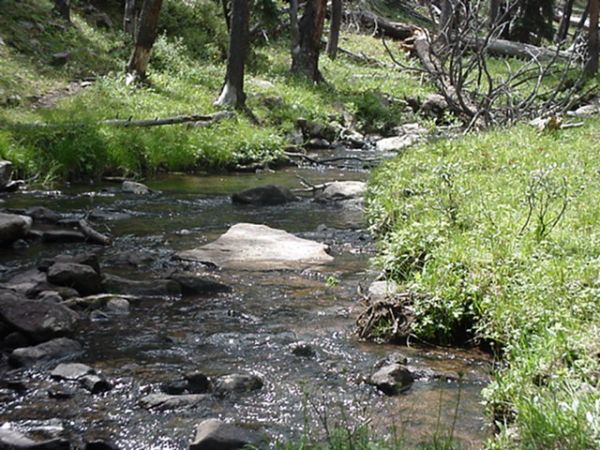
The Utah Division of Wildlife Resources will again be coordinating with the U.S. Department of Agriculture, Forest Service to conduct more treatments on two drainages in the High Uintas to help restore native Colorado River cutthroat trout.
Over the past decade, DWR biologists have treated different waterbodies on the north and south slopes of the Uintas with rotenone to help with native cutthroat trout conservation. The treatments use rotenone to remove non-native fish from the areas where native cutthroat trout will be restored.
Rotenone is a natural substance that comes from the roots of a tropical plant in the bean family. It's a respiratory toxin to fish, but it is not dangerous to people, pets or other wildlife, especially in the extremely low quantities that biologists use to treat streams and lakes. However, there will be a lot of crews and equipment in the area during the treatments, and the Ashley National Forest will be closing the impacted areas. The public should stay out of these areas during the treatments, so that the DWR can safely and effectively complete the projects.
"Over the past 20 years, we have made significant progress on Colorado River cutthroat trout restoration in northeastern Utah," DWR Northeastern Region Aquatics Manager Natalie Boren said. "Building robust and resilient populations across the landscape will help ensure this species persists well into the future."
This year, biologists will be conducting the treatments in the following areas in the High Uintas:
- Fall Creek drainage (south slope) from Aug 3-6. (The area should reopen to the public on Aug. 8.)
- North Fork Sheep Creek (north slope) on Aug. 19 and Aug. 26.
"The temporary closure of the treatment area only affects treated waters and prohibits the public from entering the water and obtaining drinking water from sources in the treatment area. All hiking trails and other access will remain open to public use," DWR Northeastern Region Outreach Manager Tonya Kieffer-Selby said. "The treatment areas will be well signed and will reopen after the treatment process is over and rotenone levels are no longer detectable in the streams."
A series of two to three treatments is the standard protocol for effective cutthroat trout restoration. For Fall Creek, this will be the second year of treatment, and this is the first year of treatment for the North Fork of Sheep Creek.
Fish salvage efforts will take place prior to the treatment since the North Fork of Sheep Creek currently holds a genetically pure population of Colorado River Cutthroat Trout. All size classes of cutthroat trout that can be removed prior to the treatment will be held onsite, and the fish will be released back into the creek once the water has oxidized, in order to repopulate the stream.
Why rotenone treatments are done
Habitat loss, spawning with non-native trout and competition from non-native trout have caused dramatic declines in native cutthroat trout populations around the West, leading to concerns about the species' future. These treatments will help to create a population of cutthroat trout that will contribute to the conservation of native cutthroat trout species and prevent them from being listed under the Endangered Species Act. In addition to increasing the diversity of angling opportunities, these project treatments will help the native fish and ensure cutthroat trout populations improve.
The treatments will remove the brook trout, non-native cutthroat trout and rainbow trout currently found in the streams. Biologists predict that brook trout populations could completely replace cutthroat trout in these areas in less than 20 years without intervention. These efforts are also anticipated to help the DWR better meet angling preferences, which recent surveys showed include an increased preference for cutthroat trout.
"The Uinta Mountains host over 1,000 lakes and hundreds of miles of stream," DWR Regional Sportfish Biologist Carsen Hinkhouse said. "Our efforts are targeted at restoring Colorado River cutthroat trout in a handful of these waters. Taking part in this restoration ensures native Colorado River cutthroat trout will remain on the landscape, while also providing a diverse angling opportunity."
After the treatments
The North Slope treatment is part of a larger effort to treat the upper portions of streams connected to the Sheep Creek canal.
For the Fall Creek drainage, stocking is dependent on the success of this year's treatment. If deemed successful, Colorado River cutthroat trout will be stocked into both Phinney Lake and Anderson Lake in 2027.
Angler opportunities
Even though brook trout are being removed from these treatment areas, anglers can still find them in thousands of streams and lakes throughout the Uinta Mountains. Information about different fishing opportunities is available on the DWR's Fish Utah interactive map, so the public can easily find waters to fish by species.
The DWR plans to continue providing abundant angling opportunities for several species — including both brook trout and cutthroat trout — in the Uinta Mountains. To learn more about the cutthroat trout restoration happening in the Uintas, check out this Reader Creek Restoration YouTube video or listen to this Wild podcast episode.
If you have questions about the upcoming treatments, call the DWR Vernal office at 435-781-9453.