
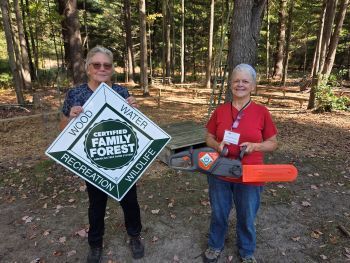
The government might classify Madelyn "Mad Dog" Kleitch as an "underserved" landowner, but in the woods, she is an overachieving landowner. Forest management may be a relatively new passion, but Maddy has a long history of good land management.
Maddy's backstory
Maddy's parents had a 220-acre farm in Sanilac County near Lexington, but they died when she was young. Her older brother decided they would manage grief through work.
"For 30 years every Sunday, we would go to the country to cut weeds and clean up debris," Maddy said.
Maddy planted thousands of white pine seedlings on the family farm and cleaned up trash dumped by locals.
"I see this as a good way to grieve – manual labor to make the environment better while screaming at the top of my lungs at how unfair life is," she said.
The family sold the farm in 2013 and Maddy used her portion of the proceeds to buy a 49-acre farm near LeRoy in Osceola County. She planted two acres of pollinator habitat, and her tenant farmer is a local leader in agroecology and healthy land management. The farm is enrolled in the Michigan Agricultural and Environmental Assurance Program to show compliance with environmental laws.
Maddy experimented with prescribed fire on the family farm and even developed a recipe to cook a whole turkey in the coals after burning apple trees. This past winter she got formal training at the Michigan Prescribed Fire Council annual meeting and attended the very first Prescribed Burn Manager class offered by GraceAnna Cooper, the DNR's prescribed fire specialist. More information about prescribed fire training is available at FireCouncil.org.
It turns out that Maddy wasn't done procuring forest land. She bought a 214-acre forest in Midland County in 2024.
"I stumbled on the Midland property through a friend in real estate. We went to look and it was love at first sight," she said. Maddy described her land management style as "bumping my nose along the way while learning what I was doing."
Maddy earned her nickname "Mad Dog" when she worked as a nurse providing home health care in neighborhoods near Detroit. Maddy is an Army veteran who served as a medic and x-ray technician during the Vietnam War. She applies her persistence and determination to forestry, too.
Maddy sought forestry advice from a variety of natural resources professionals. After she bought her Midland County forest, she visited the local USDA Service Center to meet people at the Midland Conservation District and Natural Resources Conservation Service.
"What a good group of people work in that office," she said. "They gave me the best education and helped with management suggestions. I visit frequently to ask questions and get clarification about programs. Everyone is always so kind, knowledgeable and helpful. I feel like I died and went to heaven."
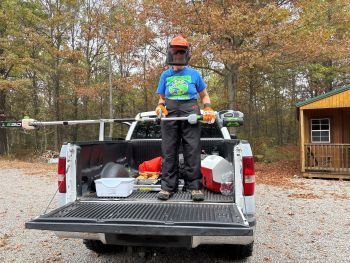
Maddy heard about the Michigan Forest Association from Elan Lipschitz at Little Forks Conservancy. Maddy joined Michigan Forest Association in spring of 2025 and attended the Michigan Forest Celebration held in Midland last fall. Maddy won a battery-operated chainsaw and safety gear from the Michigan Tree Farm Committee at one of the Michigan Forest Celebration field trips.
Maddy says, "My woods are so wonderful to me, and I want to share them with anyone who also has respect for creation. I am so happy to have stumbled on Michigan Forest Association." The 2026 Michigan Forest Celebration will be at Treetops Resort in Gaylord October 2-3.
Why use forestry programs
Maddy hired a forester early in 2025 to develop a forest management plan so she can enroll her land in the Qualified Forest Program to reduce her property taxes by 18 mills. Even with the Qualified Forest reduction, her property taxes are over $14,000 a year so she is considering a switch to the Commercial Forest Program to pay a flat rate of $1.35 per acre or just $289 a year for the 214-acre forest. Land in the Commercial Forest Program must be open to foot traffic from the public for hunting, fishing and trapping (Qualified Forest Program acreage is not open to the public).
Reducing property taxes facilitates sustainable management, so Maddy is working with her forester to implement her forest management plan and do an aspen harvest in the next year or two. She is also exploring the new Forest & Water Fund administered by Michigan Forest Association that is offering 80% to 100% cost share up to $25,000 to family forest owners for four practices: high carbon reserves (requires a conservation easement), tree planting in priority Forest to Mi Faucet watersheds, prescribed fire and climate resilience.
Maddy also used her forest management plan to certify her forest and join American Tree Farm System last fall after the 2025 Michigan Forest Celebration. Her Tree Farm inspector is Hunter Fodor of Hunter's Land Management. Hunter is a member of the Michigan Association of Consulting Foresters.
Last year, Maddy took an online Introduction to Forestry class with Jarred Saralecos of the Michigan State University Forestry Department.
"There is a lot more loving work to do," she said. "I am happy to learn anything about everything."
Learn more
Michigan Forest Association will offer a new online "Woodland Stewards" class for landowners starting in August 2026. If you join the Michigan Forest Association, you will recieve information about the class later this summer.
The 2018 Farm Bill instructed the U.S. Department of Agriculture to provide better service to landowners who have been historically underserved. Several of the forestry programs mentioned in this story have funding from USDA Forest Service that requires them to invest 40% of federal funds in underserved landowners in these five categories: new forest owners (less than 10 years), veterans, tribal members, low income, high poverty regions. Maddy fits two of these categories as an Army veteran and a new forest owner buying her forest only two years ago.
The Forest Stewardship Program is funded by the USDA Forest Service and administered in Michigan by the Department of Natural Resources. All partners are equal opportunity providers and employers. For more information, contact Mike Smalligan at SmalliganM@Michigan.gov or 517-449-5666.