
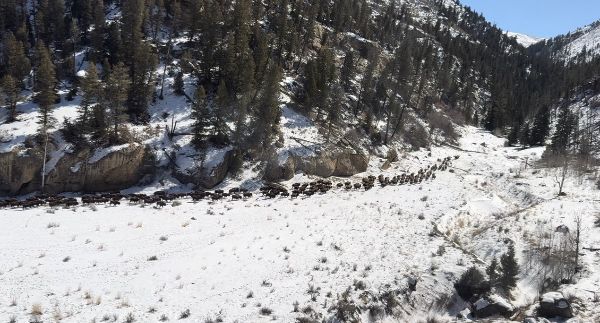
The purchase of a roughly 50,000-acre parcel of land in the roadless area of the Book Cliffs was officially finalized on Thursday and will become part of an existing Utah Division of Wildlife Resources wildlife management area in northeastern Utah.
During the 2025 legislative session, the Utah Legislature allocated $50 million to the DWR, specifically for the purchase of large trust land parcels, to secure hunting, fishing and public access on these properties into the future. One of the properties that was identified was a 50,608-acre parcel owned by the Utah School and Institutional Trust Lands Administration in the Book Cliffs roadless area of northern Grand County. The legislature passed a law in 2024 to allow the TLA to make direct sales to the Utah Department of Natural Resources, which allowed the DWR to purchase this land block and ensure it remains open to the public who have enjoyed this area for decades.
"This property provides important habitat for deer, elk, bison, black bear, Colorado River cutthroat trout and many other wildlife species, and it was crucial to ensure this area remains available for wildlife and the public," DWR Deputy Director Michael Canning said. "We are grateful to the Utah Legislature for allocating the funding for this land purchase, which will provide public hunting and fishing opportunities on this property into the future."
The property will be managed as a wildlife management area and will be added to the existing 6,929-acre Little Creek Wildlife Management Area and renamed as the Book Cliffs Roadless Wildlife Management Area.
"This sale maximizes long-term returns for the beneficiaries of the Public School Trust, and our analysis shows that selling this property at fair market value and investing the proceeds in the Permanent State School Fund will generate substantially greater returns for Utah schools than continued ownership," said Michelle McConkie, Executive Director of TLA. "This transaction allows us to convert a remote, underperforming asset into a diversified financial investment that is expected to provide stronger, more reliable returns to our beneficiaries for generations to come. We have a willing buyer prepared to pay fair market value; this is a great opportunity to strengthen the trust's financial position while fulfilling our fiduciary obligations.
"It's important to remember that Trust Lands will retain all subsurface mineral rights and the access necessary to develop those resources in the future, if that option is financially viable. That means beneficiaries receive the immediate cash from the sale, while preserving the potential value of the mineral estate. This is a practical, common-sense transaction that advances the interests of trust beneficiaries, protects future opportunities and ensures these assets continue working as effectively as possible for Utah's public schools."
"This office has closely monitored the transparent policy development for the sale of large land blocks, the due diligence of the appraisal process and the fiduciary efforts of the Trust Lands Administration," School and Institutional Trust Beneficiaries' Advocacy Office Director Liz Mumford said. "The infusion of nearly $30 million into the permanent fund will bolster the annual distribution to public schools, creating a generational impact for Utah schoolchildren."
"The Book Cliffs are part of Utah's heritage, and this purchase ensures public access to these lands for families for generations, while strengthening the school trust fund that supports our students. That's a win for conservation, a win for education and a win for Utah," Sen. Scott Sandall said.
"This purchase demonstrates that Utah can both fulfill its fiduciary responsibility to our schoolchildren and protect the outdoor heritage that makes our state unique," Rep. Casey Snider said. "We are committed to helping Utah students succeed and ensuring they have the resources and opportunities they need to thrive, while also preserving the public lands and outdoor opportunities that are such an important part of our state. This is a once-in-a-generation opportunity to permanently preserve public access to some of Utah's most remarkable landscapes. By securing these lands now, we are ensuring that future generations of Utahns will continue to have places to hunt, fish, recreate and experience the outdoors for generations to come."
Currently, there are 150 wildlife management areas in Utah. In addition to providing areas for people to hunt, fish and enjoy wildlife-based recreation, wildlife management areas help minimize and mitigate wildlife depredation on private property, and are vital to providing important winter ranges and feeding grounds for many wildlife species, including big game.