
The South Carolina Waterfowl Association (SCWA) is sharing the first migration data collected from its ongoing Mallard Research Project at the SCWA Wildlife Education Center in Pinewood, offering an early glimpse into the movement patterns of wild mallards traveling through the Atlantic Flyway.
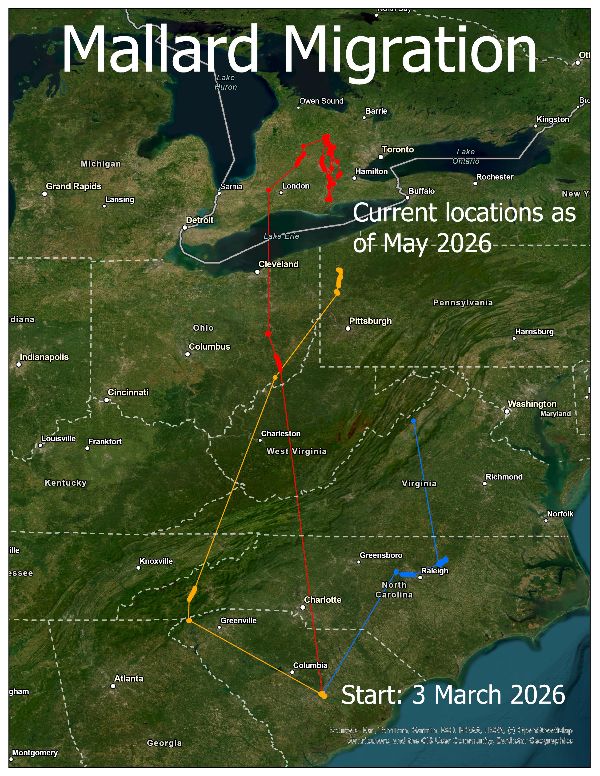
Researchers recently tracked the spring migration routes of three wild Mallard drakes captured at Cantey Bay near Lake Marion on March 3rd using a rocket net system. Each bird was equipped with a GPS-enabled cellular tracking device programmed to record a location every eight hours and transmit the data daily through the cellular network.
The preliminary tracking results revealed dramatically different migration behaviors among the three birds.
One mallard departed South Carolina just two days after being tagged and traveled as far as Ohio overnight before eventually continuing north into Canada. Another bird remained near Lake Marion for more than two weeks before beginning its migration through western North Carolina. The third duck stayed in central North Carolina for approximately two weeks before continuing into Virginia.
"The early results have already shown us how differently individual birds can behave during migration," said project researcher Margaret Jensen. "Even with a small sample size, we are seeing unique routes and stopover habits between birds that were captured in the same place."
Jensen noted that one bird's solar-powered GPS unit charged so efficiently during flight that the device automatically recorded additional position fixes to prevent battery overcharging, providing an even more detailed look at the duck's movement path.
The Mallard Research Project was launched in 2025 to better understand the future of mallard populations in the Atlantic Flyway and examine the impacts of game farm mallards and hybridization on wild birds. The study is being conducted in Pinewood, South Carolina, an area identified as a hotspot for mallard releases.
The project compares movement patterns, migration behavior, and reproductive success between wild and game farm mallards using advanced tracking technologies, including VHF radio transmitters and GPS-enabled cellular tags.
To date, researchers have released nearly 100 radio-tagged mallards, several GPS-tagged birds, and 187 banded ducks as part of the study.
"This type of research is critical to the future of waterfowl conservation," said SCWA COO Lou Tocci. "The data being collected will help conservationists better understand mallard behavior in the Atlantic Flyway while also creating hands-on educational opportunities connected to real-world wildlife science."
While researchers caution that the current sample size is too small to draw broad conclusions, the early findings reinforce the complexity of mallard migration and highlight the importance of continued monitoring and data collection.
The project is a collaborative effort between SCWA, the Clemson Kennedy Waterfowl and Wetlands Conservation Center, the University of Texas at El Paso, Palmetto Waterfowl Conservation, LLC. and generous private donors.
Additional tracking data and research updates are expected throughout 2026 as the study continues.
To learn more about SCWA and its conservation initiatives, visit www.scwa.org.
About the South Carolina Waterfowl Association: The South Carolina Waterfowl Association is a 501(c)(3) nonprofit organization dedicated to enhancing and perpetuating South Carolina's wildlife heritage through education and habitat conservation.
Facebook: https://www.facebook.com/SouthCarolinaWaterfowl/
Instagram: https://www.instagram.com/southcarolinawaterfowl/?hl=en
YouTube: https://www.youtube.com/@southcarolinawaterfowlasso3303