
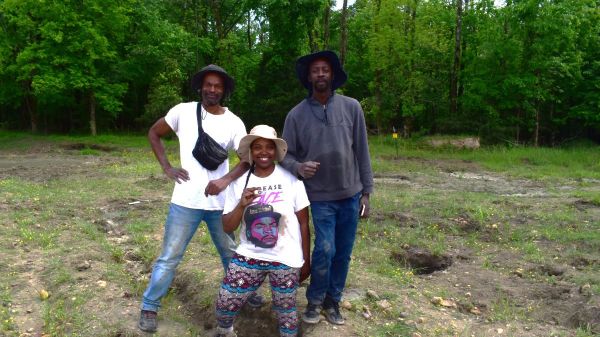
While grieving the deaths of her son and father, Pennsylvania native Keshia Smith recently found a 3.09-carat white diamond during a visit to Arkansas' Crater of Diamonds State Park, a poignant reminder that joy and hope can still emerge from the weight of sorrow.
Smith started planning her trip to Arkansas' diamond site over a year ago, researching where to go and where to dig, even reaching out online to some of the park's frequent visitors for suggestions. After losing her son in October and her father in April, Smith hoped the outing would bring some much-needed comfort. She made the road trip with her boyfriend Joey and brother Kirim and arrived at the park on Tuesday, April 21. Smith spent her first day at the park meeting people and getting the lay of the land. On her second day, she made the memory of a lifetime.
When Smith returned to the park around 9 a.m. on April 22, she greeted friends made the day before and met a few of the park's frequent visitors, who gave her tips on where to search for her diamond.
Smith was digging dirt on the south end of the park's 37.5-acre diamond search area, near an historical marker commemorating John Huddleston's 1906 discovery of the first diamonds in Arkansas. As she dug deeper, Smith saw the colors of the soil change from brown to black. After a couple more scoops, she spotted something shiny in her shovel.
Skeptical at first, Smith placed the glimmering stone in her bag and kept digging. After carrying her dirt to the park's south wash pavilion to wet sift, she was showing others the shiny crystal she had found when someone told her, "You definitely need to take that up and get it looked at." Realizing she might have found her own diamond, Smith was overcome with joy and started crying, laughing, and hugging everyone around her.
Later in the day, Smith brought her find to the park's Diamond Discovery Center, where staff confirmed that her glimmering stone was a gorgeous, 3.09-carat white diamond. When Smith heard the news, she was again overwhelmed with emotion, both the weight of her grief and the uplifting joy of finding a diamond.
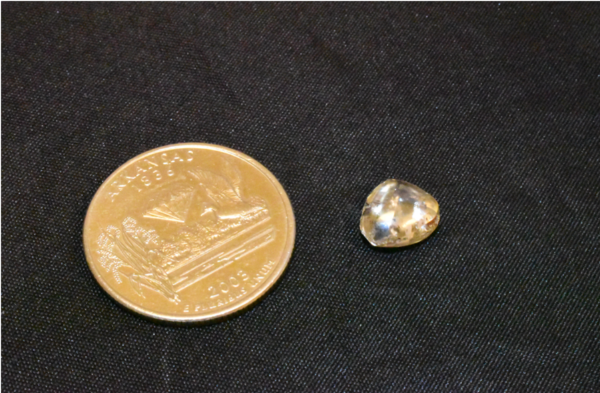
Smith's diamond has a flat, smooth appearance and is about the size of a bead. It is colorless, with a few unique inclusions around the edges. When asked what shape she thought her diamond most resembled, Smith replied, "To me it looks like a heart. That's the first thing I saw when I found it."
Smith spoke with park staff about her feelings leading up to the trip, stating, "I have felt so much pressure the last six months. In October I lost my son, and we just buried my dad a week ago. It has been a lot!" Looking at her diamond, she continued, "I really needed this. I really prayed for this, and I just can't believe it actually happened!"
Park Interpreter Sarah Bivens says, "Ms. Smith exuded joy from the moment she walked in the door. It's not uncommon for larger diamonds like this to be found during the first hour of the finder's dig time. Sometimes, I think diamond finds like this are just meant to be." Other park guests also remarked how excited and enthused Ms. Smith was to even be searching for a diamond, let alone actually finding one.
Many guests name the diamonds they find at Crater of Diamonds State Park. Smith chose to name her gem the Za'Novia Liberty Diamond. Za'sovia represents the names of her two grandchildren and Liberty represents the significance of finding her diamond during America's 250th year.
The Za'Novia Liberty Diamond is the second-largest diamond registered at the park so far this year. As of this publication, park guests have registered 214 diamonds at Crater of Diamonds State Park in 2026.
Download photos HERE.
Quick facts about Crater of Diamonds State Park
Diamonds come in all colors of the rainbow. The three most common colors found at Crater of Diamonds State Park are white, brown and yellow, in that order.
In total, over 75,000 diamonds have been unearthed at the Crater of Diamonds State Park since the first diamonds were discovered in 1906 by John Huddleston, a farmer who owned the land long before it became an Arkansas State Park in 1972.
The largest diamond ever discovered in the United States was unearthed in 1924 during an early mining operation on land that later became part of Crater of Diamonds State Park. Named the Uncle Sam, this white diamond with a pink cast weighed 40.23 carats. It was later cut into a 12.42-carat emerald shape. The Uncle Sam is now part of the Smithsonian's mineral and gem collection and can be seen at the National Museum of Natural History.
Another well-known diamond from the park is the Strawn-Wagner. Found in 1990 by Murfreesboro resident Shirley Strawn, this 3.03-carat white gem was cut into a round brilliant shape weighing 1.09 carats. It graded as ideal cut, D-colorless and flawless and was set in a platinum and 24-carat gold ring. In 1998, the state of Arkansas purchased this diamond for $34,700 in donations and placed it on permanent display at the park visitor center.
Crater of Diamonds State Park is located on Arkansas Highway 301 in Murfreesboro. It is one of 52 state parks administered by Arkansas State Parks, a division of the Arkansas Department of Parks, Heritage, and Tourism.