
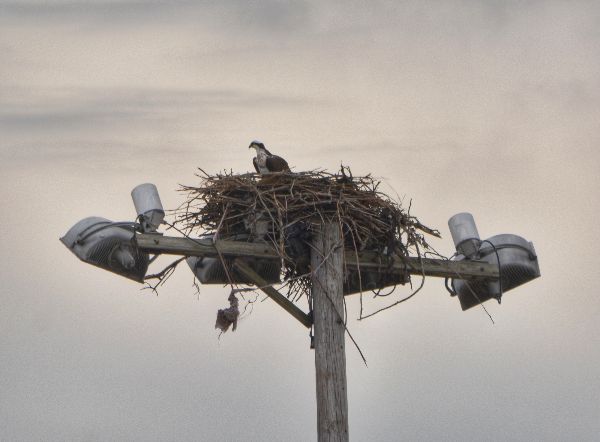
Once you know where ospreys like to build their giant nests, you won't be able to stop looking for them.
Ospreys are long-lived birds (averaging 15-20 years), and pairs usually return to the same nest and add to it each year. Made of sticks and lined with grasses, mud and soft materials, nests can reach 10-13 feet deep and 3-6 feet in diameter after years of building.
Historically, ospreys nested only on cliffs, at the tops of tall trees or on "snags" – dead trees that are still standing. But due to humans removing or disturbing these important habitat elements, ospreys have adapted to build nests on human-built structures like utility poles, towers and platforms.
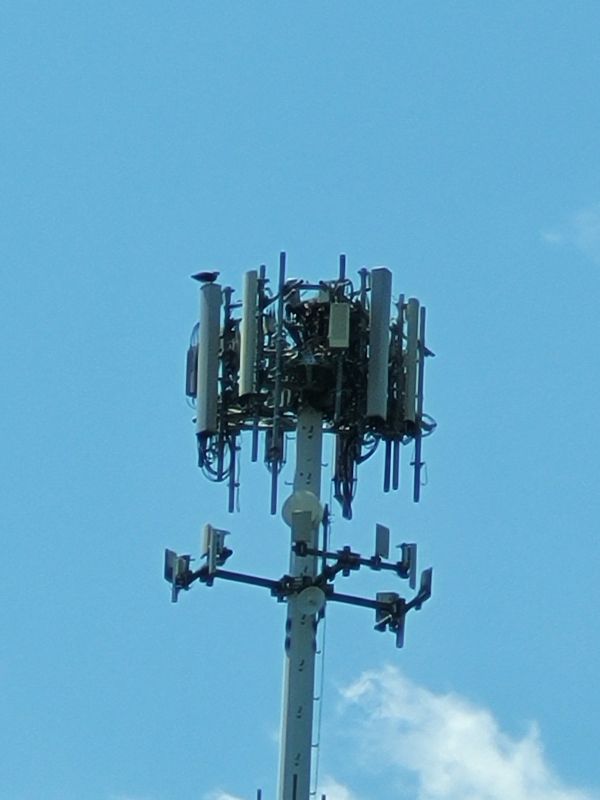
They seem to especially like cell towers. In 2024 and 2025, Adopt-A-Nest community scientists conducted 238 osprey nest check surveys in 22 Michigan counties and found that 56% of the nests observed were built in cell towers.
In fact, over 97% of the observations in this study period were of nests created on human-built structures. Nests were also found on pole platforms, electric poles, high tension towers, light poles, snags, telephone poles and water towers. Ospreys eat fish, so their favorite nesting sites are near rivers, lakes and wetlands.
"Once you know that ospreys might be nesting in tall structures all around you, it's hard to keep your eyes out of the sky," said Michigan Department of Natural Resources wildlife biologist Kara Colton. "These resilient raptors are amazing to witness, and every observation becomes part of their conservation story. Are you hooked yet? We hope you'll volunteer to adopt an osprey nest!"
Volunteer to observe nests near you
The Osprey Adopt-A-Nest program was started by MI Birds, a partnership between Audubon Great Lakes and the DNR. In 2022, the Michigan Natural Features Inventory stepped in to help support this important data collection effort long-term. This work is only possible with the help of Adopt-A-Nest volunteers who monitor osprey nests and track the reproductive success of nesting pairs throughout Michigan.
To sign up to volunteer, contact MNFI at mnfi@msu.edu and indicate the county where you would like to observe. Volunteers need to visit a nest three times, for 30 minutes each visit, in spring through late summer. A pair of binoculars is the only tool needed for most observations, though a spotting scope is helpful for monitoring cell tower nests.
Volunteers use an online form to report observations, including location information, whether a nest is occupied by a nesting pair of ospreys and, if so, whether they are successfully raising chicks.
In southern Michigan, May through July is the most active period for osprey nesting; in northern Michigan, it's June through August. By late summer, young ospreys develop feathers (called "fledging") that are large enough for flight. The birds then migrate south in the fall.
To learn more, check out the Michigan Natural Features Inventory's Osprey Adopt-A-Nest Program StoryMap.
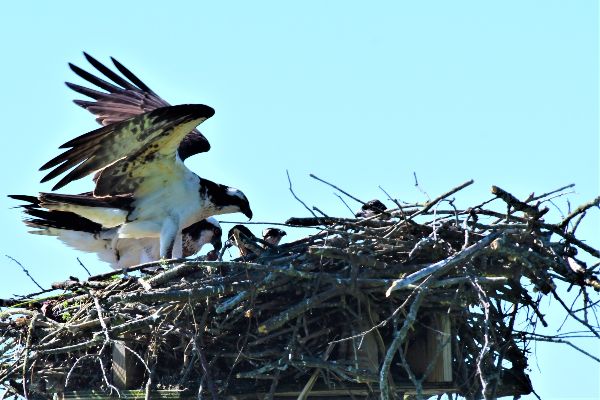
The osprey's role in Michigan ecosystems
Ospreys (Pandion haliaetus) are large, 22- to 25-inch hawks with long, narrow wings, with dark brown feathers above and white feathers below. The osprey is a species of special concern in Michigan.
Ospreys are an indicator species for monitoring the long-term health of large rivers and other water bodies. They depend on fish as their main food source and are highly sensitive to contaminants. According to the International Osprey Foundation, "The osprey is considered a sentinel species, alerting us to the changing environmental conditions in the ecosystem they inhabit, and share with us, their neighbors."
Historically, ospreys lived all over Michigan, but in the 1940s they were wiped out in the southern Lower Peninsula due to indiscriminate shooting and contaminants like the pesticide DDT. After Michigan banned DDT in 1969 (the first state to do so) osprey populations recovered well in the north, but not as well in southern Michigan.
Today, ospreys are back in southern Michigan, but there are still twice as many ospreys in the northern Lower Peninsula and three times as many in the Upper Peninsula.
"Surveying the reproductive success of osprey nesting pairs provides valuable insight into the distribution and health of populations across Michigan," said Michigan Natural Features Inventory zoologist David Cuthrell. "Data from these surveys can help scientists learn how to better aid ospreys in their recovery from previous near extirpation. It also helps us understand the overall health of the environments where they live."