
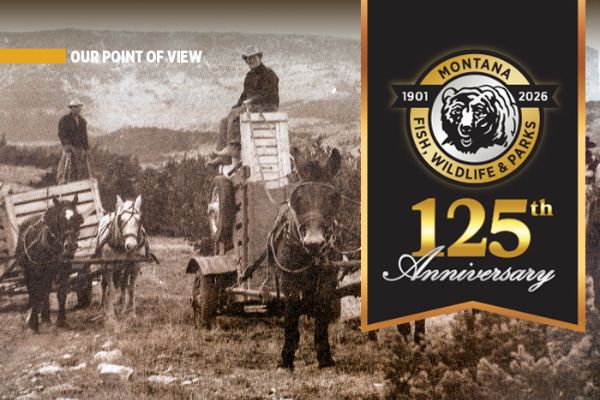
As the 27th Director of the Montana Fish, Wildlife & Parks, I'm proud to announce our quasquicentennial—the department's 125th year of conserving the state's amazing fish and wildlife resources.
The agency now known as FWP began as a modest enforcement effort in 1901 after Montana's seventh state legislature passed an act to "provide for the appointment of...game and fish wardens...to examine into and inquire about any violation of the game and fish laws of the state."
This came thanks to a steadfast effort by then-governor John E. Rickards. Like many Montanans back then, he was deeply concerned about drastic declines in fish and wildlife populations despite an assortment of state game laws—regulations that had no teeth without any field officers to enforce them.
Rickards appointed W.F. Scott as Montana's first game warden. Scott quickly hired eight deputy game and fish wardens across the state, the maximum allowed by law. To say these wardens had their work cut out for them is a vast understatement. Each patrolled an astounding 18,000 square miles on average, traveling by train with their horses from town to town. They were the department's only field employees at the time.
By the end of the decade, the number of wardens increased to 15, but the decline in game and fish species continued. Montana's pronghorn population, as just one example, fell from more than 2 million in the late 1800s to around 3,000 by 1926.
Luckily, the 1930s proved to be a turning point. In 1933, Aldo Leopold published Game Management, a seminal text establishing the field of wildlife science. A year later the U.S. Congress passed the Migratory Bird Hunting and Conservation Stamp Act and issued the first Federal Duck Stamp. Then in 1937, the milestone Federal Aid in Wildlife Restoration (Pittman-Robertson) Act was signed into law, placing an excise tax on sporting firearms and ammunition, handguns, and archery equipment. To this day, Pittman-Robertson funds underpin wildlife restoration and hunter safety education efforts across the nation, including here in Montana.
These funds allowed FWP to purchase its first big game winter range in 1940, protecting the Judith River game range for wintering elk near Utica. That same year the agency hired its first wildlife biologist, Robert F. Cooney. These conservation efforts slowly began to bear fruit.
Elk transplanted from Yellowstone National Park in the 1920s and '30s were beginning to repopulate ranges in Montana. Deer herds showed improvement as well. That helped inspire more transplants. Between 1941 and 1950, the department trapped and moved mountain goats, bighorn sheep, elk, mule deer, white-tailed deer, pronghorn, sage-grouse, American martens, and beavers to help restore them where they'd been killed off. Much of this could not have been accomplished without the consent and assistance of Montana's private landowners—including my own family.
I grew up on a ranch on the Rocky Mountain Front near Choteau that's been in our family for seven generations. I remember my grandpa telling us stories about when state game managers came and trapped mountain goats on a high corner of our land to be transplanted to other parts of the state. It's a terribly rough road to get up to that spot (we still refer to it as the Goat Trap) even on an ATV. I can't imagine hauling mountain goats in wooden carts down that mountain, but they pulled it off.
In truth, FWP's history has always been a balancing act. Generations of Montanans—my family proudly among them—came together to ensure future generations would have fish, wildlife, and a state park system to enjoy.
Take time this year to appreciate this legacy by getting outdoors to experience what 125 years of vision and joint effort has brought to life.
– Christy Clark, Director, Montana Fish, Wildlife & Parks