
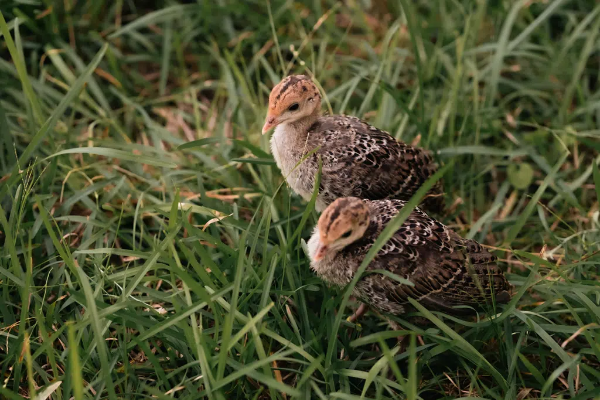
In 2010, concerns of wild turkey population declines were being discussed by Wild Turkey Working Groups. These groups were comprised of state agency biologists who recognized, based on survey data, that poult recruitment into fall flocks had diminished, averaging less than two poults per hen. Research from the past yielded the knowledge that the average of two poults per hen indicated a stable population. Any number above two poults per hen indicated a growing population.
When brought to the attention of state agency heads this suspicion of declining wild turkey populations was not pursued due to limited technology and resources to actually achieve accurate poult recruitment data at scale. Furthermore, variable approaches to determine population dynamics in each state only added inconsistency to understanding turkey populations that bridged between states in similar physiographic regions. The end result was the assumption that if there were a decline it probably could be attributed to the natural ebbs and flows in all ground nesting birds along with the byproduct that occurs after new species are established where populations artificially peak at a high level and tail off over time.
As an outdoor writer and producer of outdoor television and hunting videos, my travels have taken me all over the United States in pursuit of gobbling turkeys. My six plus decades spent in the turkey woods have afforded me the privilege of witnessing these great birds' miraculous comeback from the brink of extinction to state-agency-run hunting seasons in 49 states. In 2001, it was proclaimed that they had been re-established in every habitat capable of sustaining a wild flock, even in places where turkeys were not native to that area.
All was well in the wild turkey world for me and everyone who loved and hunted them, but in 2018, something ominous became apparent to me. It was obvious that there were just not as many turkeys in many of the places that heralded booming populations 10 years prior. The real clincher was the situation on our own land in Alabama. Our winter flock was in serious decline and had dropped from an average of 50 birds to less than 10 birds in 2019.
SKIN IN THE GAME
In June 2020, I convened a meeting at White Oak Plantation in Alabama that included myself and 13 veteran turkey hunters from across the Southeast. We were there to discuss what we perceived as population decline of wild turkeys. After that initial meeting we agreed to meet again in August. At that meeting, twelve people contributed $300 each to try to make a difference.
In February 2021, Turkeys For Tomorrow was born with the issuance of a federal 501(c)3 non-profit status. In 2023 we re-defined our mission statement to better reflect our fundamental goal: We will save wild turkeys with science based solutions for long-term sustainability.
Today, less than five years after the launch of Turkeys For Tomorrow, (TFT), it is widely accepted that wild turkey populations are in serious decline in many parts of the United States. TFT has or is funding research projects in 10 states with multiple projects ongoing in some of those states. TFT is currently working with biologists, state agencies, and universities to launch six additional research projects in 2026.
Other Non-Government Agencies (NGOs) have also responded and today there is more energy, research and financial support directed at reversing the wild turkey population decline than ever before. TFT was founded on the belief that to find answers, you have to ask the right questions. In order to do that, we have leaned on university professors, state biologists, and hunters (citizen scientists). We do not believe that scientifically proving the answer to one question is not the problem is a failure. We simply check that box, ask the next question and prove the scientific answer.
Questions like: "Why is nesting success so poor in Iowa? Is disease playing a role in Tennessee, Alabama, Mississippi, and Texas? Is it poult rearing or nesting habitat across the southeast? Is it fertility or disease in Kentucky and Alabama? The list goes on, all the while narrowing down the possibilities of the root cause.
THE POULT PROJECT
Marcus Lashley, PhD, Assistant Professor of Wildlife Ecology and Conservation with the University of Florida is currently engaged in a research project that could reveal ground breaking information. His theory is, if the problem is recruiting poults into winter flocks in sufficient numbers, why not learn more about what that takes.
"My experience and expertise are habitat," says Dr. Lashley. "In my efforts to educate myself and gain familiarity with the published turkey literature available, I realized there was very little data on hatching and rearing poults, and what was available indicated this may be a problem that could affect turkey populations. Will Gulsby, PhD, Professor of Wildlife Ecology and Management, Auburn University and I had the idea to produce a podcast that served as an information source for anyone interested in all things wild turkey. In order to provide that information, we needed to be fully aware of all the research published in the past. It was our goal to put that information out in language anyone interested could understand. When we pitched the idea to Turkeys for Tomorrow, they fully funded the podcast, and we were off to the races.
"We have several projects ongoing now that involve turkeys," he continued. "The one that is currently garnering the most attention is what we call the 'Poult Project' and it is extremely unique. We were very fortunate to partner with the National Wildlife Research Center in Gainesville, Florida, which already had aviaries built which they used for bird research and they were vacant. Another important factor was that the aviaries were large enough to manipulate the habitat and have various plant communities available to the poults. This allowed us to compare how a brood raised in natural herbaceous habitat fared compared to a brood raised in a planted or food plot environment. It was just a stroke of luck, but they were looking for projects and we had funding. The scope of the Poult Project is trying to understand what factors in habitat quality determine poult survival and success, such as growth rates and foraging. There are only a few empirical studies on poult rearing success and the ones that exist suggest there is a problem and might be limiting populations in some places. The other problem is the difficulty of studying poults in the wild. They are growing so rapidly, and we don't have the technology to track them sufficiently in the wild to gather robust data. That explains why there are so few studies on that life stage, but it does not decrease the importance of having that knowledge."
Another fortunate coincidence was that Dr. Lashley and his staff at the University of Florida Game Lab (UFGL) were monitoring over 100 GPS tagged hens in the Eastern and Osceola ranges of Florida. Permits were secured to recover eggs from the nests of hens that were killed or abandoned nests during the nesting period.
"We are able to determine when a hen has been killed by a signal issued by the transmitter. Once a nest is abandoned, or the hen is killed, there is a very short window of time to keep those doomed eggs viable. In order to do that, we have to maintain a temperature and humidity similar to the that of a hen sitting on the nest. Some of the eggs we salvaged were hours away from our lab and modern incubators. One of my technicians came up with the idea of heated grain (Japanese millet seeds), and a small ice chest to maintain optimal egg temperature until they could be placed in the incubator," said Dr. Lashley.
INTRICATE DETAILS
When the eggs arrived at the lab, they were measured, weighed, and speckle patterns on the eggs were recorded. They were then placed in the incubator until they hatched. Individual clutches were kept separate from other clutches to see if genetic differences produced different behavior patterns. GPS data gave the researchers some idea of how long the eggs had been incubated by the hen, but it was vital to know when the eggs would hatch so the researcher who was to become the mother hen was on hand and available for the next two weeks.
"To better determine exact hatching dates, we used a method called candling," said Dr. Lashley. "Initially, researchers would hold the eggs in front of a candle flame. The light penetrated the egg enough to determine the position and size of unhatched poult inside. Today we use a flashlight, but still call the practice candling. Typically, two days before hatching, the eggs would start to move, and we could hear the poult inside communicating with other poults in the clutch. At that time, a technician, or mother hen, was assigned to a specific clutch and he or she would start talking or communicating with the unhatched poults. Candling also revealed that the unhatched poults had turned in the egg putting their head toward the large end of the egg. Poults utilize an egg tooth located on the end of their beaks to pip a small hole in the egg shell. From that point, they pip a circle around the shell that breaks open, allowing the poult to emerge. Watching this was awe-inspiring. Times from the first pipping activity to emergence from the egg varied from one hour to as much as 36 hours. From the first time they made eye contact, you knew you had just witnessed a miracle, and you had just assumed the role of mother hen. We were pleased to see that over 80% of salvaged eggs hatched."
DAY ONE
The first day, individual broods are held in small tents large enough to accommodate the researcher and allow the poults room to explore. According to Dr. Lashley, each poult would lock eyes with the researcher as if looking for assurance. After that, they would move about the tent exploring, but often pausing to look back at the researcher to make sure mother hen was there. The entire day is spent building trust and offering encouragement. Researchers offered small insects to the poults in an effort to teach the poults what food looked like and to strengthen the bond between poults and mother hen. Renowned turkey researcher Lovett Williams had witnessed hens offering insects to poults and included that fact in one of his published papers.
DAY TWO
On day two, the researcher leads the poults into the treatment area where they will be raised. The area is designed with different versions of habitat that allows the researcher to observe and record the plant community preferred by the poults.
"One thing that was really eye opening to me was the minute these two-day-old poults hit the ground, they immediately turned into raptors," said Dr. Lashley. "Nobody had to show them what to do. They instinctively knew that if they found a bug and could swallow it, they did. They constantly checked to see where mother hen was and willfully followed her (the researcher) wherever she led. They communicated verbally as well as with soft whistles, kee-kees, and whines, stopping often to observe their surroundings. Also, on day two, we began weighing each individual poult four times each day. We also measured certain feathers four times each day — all to determine growth rates in a particular treatment area that could be compared to poults growth rates in different treatment areas."
DAY THREE THROUGH THIRTEEN
According to Dr. Lashley, these days were spent practicing the same routine. Poults would be led from where they spent the night in a small, heated tent into the treatment area to forage for food. Their diet was supplemented by regular feeding of a mixture of dried meal worms and fruit. There were regular intervals of loafing (chilling in the shade).
"The most vulnerable timeframe for poults in the wild is pre-flight. Once they can fly well enough to roost off the ground, generally their survival rate goes up substantially," said Dr. Lashley. "If you look at the literature, that's somewhere between 7 and 19 days, which is not very helpful if you are trying to design an experiment. We used netting, slightly taller than your knees, to limit their movement. We decided that, when we could not keep them inside that perimeter, when they could fly over the netting, they have reached flight. We placed several broods in these containment areas, and every brood reached flight on day 13. Once flight was achieved, they were released into the general population with other broods of similar age and development. They almost immediately began socializing in amalgamated groups, just like they would do in the wild. We still had researchers spending large amounts of time daily walking them around and continuing the mother hen role. It took an army of people to coordinate all this. Essentially, we were trying to keep them enriched while being very careful to observe and record everything on a scale. This would have been impossible to do in the wild. Another thing we noticed was that everything they did was innate. They instinctively knew to look up for danger, they knew that bright colored caterpillars were not to be eaten, loud noises produced behavioral responses consistent with what you would see in the wild. They were curious, but in a cautious way."
Dr. Lashley also shared that even though these broods were raised isolated from other broods until after flight, they all knew what turkeys were supposed to sound like. They have different sounds for different things, but they all just know that.
DAY FOURTEEN AND BEYOND
Dr. Lashley calls day 14 graduation day. Restrictive nets are removed and it is the day poults are free to mingle with other broods in the enclosure. Researchers spend hours daily observing and recording food preferences, social activities, behaviors and interactions. The poults are still weighed, and feathers are measured four times daily.
According to Dr. Lashley, these young turkeys will spend their natural lives in these enclosures, all the while being studied and observed. There are multiple experiments planned to garner more information about them from hatch to end of life. He truly believes these findings could reveal pathways and management techniques that landowners and managers can implement to improve turkey populations on the lands they manage.
Knowledge is powerful and it emboldens us to try new things. Is the answer to population decline in wild turkeys to be found by UFGL and the Poult Project? Only time will tell but documenting and proving facts about poult hatching and brood-rearing can only be a positive thing for the future of wild turkeys.
TAKE A CHANCE ON TFT
Earlier in this article, I briefly mentioned the Wild Turkey Science Podcast. When Dr. Gulsby and Dr. Lashley approached us about sponsoring the podcast, TFT was at a critical juncture. We were mid-way through our third year of existence. I won't mention exact dollar figures, but the asking amount was a reach for a fledgling organization. We asked what we could expect in return for the investment into the podcast and received a projection of 50,000 downloads. After deliberation by the TFT Board of Directors, we agreed to be the sole sponsor for the Wild Turkey Science Podcast. Today, we are well into year two of that agreement and downloads across all platforms are well into seven figures, but that is the tip of the iceberg.
"We recently asked our listeners to participate in a survey," said Dr. Lashley. "Participation from our listeners was not great but there are a few things we learned that are worth mentioning. For instance, management practices or habitat improvements discovered by podcast listeners have been implemented on almost 2 million acres in hopes of improving turkey populations. The podcast has been downloaded in more than 100 countries across the world. The podcast has been downloaded in every state in our country and in every county in several states. TFT took a chance on the Wild Turkey Science Podcast, and the Podcast took a chance on TFT. In the end, wild turkeys are the winner and that is how it should be."
From my perspective, it has been very rewarding to see the turkey community realize there is a problem with turkey populations and begin actively searching for solutions. Turkey hunters are a passionate group, and I believe they are willing to swallow any pill to ensure wild turkeys are thriving and at a minimum, populations are stable.
I ask you to consider supporting the efforts of so many in the effort to ensure wild turkeys do not go the way of the bobwhite quail. If hunters don't do this who will? If not you, who?
If you want to help Dr. Lashley and his work at the University of Florida go to: http://UFgive.to/UFGameLab
Support TFT
Wild turkey populations are on the decline throughout the nation. Established in 2021, TFT is new to the landscape, but it's driven by highly trained professionals with decades of conservation experience. To support TFT, and the complete body of wild turkey research and conservation it's leading, become a member today. An Adult Annual Membership is $50, multi-year Team Turkey Membership is $250, and Life Membership is $2,500. Every dollar counts in the fight for wild turkey preservation.