
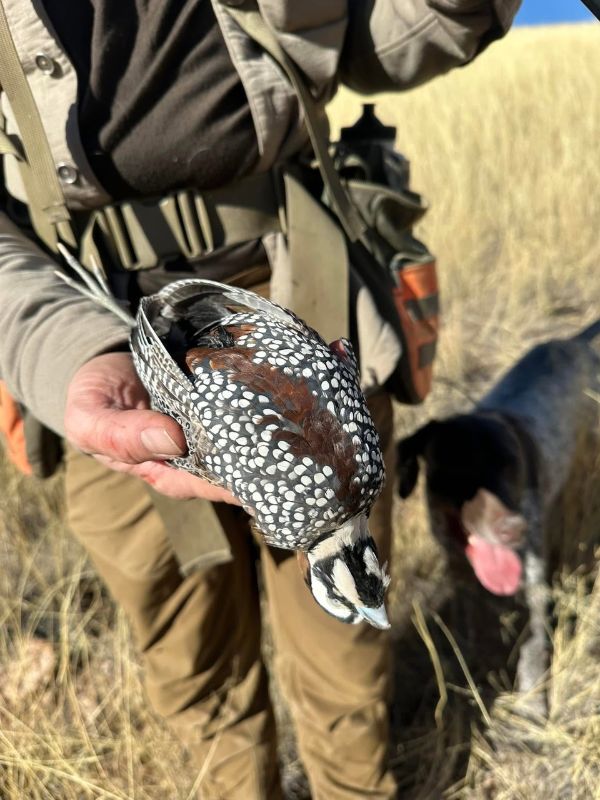
Pittman-Robertson funds the conservation of a southwestern game bird
It might be the quail that you never heard of, and perhaps for good reasons, not the least of which is its limited range in three southwestern states: Arizona, New Mexico, and Texas. That near anonymity is confounded by the fact that the bird has a host of common names or nicknames that apply depending on where they occur.
Here are a few labels: Fool’s Quail, Harlequin Quail, Montezuma Quail, Moctezuma Perdiz, Codorniz, and Mearns’ Quail.
These names came about based on the bird’s behavior, appearance, locale, and a chance encounter with a physician in the service of the U.S. Army, Edgar Mearns, M.D.
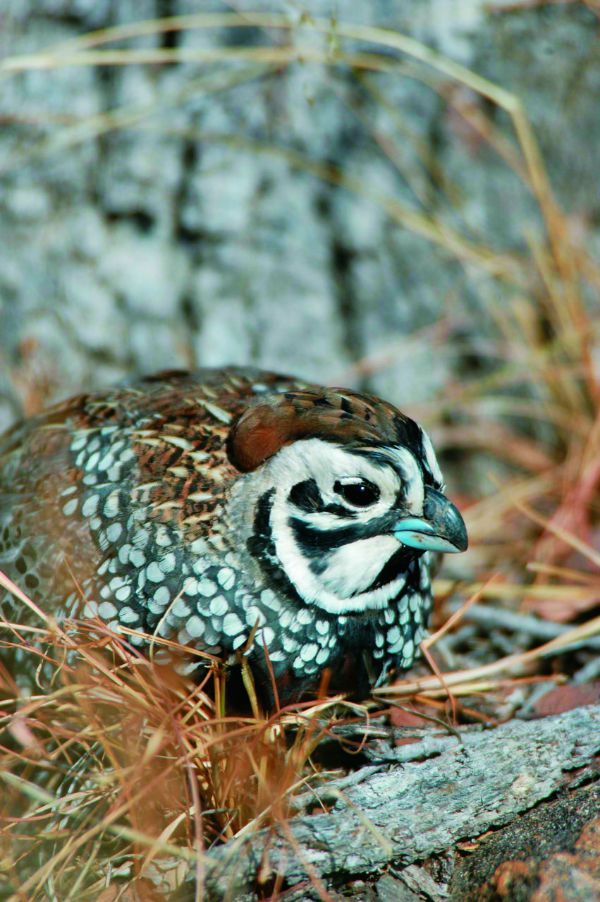
Fool’s Quail: It’s an undeserved nickname based on the bird’s tendency to freeze when approached by hunters or predators. It does not run. It flies—reluctantly. It’s a clever tactic for survival in the wild. The bird’s camouflage works exceedingly well hiding stock still in tall bunch grasses amid sparse stands of evergreen oaks and junipers—fooling hunters that might walk within inches of a bird that could go undetected. For that reason, a good pointing dog is a necessity to flush a bird for the gun.
Harlequin Quail: They do look clownish, cute, even. The name stems from its striking plumage resembling a character in an Italian comedy wearing a hodgepodge patchwork of clothing and a fanciful mask.
Montezuma Quail: This, and the Spanish-language variants speak to the bird’s extensive natural range south of the border. The bird occurs in uplands through Mexico, with the southern-most populations found near Mexico City. It is essentially a Mexican species. Its range in the United States is rather limited, persisting in the arid grassy rolling savanna studded with a sparse overstory of low-growing trees in West and Central Texas, southeast Arizona, and central and southwest New Mexico.
Mearns’ Quail: Dr. Mearns was an army surgeon and naturalist stationed from 1883 to 1888 at Ft. Verde, Arizona. In 1891 Mearns was assigned as the medical officer for the United States-Mexican International Boundary Survey, the crew that laid the international line from El Paso, Texas to San Clemente Island, California. Mearns collected an enormous number of plants and animals for science in his long military career, among them his namesake bird.
Dr. Mearns wrote in his field notes about encountering the quail: “As I clambered up this difficult slope [in southern Arizona], one after another they flew up before me, always from right in front of me, uttering their singular notes, and generally taking me when badly balanced and unprepared.”
Anyone who has hunted the softball-shaped bird knows there is no substitute for a lack of preparedness.
Since Edgar Mearns’ time, his namesake bird has declined in number, its range in the United States diminished. Still, both Arizona and New Mexico have liberal seasons open for the bird, and they have their following of ardent bird hunters.
The Texas population is closed to hunting. It will likely remain so in the immediate future. But that could turn around. Using Pittman-Robertson funds derived from federal excise taxes paid by firearms, ammunition, and archery manufacturers, Texas Parks and Wildlife Department biologists have collected tissues from isolated quail populations to map their genetics, an endeavor that includes researchers at Purdue University and Universidad Estatal de Sonora (Sonora State University).
Licensed hunters were at the fore, providing tissues, crops, and feathers from birds harvested in Arizona and New Mexico. Texas birds were also harvested using bird dogs and shotguns under a scientific collecting permit. It was the most effective and cost-efficient manner to collect the needed specimens for research purposes. Nearly 200 hunter-harvested birds from Arizona and New Mexico, and another 200 birds collected in Texas and Mexico were the basis of the genetic research.
Some findings of that research have been reported in a scientific paper published by quail researchers from Purdue University and Universidad Estatal de Sonora, joined by biologists from the Texas Parks and Wildlife Department. A second research paper from Purdue is coming soon which will highlight how populations have evolved over time, the development of unique regional adaptions, and how expected changes in habitat will affect the species over the next century.
Population expansion in Texas may require the transplanting of birds from an outside source and genetic mapping could inform scientists where best to derive those birds. Interestingly, populations in central Mexico may be better suited, genetically, for the task than populations north of the border. Texas biologists are hopeful that increased awareness and investment in habitat restoration, working with landowners, will lead to huntable populations.
Pittman-Robertson dollars fund habitat management and the collection of general hunter-harvest data that inform hunting regulations set by the New Mexico Department of Wildlife. The Department has also used these funds to support university-level research in habitat selection and responses to tree canopy thinning, using telemetry transmitters to track bird movements. Land management agencies use recommendations from this research to selectively thin juniper stands to encourage the growth of grasses that provide essential habitat for quail.
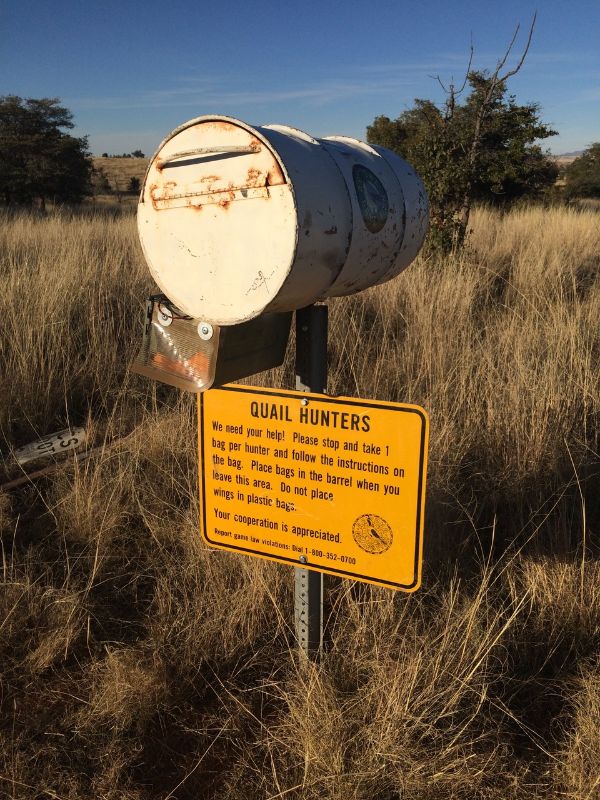
Similarly, the Arizona Game and Fish Department over the last five years has restored grasslands in southern Arizona and is presently engaged with the U.S. Forest Service to thin encroaching mesquite and juniper from 3,000 acres of oak savanna. Pittman-Robertson dollars pay for ongoing extensive hunter-harvest surveys conducted via mail and email. Hunters are encouraged to place wings of harvested birds in collection barrels so that biologists can gather biological data such as sex and age of the harvested bird. In addition, state biologists contact hunters afield and occasionally at check stations to gather more data. It’s labor-intensive but the resulting data are rich and important to conservation.
No matter what you call the ornately dressed bird, it is an inherent part of the Southwest and a delight to hear and see. Watching one burst into flight across the tawny grasslands of a rolling savanna, with a bird dog holding steady on point, is the culmination of conservation that starts with Pittman-Robertson.
– Craig Springer, for the USFWS, Office of Conservation Investment