
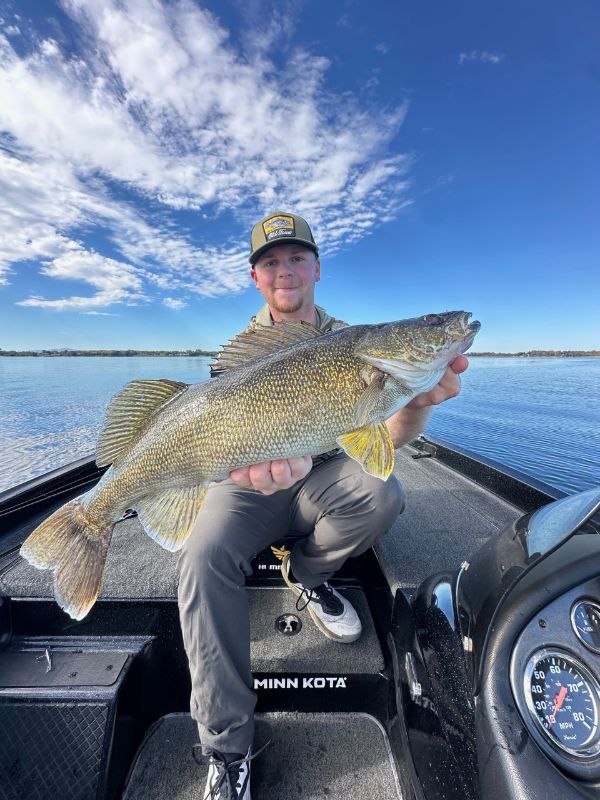
Would you rather haul a five-pound walleye up from the nearby reservoir on a downrigger or would you rather have the same fish filleted and beer-battered, sending flecks of sizzling grease arcing off the stovetop?
“Yes,” to both is probably any ardent angler’s answer.
You cannot have one without the other, and getting into a boat on a Saturday morning often leads to fish in the skillet.
But that is not the first step to putting a delectable on the plate. The progression to the skillet starts in of all places, the C-suite office of the tackle manufacturer or importer.
Every fiscal quarter fishing tackle company accountants and comptrollers, in accordance with the Sport Fish Restoration Act (SFR), cut a federal excise tax check to the U.S. Treasury. Those dollars, coupled with proceeds from fishing license sales, make their way to state fish and wildlife agencies to fund fisheries research and management, aquatic education, and boater and angler access to public waters.
Money changing hands is not the story: it is what’s done with it that makes a difference in the lives of Americans.
Home Field Advantage
Biologists with the Minnesota Department of Natural Resources used SFR dollars to learn more about walleye in the southern part of the state to refine management strategies. Through careful collection and analysis of data, their multi-year examination of walleye fry survival to fingerling size revealed that locally sourced walleye have a home field advantage.
Fisheries managers for many years stocked walleye fry in southern Minnesota lakes from an easily accessed, well established broodstock in northern Minnesota.
Cursory studies indicated that the genetically adapted southern-strain appeared to outlive the northern cousins that had been stocked on top of them en masse, spring after spring, year after year.
To suss out a potential course of action, biologists stocked equal numbers of southern-strain and northern-strain walleye fry in six lakes in spring over four years. All walleye fry were marked according to origin. Then in the autumn, biologists returned and collected fingerling walleye to determine survival.
The results were clear: the locally sourced southern Minnesota walleye outlived the northern-strain. The native walleye were better suited to their native habitats.
This walleye research was partly an economics study, too. The biologists calculated and compared costs of using a local source of walleye rather than continuing with the northern-strain as they had been done for decades.
The heavy upfront cost of creating a southern-strain broodstock would ultimately result in long-term savings. Locally sourced walleye are better adapted to their home waters, increasing their chances of surviving the first summer and eventually making it to the livewell, and the skillet. That improved survival could make the investment worthwhile by reducing the need to repeatedly stock fish that are less likely to survive. In turn, those savings could help preserve SFR and fishing license funds for other sport fish conservation needs.
Virginia is for Walleye Lovers
Biologists with the Virginia Department of Wildlife Resources (VDWR) also seek to refine walleye management.
Walleye native to the Appalachian region, called Highlands walleye, are genetically different from northern walleye that have been introduced through past stocking efforts. The two strains can interbreed gradually diluting or erasing the unique genetic characteristics that allow native Highlands walleye to thrive in local conditions. Over time, this genetic mixing could make it more difficult to conserve and maintain the native Highlands walleye population.
Using SFR dollars, VDWR biologists are creating a rapid and affordable genetic test to identify walleye with strong Highlands ancestry. From those fish, they intend to create a broodstock for the Appalachian walleye.
Researchers will collect small fin clips from 400 adult walleye in the New and Clinch rivers. Geneticists will use these samples to develop a panel of genetic markers that can distinguish Highlands walleye ancestry from northern walleye ancestry. The VDWR can then use this information to select future broodstock that best represent native Highlands walleye.
By improving broodstock selection, the project will help reduce genetic mixing between introduced and native walleye, protect the genetic integrity of Highlands walleye, and support long-term conservation and restoration of walleye in Virginia.
These methods and results may also benefit other state fish and wildlife agencies working to manage endemic walleye populations by providing a practical, cost-effective approach for identifying and conserving native fish.
SFR dollars yield a public benefit—advancing fisheries science, generating cost-savings, improving fishing opportunities, and in the case of walleye, putting great-tasting locally sourced food in skillets. So, would you rather…
— Craig Springer, for the USFWS, Office of Conservation Investment