
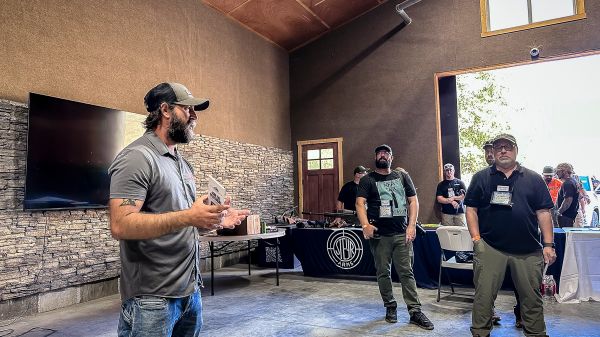
There are two—no three—things I learned from shooting the Ultimate Hunting Experience during the SilencerCo media event a little over two weeks ago in Idaho
But first, you’re probably wondering: What exactly is the Ultimate Hunting Experience, or UHE? I had the same question when SilencerCo told me I would be participating in one of its Expeditions.
I assumed—wrongly—that it was a conventional hunting competition format. Although UHE’s founders have backgrounds in Precision Rifle Series (PRS) and NRL Hunter competition, the experience isn’t built around shooters racing one another against the clock. Each UHE participant competes only against his or her own self with the goal of improving their hunting skills.
In the introduction to his Q&A with UHE co-founder Evan Dextraze, Jay Pinsky described it as “where the prey is inexperience and the trophy is success.”
Initially, I wasn’t very interested. But the absence of a timer, a complicated scoring system and a maze of divisions and classifications was refreshing. There were targets to shoot, realistic positions to negotiate and a spotter available to help. It was straightforward.
In the end, I found UHE to be a fun, highly enjoyable way to practice practical rifle shooting. That was quite a turnaround for somebody who had gone into the experience apprehensive. I didn’t merely like it. I really, really enjoyed it.
1) I Learned I Can Shoot at Distance
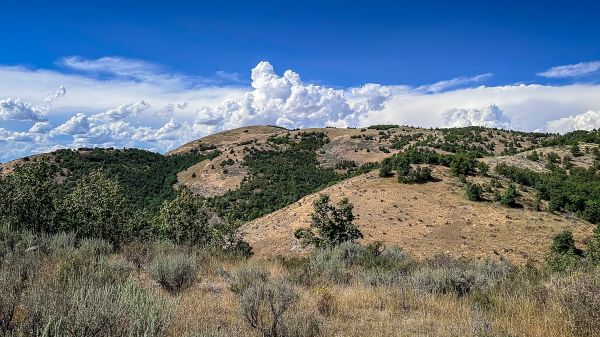
The first lesson was that I actually can shoot at distance. This was only my third opportunity to engage genuinely long-range targets. The first came in September 2022 at a Bushnell media event, where we shot from 400 yards out to a mile.
The second time was in October of 2022 at Gunsite, where Mossberg introduced their new Patriot LR Tactical. After zeroing the rifle at 100 yards, we moved to targets at 400 and 600 yards.
Since then, I hadn’t shot beyond 50 yards, aside from a possible 100-yard sight-in session that I only vaguely remember. In other words, long-range shooting isn’t exactly in my wheelhouse.
But…
While it took me five shots on the first stage to connect with a steel coyote at 880 yards, once that final shot hit, however, I found my footing on the UHE course at Day Mountain Ranch.
Next came an 828-yard bear, which I hit on the first try. I followed that with first-round hits on a coyote at 746 yards, another bear at 1,200 yards and a nutria at 200 yards.
I missed two shots at a second nutria positioned 512 yards away, then moved on and hit one at 453 yards on the first try. I’m still not sure what I did wrong at 512, but I was happy to move on.
Next came three trash pandas at 250 yards. I hit each one with a single shot, then scored another first-round impact on a wolf at 605 yards.
At this point, I was feeling myself—until I faced an elk target at 1,050 yards. I missed on the first shot and promptly gave up. There’s something about a downhill prone shooting position aiming at an uphill target that my neck doesn’t particularly enjoy—if the pain was any indication.
That ended our time on the UHE course. We didn’t have time to complete the full course of fire, but the point wasn’t to post a final score. It was to build confidence, and that’s exactly what the experience did for me.
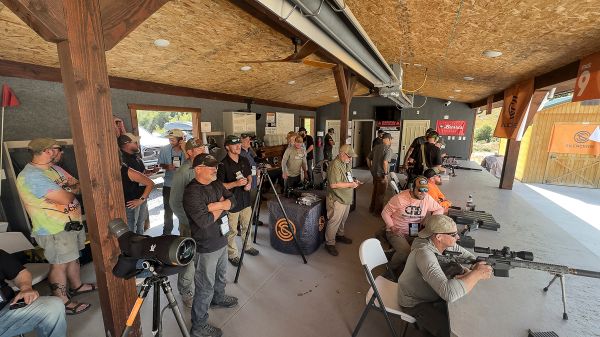
We continued shooting later as part of the SilncerCo media event. I cleaned a three-rifle course, that began with a .450 Bushmaster at 200 and 300 yards, firing twice at each target. I then scored two hits at the same distances with an 8.6 Blackout. Both rifles were fired from a seated bench position.
For the final position, we stood at the bench and used a bag to engage an uphill target at 500 yards. The challenge was to hit it seven times with seven shots using an AR-15 chambered in 5.56 but zeroed for 100 yards.
According to the spotter, I hit all seven—presumably by using the Force, because I couldn’t tell you where I held on the reticle.
I quite literally eyeballed it, which the other shooters didn’t much appreciate when they asked where I had held.
2) I Learned How to Properly Hold and Shoot a Rifle
There’s a reason I shot so well. Actually, there are two reasons. Both are thanks to SilencerCo.
The first is that SilencerCo pro staffers Clay Blackketter and Austin Orgain gave us some invaluable instruction. They explained that the harder you fight to control the rifle, the more difficult it becomes to maintain a stable sight picture.
Instead of leaning into the rifle and trying to force it to remain still, I needed to do the opposite and just relax and allow the gun to settle naturally. It worked brilliantly.
I can’t overstate how much that advice changed my understanding of rifle shooting. I wasn’t the only one who came away from the instruction with that revelation.
This is undoubtedly common knowledge among experienced rifle shooters, but it isn’t necessarily something a person picks up alone. Once I relaxed and let the rifle settle, whether it was supported by a bipod or a bag, the difference was night and day.
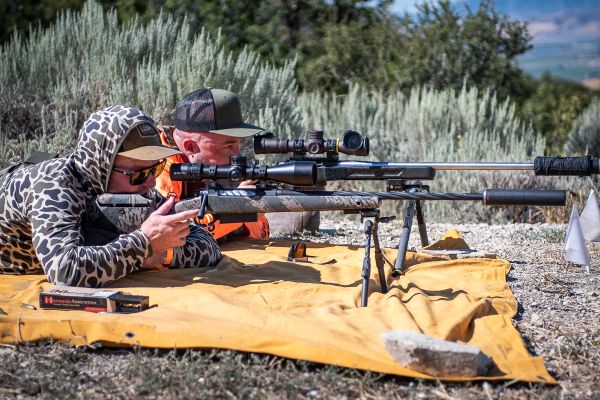
The second reason falls squarely on the shoulders of Chase Glenn, SilencerCo’s VP of Strategic Execution. Chase is a competitive rifle shooter, and more importantly served as the captain of our squad. Having him shoot first, and explain his hold, had a big impact on my own performance.
His coaching on the stage, coupled with the shooting technique lessons from Blackketter and Orgain, was the secret sauce for my success during the media event.
It was such a good feeling hitting targets with relative ease that I can’t wait to get out and shoot my Mossberg Patriot LR Tactical in 6.5 PRC. Paired with a Bushnell Match Pro ED 5-30x56 FFP—and assuming I can zero it properly—it should make an excellent combo.
And yes, I’ll be shooting this setup suppressed.
3) I Learned Shooting Suppressed is the Way to Go
I often quote my friend Ethan Lessard of Q, who once told me, “Shooting without a suppressor is uncivilized.”
No truer words were ever spoken, especially after my time in Idaho.
After shooting the UHE course with nothing but suppressed rifles, I can tell you this: If you live in one of the 41 states that allows you to hunt with a suppressor and you aren’t using one, you’re doing it wrong.
About halfway through the UHE stages, I suddenly remembered that every rifle was suppressed. I had completely forgotten, in part because it was so comfortable to communicate without talking over bulky hearing protection.
And don’t get me started on trying to get on the stock while wearing a pair of earmuffs.
Hunting suppressed—and just shooting suppressed in general—is the way to go.
Luckily, I hear there’s a bit of a suppressor gold rush underway, and getting your hands on one is both easier and faster than it used to be.
– Paul Erhardt, Managing Editor, the Outdoor Wire Digital Network