
I don't like anyone telling me what to do, especially the government. But sometimes I’ll make exceptions.
Like when government messages are for my own good.
Much of what a state agency like Montana Fish, Wildlife & Parks does is to explain what is legal and not. You need to have a Conservation License to use a fishing access site. You must wear 400 square inches of blaze orange when big-game hunting. It’s not legal to shoot at waterfowl after sunset.
That type of thing.
But what about ethics? For the most part, thankfully, FWP keeps its nose out of your business, despite being urged by individuals and groups to promote their pet concerns. That’s smart. Some anglers want everyone to release every trout they catch, even when it’s legal to keep a few. Some hunters denounce shooting ducks on the water, even though someone like me might want to take the sure shot and not risking missing or, even worse, wounding the bird.
The list goes on and on. What I think is unethical or unsportsmanlike, like shooting at an elk beyond 400 yards, may be just fine with you, and vice versa. FWP’s role in such matters, generally, is to make clear what is legal and not, enforce those laws, and then butt out of the rest.
The exceptions come when certain behaviors—even though legal—can endanger people’s own lives, or the lives, property, or recreational experience of others. One example is FWP’s yearly Bear Aware campaign. Each September, the department goes into overdrive promoting things people can do—like carrying accessible bear spray and securing food attractants—to reduce the odds they will be harmed by a bear or that a bear will need to be killed for doing something that could have been prevented, like raiding campsites scattered with accessible food.
Another area where I’m okay with FWP cautioning me and others is when it comes to water and hypothermia safety: Don’t boat in high water. Stay off thin ice. Always wear a well-fitting life jacket (PFD) when boating—especially in fall, winter, and spring when water is dangerously cold.
Or when the department warns against crowding others at boat ramps or while floating down a river.
Again, none of these messages focuses on illegal activity, only behaviors that can put someone’s life at risk or ruin others’ recreational experience.
It’s in this light that FWP has in recent years been promoting ethical hunter behavior on private property.
“We’ve been focusing on the five main things landowners have told us some hunters do that they really find annoying—leaving closed gates open, littering, driving across fields, shooting near livestock, and knocking on doors before dawn to ask permission,” says Greg Lemon, head of the department’s Communication and Education Division.
Lemon explains that the landowner focus is critical because so many of FWP wildlife habitat and hunting access programs are on private property. “Without the cooperation of landowners, a huge amount of habitat improvement and hunter access just wouldn’t exist,” he says.
The FWP campaign is “Protect the Hunt. Respect Access.” (Learn more here)
“The idea is that hunting on private land is a privilege, and we all need to respect that and act accordingly,” Lemon says. “Otherwise, we could lose millions of acres of access, which would threaten hunting in Montana as we know it today.”
In addition to the behaviors Lemon lists above, hunters also need to patrol their
own ranks.
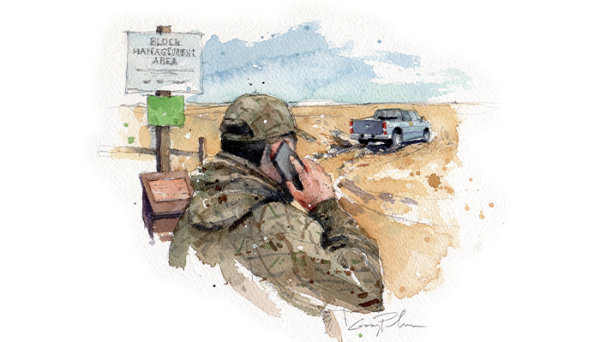
“It’s not just doing the right thing yourself but making sure others do, too,” he says. “When you see someone messing up a Block Management Area, say something to that person, or take down their license number and call the local game warden.”
That’s because they are also messing with your and my opportunities to hunt there and other private lands in the future.
Protecting public access by improving landowner relations? That’s one private affair I’m happy to see government stick its nose into.
– Tom Dickson, Illustration by Gary Palmer
Today's feature is courtesy of Montana Outdoors Magazine, and is reprinted here with their permission. Montana Outdoors is the official magazine of Montana Fish, Wildlife & Parks. You can subscribe to Montana Outdoors here.