
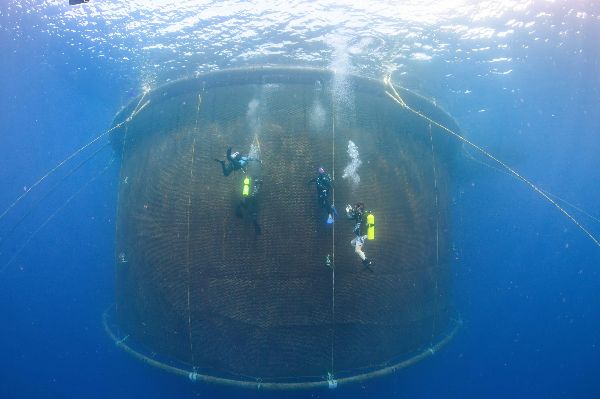
Florida may soon be home to two very different experiments in raising fish for the American seafood market—one 40 miles offshore in the Gulf of Mexico and the other, already in operation, inside a giant building south of Miami.
Ocean Era, a Hawaii-based mariculture company, has received final approval from the U.S. Environmental Protection Agency for its Velella Epsilon demonstration project, moving a proposed offshore fish farm closer to reality.
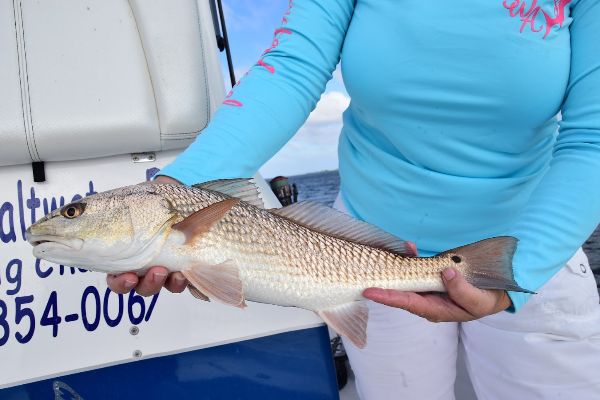
The project would place a single large net pen in federal waters about 40 to 45 miles southwest of Sarasota. The pen would contain as many as 20,000 red drum, native to the Gulf, which would be grown for about 12 months before harvest.
At an 85 percent survival rate and an estimated harvest weight of 2.75 pounds per fish, production would be about 46,750 pounds.
That is a small amount of seafood by commercial aquaculture standards, and Ocean Era describes Velella Epsilon as a demonstration project rather than a full-scale commercial fish farm. The idea is to find out what happens when fish are raised in a large offshore enclosure while measuring the effects on the surrounding marine environment.
The project has been nearly a decade in development and has gone through multiple rounds of federal review and environmental challenges. Earlier versions called for raising almaco jack, but the company eventually switched to red drum. EPA's permit has also been modified to address such things as production levels, net material and the mooring system.
The environmental questions are central to the experiment. Fish consume feed, and some feed inevitably goes uneaten. Fish also produce waste. Critics of offshore aquaculture have raised concerns about nutrients entering the Gulf, along with pathogens, microplastics, interactions with wild fish and other possible effects.
Ocean Era argues that an offshore location provides enough water movement and dilution to make the environmental effects manageable and, more importantly, that the demonstration will provide actual field data rather than relying on laboratory models.
The project is not yet a commercial operation. Funding, installation and other regulatory and logistical steps remain before fish can be stocked. Ocean Era has said it hopes to have the pen operating as early as February.
At the same time, about 250 miles southeast of Sarasota, another Florida fish-farming experiment is already producing millions of pounds of fish—but it never puts a fish in the ocean.
Atlantic Sapphire operates a massive indoor Atlantic salmon facility in Homestead. The company calls the operation a "Bluehouse," and it represents almost the exact opposite philosophy from Ocean Era's offshore pen.
The salmon are raised in a land-based recirculating aquaculture system, or RAS. Water is continually filtered, treated and reused, with the company reporting that more than 99 percent of the water is recycled.
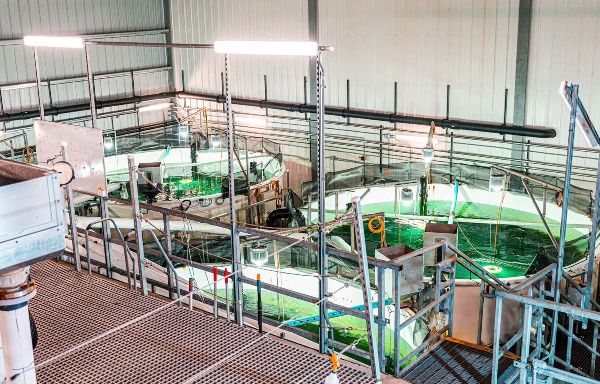
The choice of South Florida for Atlantic salmon sounds strange until you look underground. The facility uses deep groundwater sources, including naturally filtered saline water, while sophisticated systems control temperature, oxygen, carbon dioxide and other water-quality parameters inside the tanks.
The salmon never have to cope with the warm Gulf of Mexico, sea lice, ocean storms or the biological variables encountered by fish raised in conventional marine net pens.
The scale is dramatically different from Ocean Era's demonstration. Atlantic Sapphire's Florida operation has a stated Phase 1 capacity of roughly 7,500 to 8,500 metric tons of salmon annually—roughly 16.5 to 18.7 million pounds. The company has plans to eventually increase total production to approximately 25,000 metric tons annually.
The packaged fillets are being marketed by Publix, among others—they’re for sale in our local store here in Guntersville.
The price is a bit higher than for the salmon that comes from cold water oceanic farms so far—and therein lies part of the problem.
Atlantic Sapphire has experienced fish mortalities, technical problems and substantial financial challenges while trying to make a huge recirculating system work at commercial scale. The company has nevertheless continued operating and improving the facility. During the first half of 2026, it reported increased harvest volume and higher live biomass compared with the same period a year earlier, along with improvements to its water-treatment and cooling systems.
The two Florida projects illustrate the fundamental choices facing the rapidly developing aquaculture industry.
Put the fish in the ocean and let the Gulf provide the water, temperature moderation and enormous volume needed to disperse waste, as Ocean Era proposes. Or keep the fish on land and attempt to control virtually every aspect of their environment, as Atlantic Sapphire is doing.
Neither approach eliminates environmental and economic questions—and Florida is particularly sensitive to both.
The offshore model raises questions about nutrients, waste, escaped fish, wildlife interactions and the cumulative effects if dozens of pens eventually occupy coastal waters. The land-based model eliminates most direct interaction with wild marine life but requires massive infrastructure, continuous water treatment and considerable energy to maintain the proper conditions for a cold-water fish in subtropical Florida. And the price has to become competitive, or failure is certain.
Florida already has a substantial aquaculture research infrastructure, including state and university facilities raising marine fish for research and stock enhancement. What is different now is the scale and commercial ambition of these projects.
For anglers and boaters, the offshore experiment may attract the most immediate attention because it puts a new structure—and 20,000 farmed fish—in the Gulf.
This is not an immediate non-starter because vast schools of adult redfish, 10 pounds and up, naturally swarm in the waters of the continental shelf—the net pen won’t add any significant amount of waste to what’s already there. But what happens if there are dozens of these pens, much larger, a few years down the road?
At the very least, this is an experiment that anglers and environmentalists will want to watch closely for the foreseeable future.
– Frank Sargeant, Editor, The Water Wire