
Several years ago, during a conversation about the need for more shooting ranges, Jim Shepherd threw out the idea of “100 new ranges—two per state.”
It was a simple concept, an easy goal to understand and, in some cases, an achievable one.
Sure, there are states where building a new shooting range presents major hurdles. Rhode Island doesn’t have much room, and starting any business in California is a punishing process. Opening a shooting range there probably makes Sisyphus’s job look easy.
But other states offer great opportunities for new ranges.
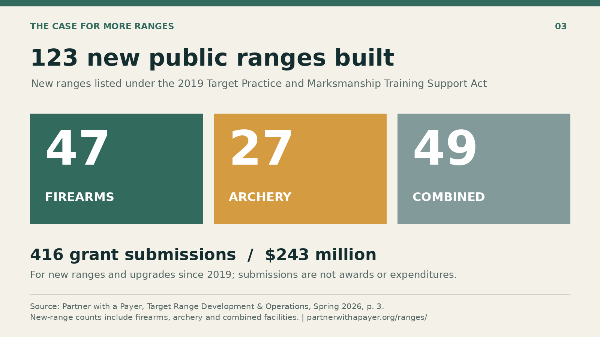
And there has been progress. A spring 2026 update from the federal Office of Conservation Investment lists 123 new public ranges built under the 2019 Target Practice and Marksmanship Training Support Act. Those include 47 firearms ranges, 27 archery ranges and 49 combination facilities. So the idea of building another 100 ranges isn’t particularly outlandish. The question is where the next 100 should go.
That conversation with Jim probably took place around the time I wrote “Between The Berms: 10 Years Wasted” for the June 12, 2013, edition of The Shooting Wire.
In that column, I lamented the missed opportunities that followed “the major court and legislative victories on the ‘let’s sue gunmakers for the actions of criminals’ front.”
I wrote, “Instead of standing on top of the political heap, planting our flag and daring anybody to try and knock the king of the hill off, we should have been building our softer side. We should have been cultivating our outreach effort to women.”
Providing more locations for people to enjoy shooting is an important part of that equation. Firearms ownership and recreational shooting become more mainstream as more people—particularly those we might think of as nontraditional participants—start shooting and buying guns.
But those opportunities need to be where people can use them. In a 2023 NSSF survey of state wildlife agencies, respondents identified urban and suburban ranges as having the greatest public demand—and as the most difficult to provide. Finding places to build was their biggest expansion obstacle.
Which brings us back to the present.
Today, we continue to win legal victories—on what seems a daily basis—thanks to the work of the Second Amendment Foundation, NRA, Firearms Policy Coalition and Gun Owners of America, along with financial backing from NSSF and its member companies.
We are nearly invincible—at least it feels that way—when it comes to fighting in the courts.
The problem with that sentiment is the dark political cloud on the horizon.
That cloud looks darker as we approach the midterm elections, with polls showing Trump’s approval below 40% and disapproval above 60%.
In modern politics, that 40% approval threshold is important because it’s where the candidate becomes so toxic that even their core base begins to fracture. Those are the kinds of numbers a Lee Atwater-style, all-out negative ad campaign aims to produce.
It’s a different story altogether when a president’s own actions appear to be driving the decline. His most committed supporters will dispute that assessment. But when vulnerable incumbents openly break with the president on certain issues to protect their reelection prospects, the ice is getting thin.
Losing the House, the Senate or both in the midterms would be a warning sign heading into 2028. And if Democrats emerge from that election controlling Congress and the White House, the judiciary could face renewed pressure for change.
The prospect of expanding the Supreme Court to shift its ideological balance is a legitimate concern. For the firearms industry, the stakes include the future of favorable court rulings and the prospect of stricter gun control and punitive regulation.
Which gives us a little over two years to make as much progress as possible before the political landscape could change substantially.
The court battles will continue under the Supreme Court’s current makeup, backed by firearms organizations and the industry.
But building that softer side means giving more people places to shoot. We need to fund and start building more ranges now—public, private and commercial.
NSSF and Southwick Associates produced state reports showing where existing ranges are located and where shooters live. Those reports help states identify promising locations for new public ranges built with Wildlife Restoration funds.
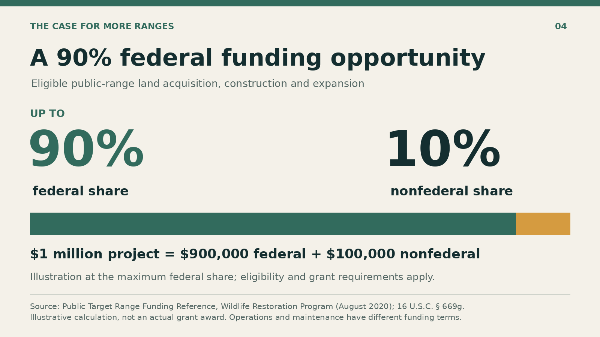
And the federal share can cover up to 90% of an eligible public-range land acquisition, construction or expansion project. On a qualifying $1 million project, that leaves a $100,000 nonfederal share. That’s a meaningful incentive to start turning a range proposal into an actual place to shoot.
Partner with a Payer also identifies potential sources of matching support, including grant programs from the MidwayUSA Foundation, NRA, The 1791 Foundation and Easton Foundations. Eligibility depends on the project and program.
On the commercial side, Range USA opened its first location in 2012. It now has 52 locations nationwide offering more than 1,100 indoor shooting lanes.
Opening another 100 ranges in the next two years is a high hurdle. Securing funding, navigating local regulations, meeting building codes and completing construction all take time.
But we can’t count on the political climate staying in our favor, so there’s no time like the present to get more ranges underway. Otherwise, we’ll look back at this period and ask the same question I asked in 2013: Why didn’t we do more with the momentum we had?
– Paul Erhardt, Managing Editor, the Outdoor Wire Digital Network