
I’d concluded, before the question was asked, that most who argue for the need for more sight radius on guns with iron sights – particularly on handguns –are the folks who weren’t getting the most out of the gun to start with.
They were looking for a reason for lousy shooting.
Still, testing what I could do with a 4” DA revolver versus a 6” revolver, as a matter of shooting off-hand, held some appeal. I thought the difference would be minute, particularly when shooting without a machine rest.
Finding another issue crop up was icing on the cake. It’s a good reason to do old-fashioned, one-handed target shooting.
The test was simple: I’d use two revolvers of the same make and caliber with variation in barrel lengths just to see if I could detect a difference based on sight radius.
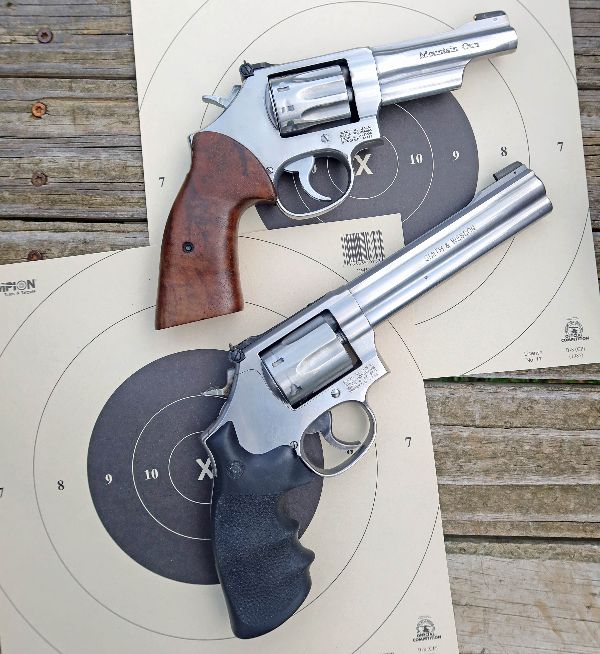
The revolvers weren’t exactly the same, I cheated a bit. The first was my long-owned two-caliber 22 revolver, a Smith & Wesson Model 617. It features a six-shot cylinder, factory-supplied Hogue Monogrip stocks, and Patridge front sight atop a six-inch barrel with an underlug. It’s a heavy heater, featuring a nominal sight radius of 8.3”.
I’m frail, so the other gun was also a M617, but this was the Lipsey’s Exclusive S&W Mountain Gun variant, with a four-inch skinny barrel and a brass bead on the face of the Patridge front sight. Its sight radius has been listed as around 6.3”.
Is the difference in sight radius critical to practical accuracy?
I set up a B-8 repair center at 25 yards and shot one-handed, bullseye style. Alternating right hand/ left hand per each five-shot string, that kept me honest, as well as confirming (or not) my hold and stance.
With the six-inch gun, using Winchester Wildcat 22 LR, my first group was pressed to the left for a 40/50. Changing hands and adjusting my hold, I shot a 44/50 with the left hand. That’s not enough difference to be relevant.
With my left, I noticed that I was very shaky. I’d not worked “weak hand only” for some time. On one round, I held a bit long and had to lower the gun to relax, then try again.
With the Mountain Gun, I favored high on the first (right-handed) string for a 42/50. Left-handed, I had two off the paper, favoring far to the right. That’s not the gun or sight radius. It’s all hold.
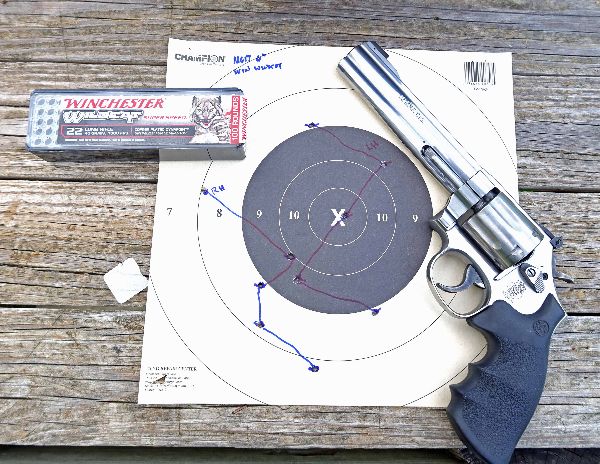
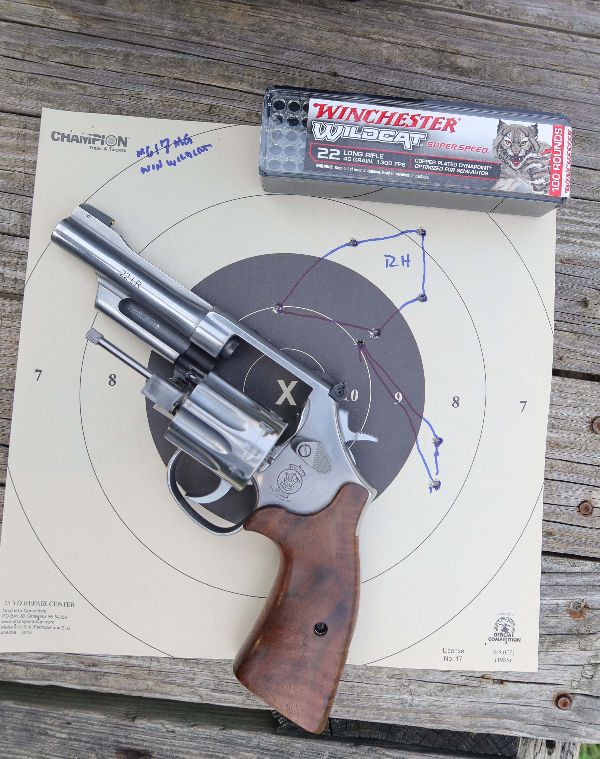
Measuring groups, the best five-round string went to the four-inch Mountain Gun with a 3 ¼” group. The longer, heavier gun yielded groups of 5 5/8” and 5 7/8”.
The guns have different stocks, there’s a brass bead in the front sight of the newer gun and there’s the barrels’ weights affecting stability. I believe that the lack of stability and left-handed practice contributed to me going off the rails.
Another difference only occurs in double-action, the length of cylinder travel between shots. The longer gun has a six-round cylinder; the new gun has a 10-shot cylinder.
A better comparison would be with a 4” M617 configured like the 6” gun.
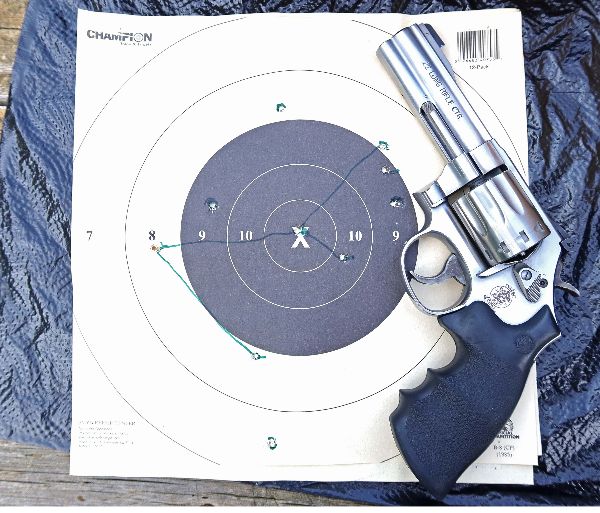
I tried that on a later range trip. I used Remington Bullet ammo in a S&W M617-6 4" gun, this with the underlug like the 6" gun. I fired a 5 7/8" group with three hits inside 2 3/4". I did that one "ball and dummy," with empty cases dispersed in the 10-shot cylinder, five live rounds amongst five empties. The resulting score was 86/100-1X.
Nearly no difference between the short gun and the longer analog.
On that first trip, I finished up with the “Shootist Challenge.” Shot at 25 feet (“10 paces) one-handed on an outline of an old-fashioned five-inch envelope, the target has a 1” square image of a “stamp.” The deal is to shoot six rounds, one handed, putting all on the envelope and at least one on the stamp.
With the older gun, I had a group of 3 5/8”. As the wind was fluttering the target sheet, I pushed one low, still on the envelope. I was rushing the shot before I lost the target. The best three were in 1.5” and I tagged the “stamp” on the edge with one round.
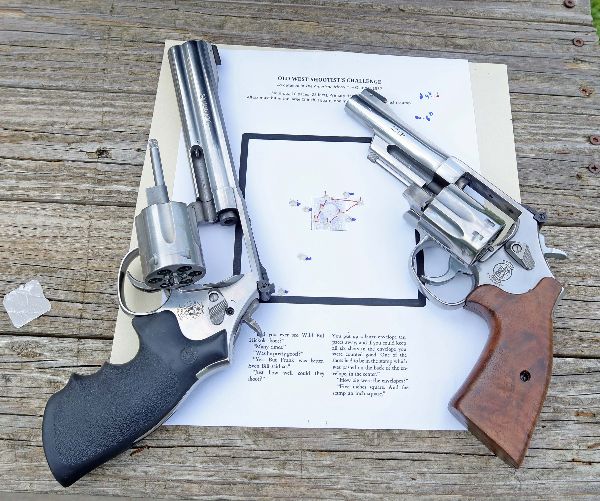
I secured the target before shooting it again. With the Mountain Gun, I had five of six hits on the “stamp.” A single round was just about 1” to the right of the stamp image. Six rounds went into 1 ¼” with four of those hits into ¾”.
For some shooters, the distance between the iron sights on a handgun may make a difference. In fact, when shooting the long line (50 yards) for bullseye, it may take on increased importance. The shorter the sight radius, the less acceptable error in sight picture you have.
For my uses, the shorter guns seem to do just fine.
– Rich Grassi, Editor, The Tactical Wire