
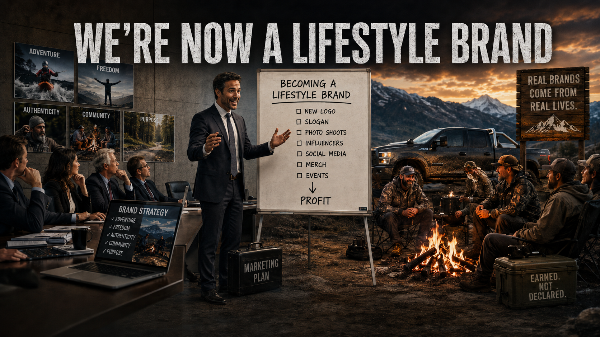
One of those well-intentioned but often misused buzzword combos in the marketing world is ‘lifestyle brand.’
Calling your company’s brand a lifestyle brand is a bold statement, especially when you’re not really a lifestyle brand.
You see, the first rule of Lifestyle Brand Club is you never talk about being a lifestyle brand. And the surest way to prove your brand isn’t a lifestyle brand is to declare you are one.
Sure, you may want to be a lifestyle brand and are eager to speak it into existence, but manifesting—that’s what the new-age cool kids call it—doesn’t make it so. You’re just selling customers on a brand realignment they themselves don’t see and probably never will.
It’s Not Lifestyle, It’s Identity
The problem starts with confusing lifestyle marketing with lifestyle branding.
Put a hunter in a duck blind, a shooter on the range, a family around a campfire or some rugged-looking guy next to an equally rugged-looking truck and you’ve created lifestyle marketing.
Congratulations.
You’ve also created imagery that could probably be used by a gun company, boot company, knife company, cooler company, truck company, outdoor apparel company or, depending on how expensive the photographer was, a bourbon company.
None of that makes you a lifestyle brand.
What makes a lifestyle brand different is identity.
Kellogg School of Management describes lifestyle branding in terms of moving beyond functional product benefits toward positioning that is self-expressive and relevant to a consumer’s identity.
In less business-school language, the question changes from, “Why should I buy this product?” to, “What does owning this product say about me?”
A customer buys a product because it performs a task. A customer identifies with a brand because that brand represents something about who they are—or perhaps who they want to be.
Harley-Davidson represents independence, rebellion, freedom and membership in a very identifiable tribe. Nike accomplished much the same thing around athletic identity. Patagonia did it around outdoor recreation and environmentalism. YETI turned a premium cooler into something that communicates membership in outdoor culture.
In each case, the product came first and the identity grew around it. That order matters.
Your Customer Gets A Vote
"Marketing people like to think they own the brand. They don’t.” noted experts during a Cannes Lions panel on brand authenticity.
They manage it, influence it and communicate it. Ultimately, the customer determines what the brand means.
You can spend millions telling customers your company represents adventure, freedom, confidence, authenticity or whatever word scored highest during the agency’s latest brainstorming session.
If customers don’t make that connection themselves, it’s just advertising copy.
And therein lies the problem with announcing a transition to becoming a lifestyle brand. The company is essentially telling customers, “This is what our brand means to you now.”
That’s completely backwards.
Lifestyle brands emerge when consumers begin attaching meaning to a product beyond its functional purpose.
Glock is an interesting firearms example.
For decades, Glock earned its position in the market by producing straightforward pistols that developed a reputation for working when they were supposed to. Customers built a culture around Glock because the product had already established an extraordinarily clear identity.
Today, Glock means something beyond being a polymer pistol that’s available in several sizes and calibers.
That’s very different from sitting around a conference table and deciding next year’s strategic objective is to become a lifestyle brand.
So, Why The Pivot?
When an established company announces it is transitioning from product-focused marketing toward lifestyle branding, the obvious question is: Why?
If your existing positioning is working exceptionally well, why abandon it?
Maybe your products are no longer differentiated enough from the competition. Perhaps competitors have caught up technologically. Maybe the customers who built the brand are aging and you’re desperately trying to attract a younger demographic.
Considering this economy, maybe sales have flattened. Maybe the brand has become stale. My money is on the tried-and-true option of management simply getting bored with selling what the company actually makes.
None of those automatically means the business is failing, nor does it mean lifestyle-oriented marketing is necessarily a mistake.
But the change itself can be an admission that the old marketing approach is no longer delivering the desired result.
For years the argument was: Our product is better because of these features, this performance, this quality, this innovation or this reputation.
Then somebody decides those arguments aren’t enough and now the product needs to represent an entire way of life.
That’s not merely a new advertising campaign. That’s a significant strategic change.
Before congratulating yourselves on becoming a lifestyle brand, it might be worth asking why you suddenly felt the need to become something other than the brand you spent decades building.
Welcome To The Buzzword Cycle
Marketing has never suffered from a lack of fashionable terminology.
Disruptive. Experiential. Omnichannel. Storytelling. Authenticity. Purpose. Community. Engagement.
And now everybody wants to build a lifestyle brand.
Somewhere there is undoubtedly a PowerPoint deck explaining how Gen Z and Millennials don’t buy products, they buy experiences. There’s probably a stock photograph of attractive young people laughing around a campfire, too.
The problem with marketing trends is everybody discovers them at approximately the same time and then chases the trend, oblivious to the fact they aren’t the trendsetter.
Take one of those trendy ads, replace the logo and ask yourself whether you can still identify the company.
If the answer is no, your fancy new lifestyle campaign may actually be doing the opposite of what branding is supposed to do.
Instead of making your company more recognizable, you’ve made it look like everybody else.
What Happened To The Product?
There’s another danger in moving too aggressively toward lifestyle positioning: losing sight of the thing that created the brand in the first place.
Products generally earn brands their reputations.
Glock became Glock because the pistols worked. Benelli earned its reputation through great shotguns. Ruger built its identity around rugged, reliable firearms. Beretta carries centuries of history, sporting tradition and craftsmanship. Sig Sauer built around engineering and innovation.
Those associations are valuable because they are specific.
“Adventure,” “freedom,” “authenticity” and “living boldly” aren’t specific. Thousands of companies can—and do—use them.
The more abstract your positioning becomes, the less territory you may actually own.
Firearms Already Come With A Lifestyle
This industry has another advantage that makes some lifestyle-brand pivots particularly puzzling.
Firearms already exist within well-established lifestyles.
Hunting is a lifestyle. Competitive shooting certainly is. Concealed carry often becomes part of somebody’s daily identity. And there are any number of other segments within Gun Culture 2.0.
The customer already brings the lifestyle.
Manufacturers don’t necessarily need to invent one. They need to determine where their brand authentically fits within those existing communities.
That’s a much harder marketing assignment than announcing, “We’re becoming a lifestyle brand.”
But instead of asking customers to adopt an identity created in a conference room, you’re identifying something already present and strengthening the relationship between customer and brand.
The Lifestyle Brand Test
There’s a fairly simple way to determine whether your company is actually becoming a lifestyle brand.
Ask your customers what owning your product says about them.
Don’t give them choices. Don’t explain the strategy first. And definitely don’t let the marketing department answer for them.
If their responses consistently describe the identity you believe your brand represents, congratulations. You may actually be onto something.
If they stare blankly and say, “It means I bought your gun,” you have more work to do.
That doesn’t mean you have a bad brand. You may have an extremely strong product brand.
The obsession with transforming successful product brands into lifestyle brands overlooks an important point: making products people actively want to buy is still a pretty good business model.
You don’t have to sell someone an identity if you already sell them an exceptional product.
The Second Rule
Which brings us back to Lifestyle Brand Club.
The first rule is you never talk about being a lifestyle brand.
The second rule is your advertising agency doesn’t get to decide you’re one either.
Your customers do.
If they wear your logo when they aren’t being paid to, form communities around the brand and use ownership as shorthand for something about themselves, then you might legitimately have a lifestyle brand.
Congratulations. At that point you probably won’t need to announce it. Everyone will already know.
But when an established company suddenly declares it is transitioning into a lifestyle brand, perhaps the first question shouldn’t be how exciting the new marketing direction looks.
Maybe the question should be much simpler.
What happened to the brand you already had?
– Paul Erhardt, Managing Editor, the Outdoor Wire Digital Network