
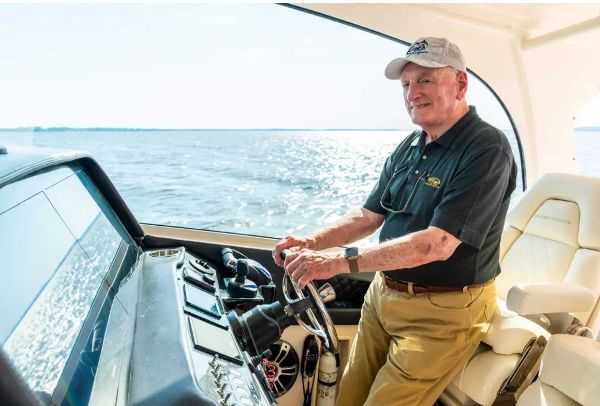
Eddie Smith Jr. could have sold Grady-White Boats for more than $400 million.
At 83, after 58 years of owning the North Carolina boatbuilder, he had earned the right to cash out. Instead, Smith has transferred the company into a structure designed to keep it independent and direct its future profits to charity.
To understand why Smith's decision is significant, it helps to understand why Grady-White commands such loyalty among its owners.
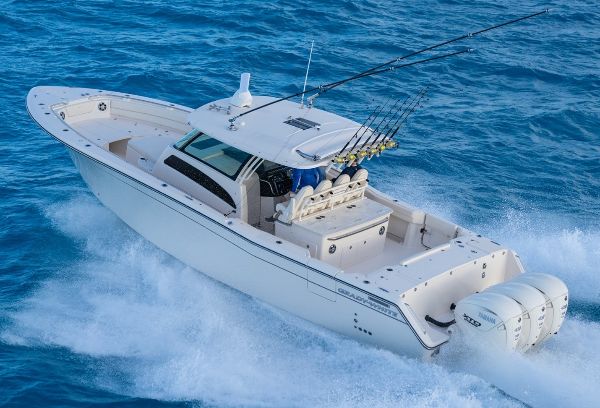
Talk to Grady-White owners and the same themes come up repeatedly: ride, construction, reliability, thoughtful layouts and customer service. The company's SeaV² hull has a particularly strong following among people who routinely run offshore. Owners describe the boats as solid, dry and predictable in rough water, with a ride they consider better than many competing boats of similar size. They also point to substantial hardware, good fit and finish, practical fishing features and a construction philosophy that favors durability over chasing the latest styling trend. Owner’s have learned to expect strong support from the factory and dealers when something does go wrong.
That reputation comes with a price. Grady-Whites generally sell at a premium to many competing fiberglass fishing boats. But that premium, along with their reputation for offshore capability and longevity, has helped create unusually strong customer loyalty.
That loyalty is a big part of what Smith has spent 58 years building.
He was 26 years old in 1968 and knew relatively little about boatbuilding when he met Grady-White co-founder Don White. The company was struggling, still committed largely to wooden boats as fiberglass was taking over recreational boatbuilding. White was considering shutting it down.
Smith saw an opportunity.
His father, Edward C. “George” Smith Sr., had built a successful mail-order textile business—in panty-hose, among other delicates. He loaned his son the money to buy Grady-White.
Smith went to work.
He pushed the company toward fiberglass, concentrated on boats that fishermen actually wanted and put his own savings into the business. During the early years, he reportedly sometimes worked 80 to 100 hours a week.
The gamble paid off. Grady-White became one of America's best-known builders of offshore and coastal fishing boats, with a reputation for quality and customer service that has endured for decades.
Smith's decision about the company's future came after a series of personal losses.
He had expected his son, Chris, to eventually take over Grady-White. Chris died of ALS in 2021. Smith's wife, Jo, died the previous year.
With the family succession plan gone, Smith began considering what should happen to the company after his own retirement. He had reportedly received offers exceeding $400 million, but selling would have put Grady-White's future in somebody else's hands. Smith wanted to protect the employees, management and culture that had developed during his ownership.
His solution was inspired in part by Patagonia.
In 2022, Patagonia founder Yvon Chouinard transferred the company's voting stock to a purpose trust and its non-voting stock to the Holdfast Collective, a 501(c)(4) nonprofit. Excess profits are directed toward environmental and political causes.
Smith has adopted a similar structure. Grady-White's voting stock has gone into the Grady-White Boats Perpetual Purpose Trust, which is intended to keep the company from ever being sold. Its non-voting shares have gone to a 501(c)(4) nonprofit that will receive future profits for charitable purposes.
There is an important difference between the two companies.
Patagonia's charitable operation is explicitly environmental and activist, and its nonprofit structure can engage in lobbying and political activity, most of which trend Liberal. Grady-White's stated charitable purposes are broader, including conservation, education, health care and community needs, particularly in eastern North Carolina. And Smith reportedly leans Conservative.
NRS, the Idaho-based paddlesports company NRS also arranged an unusual succession. Founder Bill Parks chose employee ownership rather than selling the company to an outside buyer, and NRS became 100 percent employee-owned in 2014. The structure is different, but the goal of preserving the company and the people who built it is similar.
At Grady-White, employees don't own the company, but can look forward to a long, stable future there. The trust controls it while the nonprofit receives its economic benefit. President Kris Carroll remains in charge, daily operations continue in Greenville, and Smith becomes CEO emeritus.
With the arrangement, Smith earns the satisfaction of knowing his hard work will result in a lot of good for future generations of Americans, a safe harbor for his many employees and a continuation of the brand he worked so hard to build.
The name on the boats remains Grady-White, but for all who know and appreciate the brand, Eddie Smith is—and will remain--the man who gave the company its soul.
– Frank Sargeant, Editor, The Water Wire