
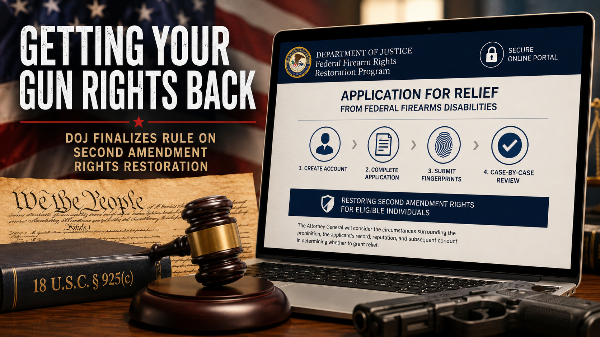
For more than 30 years, federal law has provided a way for certain people prohibited from owning firearms to petition the government to get their gun rights back.
Well, technically.
In reality, you had about as much chance of getting your rights restored through 18 U.S.C. § 925(c) as I have of getting an invite to walk the red carpet at the Met Gala. (Important note: For the record, I would never go.)
The process existed. You just couldn't use it. But that's about to change.
The Department of Justice has finalized a rule establishing the Federal Firearm Rights Restoration Program, creating an online application process for individuals prohibited from possessing firearms under federal law to petition for restoration of their Second Amendment rights.
And considering DOJ estimates the rule could affect at least 20 million American adults, this isn't exactly a minor administrative change.
Congress Giveth, Congress Taketh Away
Under 18 U.S.C. § 925(c), certain prohibited persons can apply for relief from their federal firearms disability.
The Attorney General can grant relief if the circumstances surrounding the prohibition, along with the applicant's record and reputation, indicate the person isn't likely to pose a danger to public safety and restoring their rights wouldn't be contrary to the public interest.
Seems straightforward enough.
You screw up. You pay your debt to society. You demonstrate you're no longer a danger. You apply to have your rights restored.
Except Congress made the whole thing essentially useless back in 1992.
That's when Congress prohibited the Bureau of Alcohol, Tobacco, Firearms and Explosives (ATF) from spending appropriated funds to investigate or act on individual § 925(c) applications.
Yes, you read that correctly.
Congress created a process for restoring your rights and then prevented the agency responsible for administering it from spending money to actually administer it. Or, in today's terms, they "defunded the ATF" when it comes to restoring your rights.
Government efficiency at its finest.
DOJ Pulls Out the Hammer
That began changing last year when DOJ withdrew authority to administer § 925(c) from ATF and brought the restoration process under the Attorney General.
After proposing a new regulatory framework and receiving public comments, DOJ has now finalized the rule, creating the Federal Firearm Rights Restoration Program.
To be clear, DOJ isn't handing out "Get Your Gun Rights Back Free" cards.
Applications will be reviewed individually, including why the applicant became prohibited, criminal history, reputation and subsequent conduct.
There is a significant difference between somebody convicted of a nonviolent felony 25 years ago who completed a sentence and has lived a law-abiding life since, and somebody with a continuing pattern of criminal behavior.
Federal law might classify both as prohibited persons, but common sense tells you they're not necessarily the same public-safety risk.
The whole point of § 925(c) is recognizing that distinction.
Not Everybody Gets to Play
Before anybody starts hyperventilating about DOJ putting guns back into the hands of violent criminals, that's not what this program does.
Certain applicants are presumptively ineligible.
Violent felons, registered sex offenders, people unlawfully in the United States and individuals presenting an ongoing public-safety risk face significant barriers to relief absent extraordinary circumstances.
The final rule also establishes a permanent presumption against relief for specified serious offenses, a 10-year presumption for categories including drug trafficking and misdemeanor domestic violence, and a general five-year presumption for other felony convictions.
In other words, simply filling out an application doesn't make somebody eligible to walk into the local gun shop and start filling out a 4473.
Applicants still have to make their case. And DOJ still has to approve it.
There's Also the State Problem
Relief under § 925(c) removes the federal firearms disability.
That's it.
If your state independently prohibits you from possessing a firearm, DOJ's approval doesn't override that prohibition. Depending on where you live, getting your federal rights restored could therefore be only step one.
Welcome to gun laws in America.
NRA: A Step in the Right Direction
The National Rifle Association participated in the rulemaking process by submitting comments on DOJ's original proposal.
Following publication of the final rule, NRA issued the following statement:
"NRA has long championed full restoration of Second Amendment rights for individuals who paid their debts to society and who are not demonstrably dangerous to public safety. NRA submitted extensive comments in response to the original proposal to ensure the process was fair, accessible, and consistent with the underlying statute. While the final rule falls short on a few of these suggestions, it is an important step in the right direction. As ever, we will continue our advocacy to ensure no American is unduly deprived of the right to keep and bear arms." — NRA
That phrase—"paid their debts to society"—gets to the heart of the issue.
If somebody commits a nonviolent felony at 22, serves a sentence and then spends the next 20, 30 or 40 years as a productive, law-abiding citizen, at what point has that debt actually been paid?
Under the system we've had for the last three decades, when it came to Second Amendment rights the answer was essentially: never.
Congress had already created a mechanism for answering that question on an individual basis. It just made sure nobody could use it.
Twenty-Five Million Potential Applicants
DOJ estimates the rule could affect at least 20 million adults. That's not 20 million people suddenly getting their gun rights back. Not even close.
DOJ anticipates roughly 330,000 applicants annually once the program is operating. Processing that many applications on a genuine case-by-case basis won't exactly be a small undertaking. Anybody who has spent quality time waiting on the federal government to process paperwork is probably already chuckling.
Still, that's a problem worth having.
After 30 Years, There's Finally a Door
The final rule takes effect 30 days after publication in the Federal Register, with applications handled through DOJ's Federal Firearm Rights Restoration Program.
How quickly applications will be processed, how often relief will be granted and how DOJ will handle borderline cases are questions we'll have to watch.
And there will undoubtedly be litigation. Because this is firearms law in America. Of course there will be litigation.
But strip away the regulatory language and bureaucratic machinery and the underlying concept is pretty simple. People can change.
Congress recognized that when it wrote § 925(c). For more than three decades, that process existed mostly as words printed in the U.S. Code. Now, somebody might actually be able to use it.
Imagine that.
– Paul Erhardt, Managing Editor, the Outdoor Wire Digital Network