
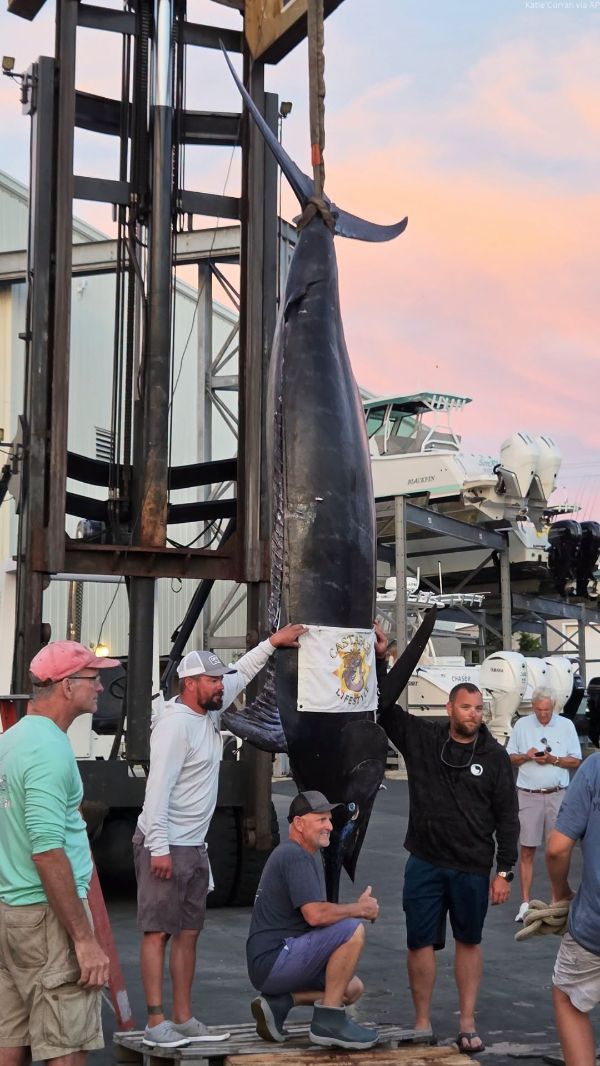
A 1,260-pound blue marlin landed off Massachusetts last week is the kind of fish that makes even experienced billfish chasers stop and stare.
Captain Damon Sacco and angler Walter Chapman caught the giant Aug. 19 while fishing Atlantis Canyon, about 100 miles off Cape Cod. The fish measured more than 11 feet and weighed 1,260 pounds—believed to be the largest blue marlin ever landed off the U.S. East Coast and only 142 pounds shy of the Atlantic world record. Its head is being sent to the University of Maine for research, with scientists estimating the fish could be 25 to 30 years old.
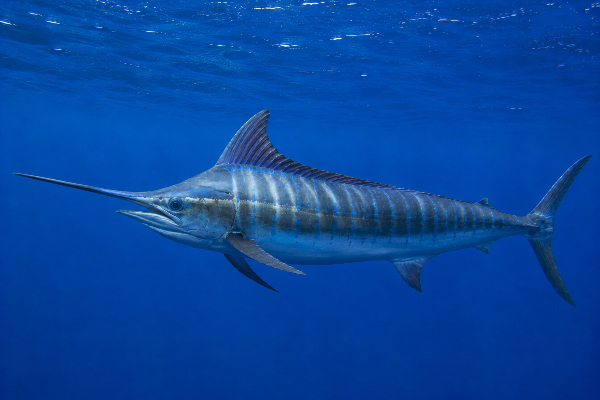
A blue marlin that size in New England is remarkable because the Northeast is normally too cold for the species except during its short summer appearance. Yet the catch also raises a larger question: Are blue marlin actually becoming more abundant along U.S. coasts, or are American anglers simply becoming much better at finding and catching the fish that are already there?
The answer appears to be some of both.
The latest International Commission for the Conservation of Atlantic Tunas (ICCAT) assessment found Atlantic blue marlin still overfished, with estimated biomass at about 67 percent of the level associated with maximum sustainable yield at the end of 2022. At the same time, fishing mortality was “no longer judged to be excessive”, and the assessment showed signs of improving biomass. Conservation measures, including reduced allowable landings and restrictions on U.S. recreational harvest, appear to be helping the stock.
But that doesn't mean every increase in blue-marlin catches represents a corresponding increase in the population.
Recreational blue-marlin landings by U.S. rod-and-reel anglers totaled an estimated 23 metric tons in 2023, compared with 22 metric tons in 2022. Commercial U.S. vessels cannot retain or sell Atlantic billfish, but blue marlin continue to be caught incidentally by pelagic longliners targeting tuna and swordfish. Commercial longline bycatch remains the larger source of fishing mortality; recreational fishing has historically accounted for a much smaller portion.
The problem is that recreational catch rates have become increasingly difficult for scientists to interpret.
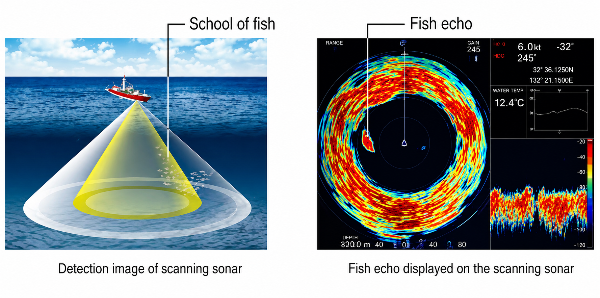
Modern anglers have an extraordinary advantage over the fishermen who generated much of the historical catch data. GPS, satellite weather, sea-surface-temperature charts, current information, sophisticated autopilots and most of all increasingly powerful sonar have transformed offshore fishing from a largely exploratory exercise into something much closer to targeted hunting.
The newest generation of omnidirectional sonar is particularly important. Rather than simply showing bottom structure or fish beneath the boat, these systems can scan hundreds or thousands of feet around the vessel, allowing tournament crews to locate and target individual pelagic fish. A 2026 study of a North Carolina pelagic sportfishing tournament found that boats equipped with omnidirectional sonar had significantly greater catch efficiency than boats without it. An individual large fish can be tracked for miles until it is finally caught.
ICCAT recognized the problem in its 2024 blue-marlin assessment. Scientists concluded that changes in recreational vessel fishing power—including technological advances such as GPS and live sonar—made the U.S. recreational tournament data difficult to use as a straightforward index of abundance. The recreational tournament index was not incorporated into the assessment pending further work on accounting for increased catchability.
There’s another technological change that may be just as important: the boats themselves.
Large outboard-powered catamarans have changed the practical geography of offshore fishing.
Catamarans are much faster than traditional inboard sportfishers and can also provide a relatively soft, stable ride in rough offshore conditions, allowing crews to maintain a higher average speed when conventional boats may have to throttle back. That can turn an offshore fishing ground that once required a major expedition into a practical day trip.
Consider fishing 100 miles offshore. A boat averaging 25 knots needs four hours to get there. A boat averaging 40 knots takes 2½ hours. The difference on the round trip is three hours—time that can instead be spent searching for fish.
More important, a fast, long-range boat can respond when the fish aren't where they were expected to be. If a current edge, temperature break or concentration of forage shifts 30 or 50 miles, the modern boat can go after it.
And satellite services like Roff’s or Hilton show anglers where the fish are most likely to be based on those conditions in real time.
Put faster boats together with long-range fuel capacity, high-speed catamaran hulls, modern electronics, satellite weather and sea conditions and omnidirectional sonar, and today's offshore fisherman can search vastly more water and find individual marlin much more efficiently than anglers could a generation ago.
That makes the apparent blue-marlin resurgence difficult to interpret.
The Atlantic stock may indeed be recovering because conservation has reduced fishing mortality. At the same time, warmer water and changing oceanographic conditions may be making suitable habitat available farther north, allowing more fish to reach U.S. waters. And the recreational fleet is becoming dramatically more effective at locating those fish.
That distinction matters to fisheries scientists because more fish caught per boat-day doesn’t necessarily mean more fish in the ocean if the boats have become much better at finding fish.
The blue-marlin fishery may be getting better. The population appears to be improving, although it remains below the desired level. But the fishermen are getting better, too—and dramatically so. How that all averages out remains to be seen.
– Frank Sargeant, Editor, The Water Wire